Shimotoriwatari Kuyo Sekito: A 13th-Century Stone Monument Revealing Kamakura-Era Buddhist Faith in Fukushima

Discover the Shimotoriwatari Kuyo Sekito, a nationally designated Historic Site in Fukushima featuring a rare 1258 Amida Triad relief. Learn about this touching memorial built by a daughter for her mother during the Kamakura period.

Shimotoriwatari Kuyo Sekito: A Daughter's Eternal Prayer for Her Mother

In the quiet countryside of Fukushima City, nestled within the grounds of Yosenji Temple, stands a remarkable stone monument that has witnessed over 760 years of history. The Shimotoriwatari Kuyo Sekito (下鳥渡供養石塔) is not merely an ancient artifact—it is a timeless testament to filial devotion, Buddhist faith, and the artistic achievements of Kamakura-era Japan.

This nationally designated Historic Site offers international visitors a rare opportunity to encounter an exceptionally well-preserved example of medieval Japanese religious art, far from the crowded tourist paths of Kyoto or Tokyo.

What is the Shimotoriwatari Kuyo Sekito?

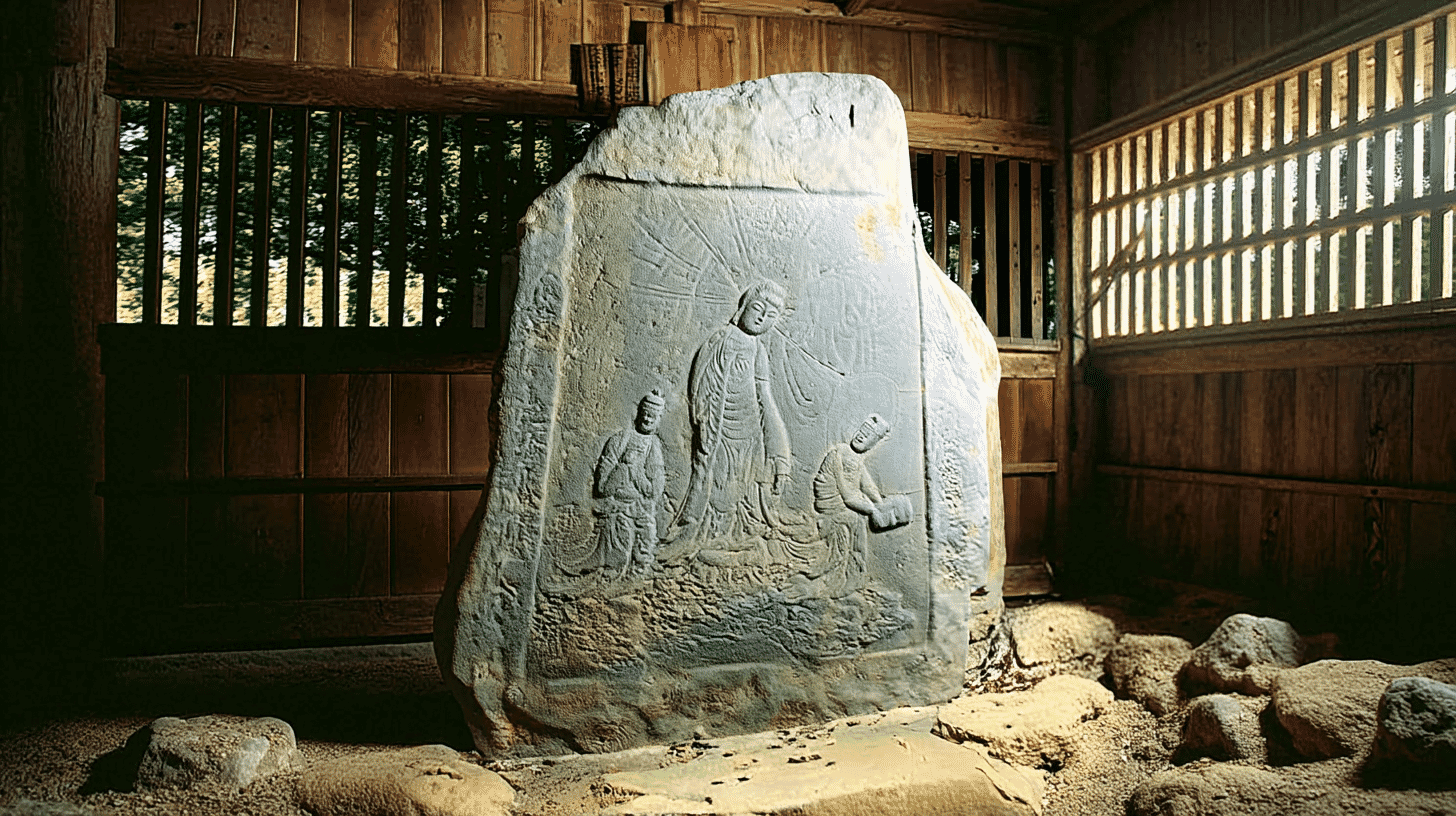
The Shimotoriwatari Kuyo Sekito is a large stone stele carved from andesite tuff, standing approximately 170 centimeters tall and 115 centimeters wide. Its surface has been carefully polished and features an exquisite relief carving of the Amida Sanzon (Amida Triad)—one of the most important iconographic representations in Pure Land Buddhism.

The relief depicts Amida Nyorai (Amitabha Buddha) at the center, flanked by Kannon Bosatsu (Avalokitesvara) holding a lotus pedestal and Seishi Bosatsu (Mahasthamaprapta) with hands joined in prayer. All three figures are shown descending on clouds, their robes billowing gracefully in a celestial breeze—a dynamic representation of the "raigo" or welcoming descent, when Amida Buddha comes to guide the faithful to the Pure Land at the moment of death.

A Touching Story of Filial Devotion

The monument bears an inscription that reveals its poignant origin. Carved along the left edge are the words "Right, this is for my sorrowful mother. Respectfully submitted by a woman of the Taira clan." On the right edge, the date is recorded: "The 18th day of the 9th month, Shoka 2 (1258)."

This inscription tells us that nearly 800 years ago, a woman from the Taira clan commissioned this magnificent stone monument as a memorial offering for her deceased mother. The sincerity of her devotion is evident in the extraordinary quality of the carving and the careful choice of the Amida Triad—expressing her prayer that her mother would be welcomed into Amida's Western Paradise.

During the Kamakura period, the Shimotoriwatari area was part of the domain controlled by the Nikaido clan, who held the prestigious position of Hyojoshu (Council of State) in the Kamakura Shogunate. Historians speculate that the "woman of the Taira clan" may have been connected to this powerful family, though the Nikaido clan officially claimed Fujiwara lineage, leaving her exact identity a historical mystery.

Why is it Designated as a National Historic Site?

The Shimotoriwatari Kuyo Sekito was designated as a National Historic Site on June 7, 1935, recognizing its exceptional cultural and historical significance. Several factors contribute to its importance.

First, it represents an extremely rare example of Pure Land Buddhist artistic expression in the Tohoku region during the Kamakura period. The relief carving of the Amida Triad in the raigo (welcoming descent) style is considered the finest of its kind in Fukushima Prefecture.

Second, the monument's remarkable state of preservation is notable. According to historical records, the stone lay face-down in the earth for an extended period, which protected the carved surface from weathering. This fortunate circumstance has allowed the intricate details of the flying clouds and flowing robes to survive in exceptional condition.

Third, the clear inscription provides precise dating and context, making it an invaluable historical document for understanding Kamakura-period religious practices and women's roles in Buddhist patronage.

Fourth, the monument represents important evidence of the spread of Pure Land Buddhism to northeastern Japan during the medieval period, when documentary sources for this region are scarce.

Artistic Highlights and What to Look For

When visiting the monument, take time to appreciate the sophisticated artistic techniques employed by the medieval craftsman. The carving of the flying clouds beneath the three figures is particularly noteworthy—delicate and dynamic, they create a sense of celestial movement. The treatment of the Buddhist robes, with their elegant flowing lines suggesting movement through heavenly space, demonstrates remarkable skill.

Amida Nyorai at the center is depicted with a radiant halo (kouhai) emanating rays of light. Kannon Bosatsu extends a lotus pedestal forward—symbolically ready to receive the soul of the deceased—while Seishi Bosatsu maintains a pose of reverent prayer. Both bodhisattvas are shown with circular halos.

The composition captures the essence of Pure Land Buddhism's most comforting promise: that Amida Buddha, accompanied by his attendants, will personally come to welcome faithful believers at the moment of death and escort them to rebirth in the Western Paradise.

Yosenji Temple: More Treasures Await

The Shimotoriwatari Kuyo Sekito is located within the grounds of Yosenji Temple, a Soto Zen temple with its own significant treasures. The temple's main hall houses a wooden seated statue of Shaka Nyorai (Shakyamuni Buddha) that has been designated as a National Important Cultural Property.

This Buddha statue, created in 1371 during the Oan era, bears an inscription identifying the Buddhist sculptors Ensho, Hokyo, and Joen as its creators. Standing at 87.9 centimeters in height, it represents the artistic traditions of the late Kamakura to early Muromachi period and provides an excellent complement to the stone monument.

The temple itself was established by Gyokuho Hoseki, the sixth head priest of Yorin-ji Temple, which was founded with the patronage of Date Tanemune, an ancestor of the famous Date clan of Sendai.

Visiting the Monument

The stone monument is protected within a small wooden shelter (ooi-ya) located on a small hill behind Yosenji Temple, approximately 100 meters north of the main temple buildings, amid a peaceful grove of trees. The shelter features lattice windows that allow visitors to view the monument while protecting it from the elements.

The shelter is kept locked for preservation purposes, but visitors can observe the monument through the lattice barriers on the front and side. The filtered natural light creates a contemplative atmosphere appropriate to this sacred memorial.

Exploring the Surrounding Area

A visit to the Shimotoriwatari Kuyo Sekito can be wonderfully combined with other attractions in Fukushima City and its surroundings.

Iizaka Onsen is one of Japan's most historic hot spring resorts, counted among the "Three Famous Hot Springs of Oshu" along with Naruko and Akiu. Just 20 minutes by train from Fukushima Station, this charming town offers nine public bathhouses, including the legendary Sabako-yu where the haiku poet Matsuo Basho is said to have bathed during his famous "Narrow Road to the Deep North" journey. The hot waters are known for being particularly hot—a unique characteristic locals take pride in.

Hanamiyama Park is one of Fukushima's most celebrated destinations, especially during spring when the hillside erupts in a spectacular display of cherry blossoms, plum blossoms, magnolias, and forsythia. The famous photographer Shotaro Akiyama described it as a paradise on earth.

The Fruit Line is a scenic route connecting Iizaka Onsen to Tsuchiyu Onsen, lined with orchards offering seasonal fruit picking. From June's cherries through summer peaches to autumn grapes and winter apples, visitors can enjoy fresh, locally grown fruits.

Bandai-Azuma Skyline is one of Japan's most spectacular mountain driving routes, offering breathtaking views of the Azuma mountain range. The 29-kilometer route reaches elevations over 1,600 meters and features dramatic landscapes including the volcanic Jododaira plateau.

📍 Plan Your Visit to Fukushima
Find tours, activities & transport passes near Shimotorito Memorial Stone Pagoda
[ Aizu-Wakamatsu Castle & Ouchi-juku Village Tours ]

Q&A

QWhat are the visiting hours for the Shimotoriwatari Kuyo Sekito?
AThe monument can be viewed during daylight hours. While the shelter is locked, visitors can observe the relief carving through the lattice windows. The temple grounds are generally accessible from early morning until around 4:00 PM. It is advisable to visit during good weather for optimal viewing conditions.
QIs there an admission fee?
AThere is no admission fee to view the stone monument. The temple grounds are open to visitors free of charge.
QHow do I get to Yosenji Temple from Fukushima Station?
AFrom JR Fukushima Station, take the Fukushima Kotsu bus bound for Torikawa. After approximately 20 minutes, alight at the San'o-shita bus stop, then walk about 5 minutes to the temple. Note that buses run only once or twice per hour. Alternatively, from Tohoku Expressway Fukushima-Nishi IC, the temple is about 2 kilometers by car.
QAre there other similar monuments in the area?
AYes, several other stone monuments (itabi) from the same period have been discovered in the surrounding area, indicating that this region had active Buddhist communities during the Kamakura period. The concentration of such monuments makes this area particularly significant for understanding medieval religious history in the Tohoku region.
QCan I take photographs of the monument?
APhotography is generally permitted for personal use. However, the lattice barriers and lighting conditions inside the shelter may make photography challenging. Please be respectful of the sacred nature of the site and avoid using flash, which could potentially damage the ancient stone surface over time.

Basic Information

Official Name Shimotoriwatari Kuyo Sekito (下鳥渡供養石塔)
Designation National Historic Site (designated June 7, 1935)
Date of Creation Shoka 2 (1258), Kamakura Period
Dimensions Height: approx. 170 cm, Width: approx. 115 cm, Thickness: approx. 36 cm
Material Andesite tuff (安山岩質凝灰岩)
Location Yosenji Temple, 17 Terahigashi, Shimotoriwatari, Fukushima City, Fukushima Prefecture 960-1106
Access From JR Fukushima Station: Fukushima Kotsu bus to San'o-shita stop (approx. 20 min), then 5 min walk. By car: approx. 2 km from Tohoku Expressway Fukushima-Nishi IC
Contact Yosenji Temple: 024-593-3141

References

下鳥渡供養石塔 - Wikipedia
https://ja.wikipedia.org/wiki/%E4%B8%8B%E9%B3%A5%E6%B8%A1%E4%BE%9B%E9%A4%8A%E7%9F%B3%E5%A1%94
下鳥渡供養石塔 - 文化遺産オンライン
https://bunka.nii.ac.jp/heritages/detail/201116
陽泉寺 - Wikipedia
https://ja.wikipedia.org/wiki/%E9%99%BD%E6%B3%89%E5%AF%BA
陽泉寺 | 福島市 | 県北 | ふくしまデータベース
https://fukushima-db.com/bunkazai/kenpoku/fukushima/048/
下鳥渡(しもとりわた)供養石塔 (陽泉寺阿弥陀三尊石仏)- 石仏と石塔
https://kawai24.sakura.ne.jp/hukusima-yousenji.html
飯坂温泉オフィシャルサイト
https://iizaka.com/
福島市観光ノート - 福島市の観光Webメディア
https://www.f-kankou.jp/

Last verified: 2026.01.29

Nearby heritages