
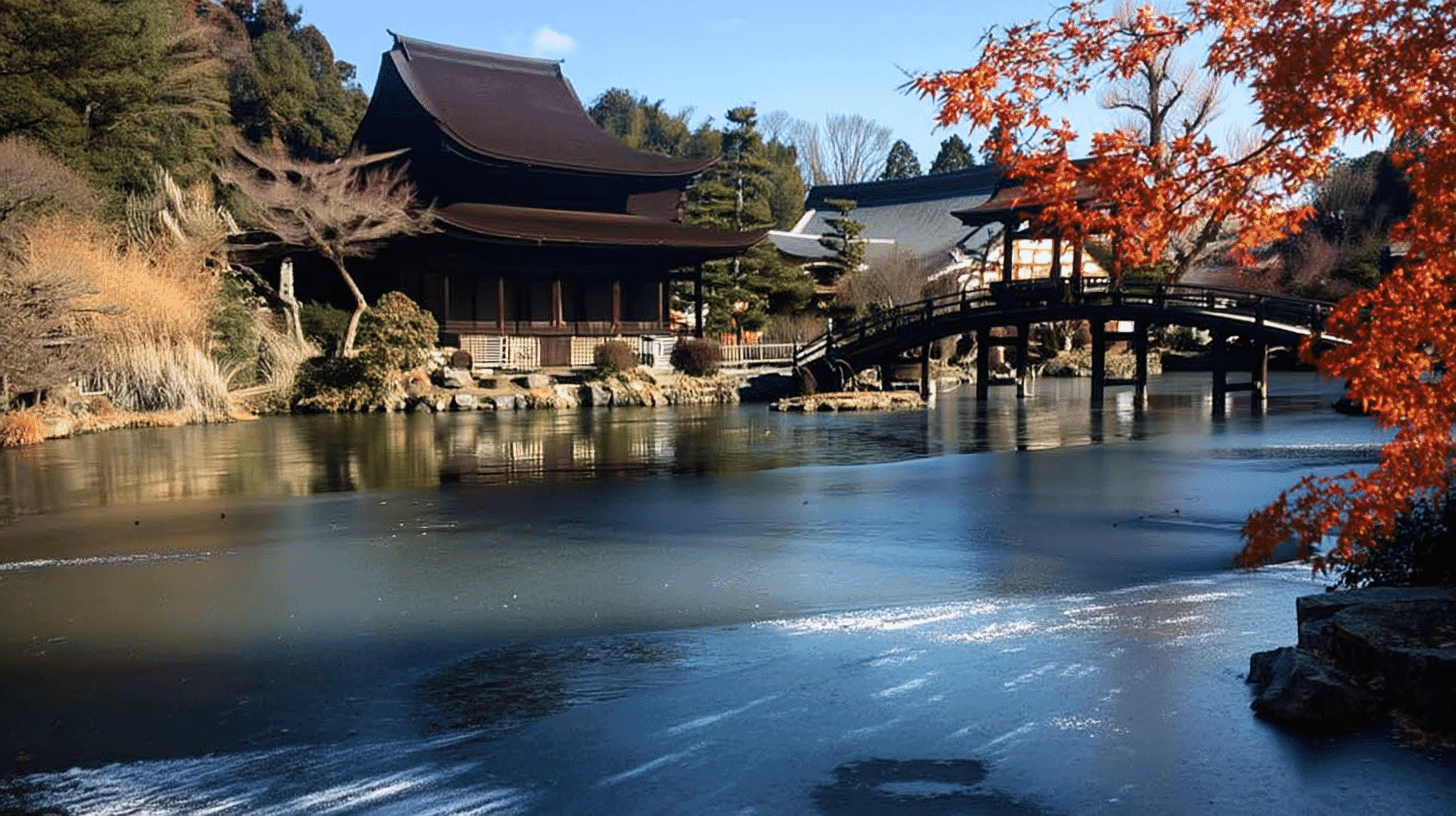
A Middle-Sized Zen Buddha Hall, National Treasure since 1952
Eihoji Temple Kannon Hall (永保寺観音堂, Eihoji Kannondo) stands at Eihoji, Kokeizan-cho, Tajimi City, Gifu Prefecture, designated a National Treasure on 29 March 1952. It had become an Important Cultural Property on 27 March 1901. The quantity is one building and the owner is Eihoji.
Its form is three bays by three bays, single storey with a pent roof, hip-and-gable roof, cypress bark. The Agency for Cultural Affairs gives the period as early Muromachi, 1333 to 1392.
The founder's hall of the same temple carries exactly the same two dates. The two buildings are treated as separate properties.
The Simplification Is What Is Valued
The Agency's assessment rests on how this hall differs from a full-dress Zen Buddha hall.
A middle-sized Zen Buddha hall, three bays square with a pent roof added and a cypress-bark hip-and-gable roof above, its design elegant and in keeping with the garden. Unlike a full-dress Zen Buddha hall it sets a low floor, keeps the eaves plain and boarded, and places bracket sets only over the columns rather than packing them between; simplifying the Zen manner while leaving the front open, it gives the exterior a deep play of shadow.
The closing line reads: this design by simplification is valued as a mark of assimilation into Japanese practice.
The simplification itself is what is praised. It is not treated as falling short of a full form but as evidence of a Japanese turn.
At the founder's hall of the same temple, the outer chamber is assessed as showing the Zen style in full. Within one temple, the two buildings are judged by opposite measures.
What Was Simplified
The record is specific about what was reduced.
The floor is set low. The eaves are plain and boarded. Bracket sets are placed only over the columns, not packed along the wall between them.
Packing brackets between the columns is the mark of a full-dress Zen Buddha hall. Here they sit on the columns alone, against the packed three-stepped sets of the outer chamber at the founder's hall.
Under the pent roof the curved tie beams are left in view, but along the open front they are omitted and brackets under the eaves take their place. Even within one building, some elements are shown and others left out.
Leaving the front open gives the exterior a deep play of shadow. The effect praised here follows from the simplification itself.
Record and Manner Do Not Agree
On the date of building, the Agency notes a gap between the written record and the style.
The chronicle of Muso records the raising of a Kannon pavilion in 1314, but the present hall is probably a building of the Nanbokucho period on the evidence of its manner.
The year in the document and the year inferred from the style do not agree. The Agency follows the style and stops at probably.
The beginning of the temple is recorded too. In 1313 Muso Soseki, 1275 to 1351, praised the site for the beauty of its landscape and set up a hermitage there, raising a Kannon pavilion the following year. Muso then passed the temple to Genno Hongen of his own line, and Genno became its founder.
At the founder's hall as well, a date of 1347 from an Edo-period record sat awkwardly against the inference from style. At this temple both buildings turn on the relation between record and manner.
Precinct and Garden
The Agency describes not only the building but its setting.
The precinct looks east to a bend of the Toki River, backs west onto a rocky cliff, faces south onto open ground, and beyond that a bridge with a pavilion is thrown across.
The environmental beauty formed by drawing this natural setting and the garden together was prized in medieval Zen temples as the character of a site, and Eihoji is one of the representative examples.
One of the representative examples, not the only one. That the hall's design is called elegant and in keeping with the garden follows from this relation to its setting.
Inside, a screen wall is set in the central bay at the back of the core with a Zen-style altar before it, holding a seated Kannon within a rocky grotto. The upper part of the core is a flat panelled ceiling throughout. The Eihoji garden is treated as a separate property.
Q&A
- When was the hall designated?
- On 29 March 1952, having become an Important Cultural Property on 27 March 1901. The founder's hall of the same temple carries exactly the same dates, though the two are separate properties.
- Why was it designated?
- The Agency records that, unlike a full-dress Zen Buddha hall, it sets a low floor, keeps the eaves plain and boarded, and places brackets only over the columns, simplifying the Zen manner while leaving the front open to give the exterior a deep play of shadow, and calls this design by simplification a mark of assimilation into Japanese practice.
- Is it judged differently from the founder's hall?
- Yes. At the founder's hall the outer chamber is assessed as showing the Zen style in full, while here the simplification of that style is what is valued. Within one temple the two buildings are judged by opposite measures.
- When was it built?
- The Agency records that the chronicle of Muso gives the raising of a Kannon pavilion in 1314, but that the present hall is probably a building of the Nanbokucho period on the evidence of its manner. Record and inference do not agree, and the Agency follows the style while stopping at probably.
- What is the setting like?
- The Agency records that the precinct looks east to a bend of the Toki River, backs west onto a rocky cliff and faces south onto open ground, with a bridge and pavilion beyond. The beauty formed by drawing setting and garden together was prized in medieval Zen temples, and Eihoji is one of the representative examples.
Basic Information
| Name | Eihoji Temple Kannon Hall (永保寺観音堂, Eihoji Kannondo) |
|---|---|
| Location | Kokeizan-cho, Tajimi City, Gifu Prefecture (Eihoji) |
| Designation | National Treasure (structure); the Eihoji founder's hall and the Eihoji garden are separate properties |
| Year Designated | 1901 (27 March), Important Cultural Property; 1952 (29 March), National Treasure |
| Quantity | 1 building |
| Dimensions | 3 bays by 3 bays, single storey with a pent roof, hip-and-gable roof, cypress bark: a middle-sized Zen Buddha hall. It sets a low floor, keeps the eaves plain and boarded, and places brackets only over the columns rather than packing them between. The front is left open, and curved tie beams show under the pent roof. Inside, a screen wall and altar stand at the back and the core carries a flat panelled ceiling. Early Muromachi period |
| Owner | Eihoji |
| Public Access | A temple building; whether and how it can be viewed follows the temple's practice |
References
- Cultural Heritage Online: Eihoji Kannon Hall
- https://bunka.nii.ac.jp/heritages/detail/121854
- Cultural Heritage Online: Eihoji Kaizando
- https://bunka.nii.ac.jp/heritages/detail/188883
- Kokeizan Eihoji official site
- https://kokeizan.or.jp/
- Gifu Prefecture tourism federation: Eihoji
- https://www.kankou-gifu.jp/spot/detail_1356.html
Last verified: 2026.09.04