
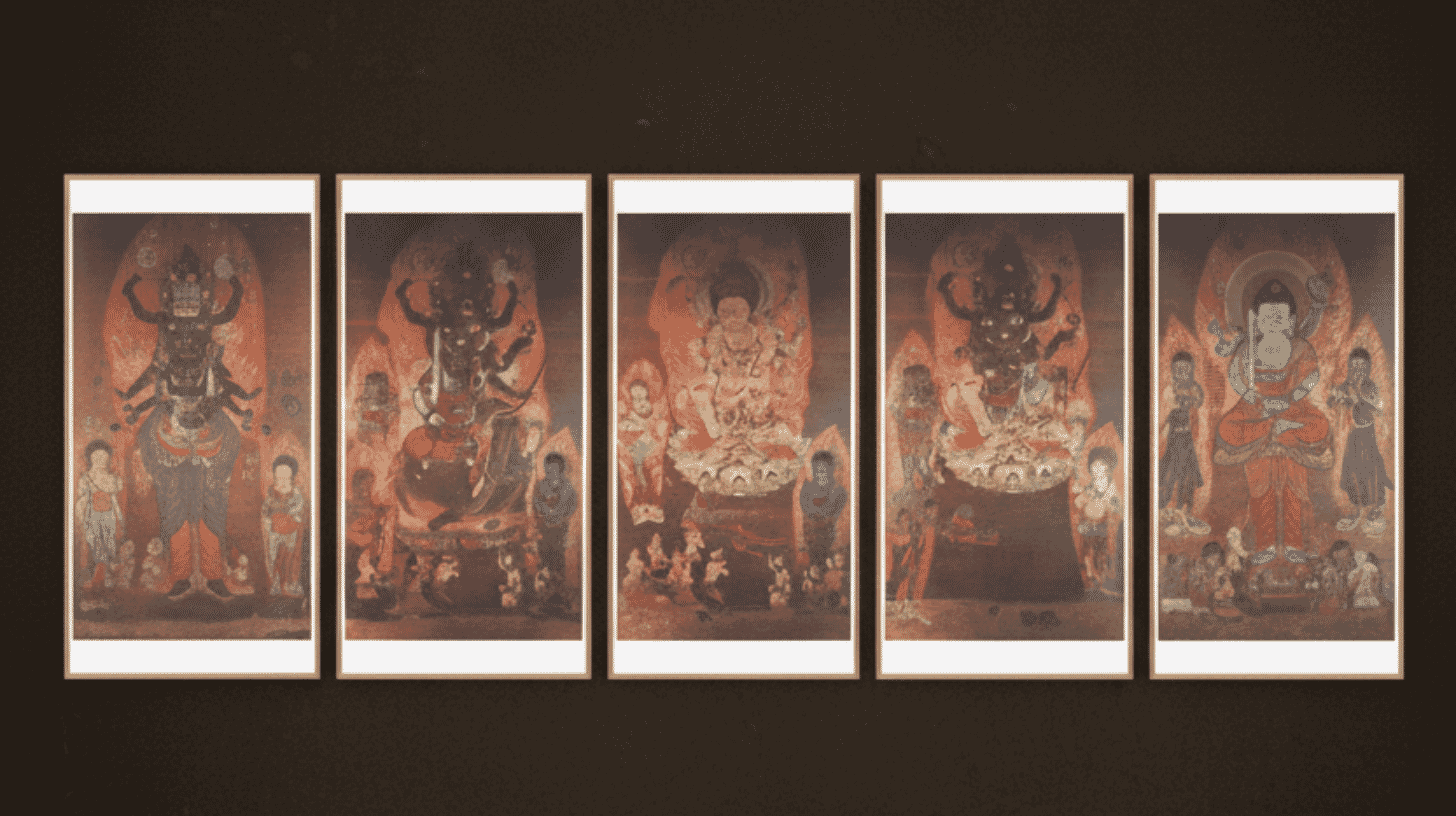
Five Hanging Scrolls, National Treasure since 2004
Five Great Wisdom Kings, Color on Silk (絹本著色五大尊像, Kenpon Chakushoku Godaison Zo) is a Heian-period Buddhist painting held by Kishinji at Ono Town, Ibi County, Gifu Prefecture, designated a National Treasure on 8 June 2004. The quantity is five scrolls, the category painting, and the owner the Kishinji religious corporation.
The Agency for Cultural Affairs explains the subject as the principal images used in the esoteric rite of the five altars. That rite sets up five altars, and one of these scrolls hangs at each.
The five wisdom kings are Fudo, Gozanze, Gundari, Daiitoku and Ususama. These are paintings, not sculptures.
Only Three Complete Sets Survive
The Agency's assessment begins with scarcity.
Complete sets of five that go back before the Kamakura period survive in only three examples: the set at Kyoogokokuji, the set at Daigoji, and this one.
The three differ in iconography. The first two are held to follow the Shingon line, while this set corresponds to what the iconographic compendia record as the manner brought back by Chisho Daishi: the Tendai Jimon line of the five wisdom kings.
The same five kings, drawn after different iconographic traditions. The Agency states that as an actual work in that line, this set is the only complete set of five from before the medieval period, and can be called the earliest surviving example, iconographic material included.
Only and earliest are both bounded by that line. This is not the earliest set of five wisdom kings in general.
Two Scrolls Carry Dates
The second axis of the assessment is the presence of dates.
The Gozanze scroll carries the year 1088 and the Gundari scroll the year 1090, each taken to indicate when it was made.
The inscriptions are in ink on the back of each silk. The Gozanze scroll reads: 1088, tenth month, tenth day, the eye-opening rite duly performed. Even the day of the consecration is recorded.
The Agency notes that among Heian Buddhist paintings only the nirvana image at Kongobuji and the Fugen Enmei image at Jikoji carry dates, and that this raises the value of the present work further.
Heian Buddhist paintings whose date of making is known are very few, and this set, with two dated scrolls, joins them.
The Five Are Not All of One Date
The Agency also records differences within the set: the five scrolls differ in expression and technique.
The Fudo scroll is the most damaged of the five, with a good deal of retouching and repainting. The shape of its flame halo and the faces of the attendant boys keep an archaic character, but from the quality of line and the sense of color it is taken to be later in date than the others.
The Agency's conclusion runs: the Fudo scroll appears to have been supplied later, for whatever reason, in imitation of an older original. Given also that the silk widths and the way the silk is joined are common to all five, the set may be taken to have been made in sequence during the Kanji era, including the original of the Fudo scroll.
The set is valued for being complete, yet one of its five is a later replacement. There was an earlier Fudo scroll, and the present one was made after it.
The Daiitoku scroll has a slightly larger picture surface and is better preserved, perhaps because of the quality of its silk. Silk and dimensions differ from scroll to scroll.
Seeing It
Kishinji owns the paintings. These are temple holdings, not objects kept on permanent display.
Buddhist paintings are vulnerable to light and are usually shown only for short periods. They may appear in special exhibitions at museums, so watch for notice of a showing.
All five are not necessarily shown together. The Fudo scroll in particular is recorded as heavily damaged, so its condition may keep it from being lent.
Kishinji is at Ono Town, Ibi County, Gifu Prefecture. The town records that the temple holds many properties designated at prefectural and municipal level as well.
Q&A
- When were these paintings designated?
- On 8 June 2004, as a National Treasure. The quantity is five scrolls, the category painting, and the period Heian. They belong to the Kishinji religious corporation at Ono Town, Ibi County, Gifu Prefecture.
- What do they depict?
- The Agency explains them as the principal images used in the esoteric rite of the five altars, which sets up five altars with one scroll at each. The five wisdom kings are Fudo, Gozanze, Gundari, Daiitoku and Ususama. These are paintings, not sculptures.
- Why are they valued?
- The Agency records that complete sets of five going back before the Kamakura period survive in only three examples, and that this one follows the Tendai Jimon line where the other two follow the Shingon line. Within that line it is the only complete set from before the medieval period and the earliest surviving example.
- Is the date of making known?
- The Gozanze scroll carries the year 1088 and the Gundari scroll the year 1090, inscribed in ink on the back of each silk. The Agency notes that among Heian Buddhist paintings only two others carry dates, which raises the value of this set further.
- Are all five of the same date?
- No. The Agency records that the five differ in expression and technique, that the Fudo scroll is the most damaged with much retouching and repainting, and that from its line and color it is taken to be later than the others, supplied in imitation of an older original.
Basic Information
| Name | Five Great Wisdom Kings, Color on Silk (絹本著色五大尊像, Kenpon Chakushoku Godaison Zo) |
|---|---|
| Location | Ono Town, Ibi County, Gifu Prefecture (Kishinji) |
| Designation | National Treasure (painting) |
| Year Designated | 2004 (8 June), National Treasure |
| Quantity | 5 scrolls |
| Dimensions | Principal images for the esoteric rite of the five altars, following the Tendai Jimon iconography. The Gozanze scroll carries the year 1088 and the Gundari scroll 1090, inscribed in ink on the back of the silk. The Fudo scroll is heavily damaged and taken to be a later replacement after an older original. The Daiitoku scroll has a slightly larger surface. Heian period |
| Owner | Kishinji religious corporation |
| Public Access | Temple holdings, not on permanent display. Buddhist paintings are vulnerable to light and shown only briefly |
References
- Cultural Heritage Online: Five Great Wisdom Kings, color on silk
- https://bunka.nii.ac.jp/db/heritages/detail/160141
- Ono Town: the Five Great Wisdom Kings and Kishinji
- https://www.town-ono.jp/0000000474.html
- Nara National Museum official site
- https://www.narahaku.go.jp/
- Agency for Cultural Affairs, National Cultural Properties Database
- https://kunishitei.bunka.go.jp/
Last verified: 2026.09.05