
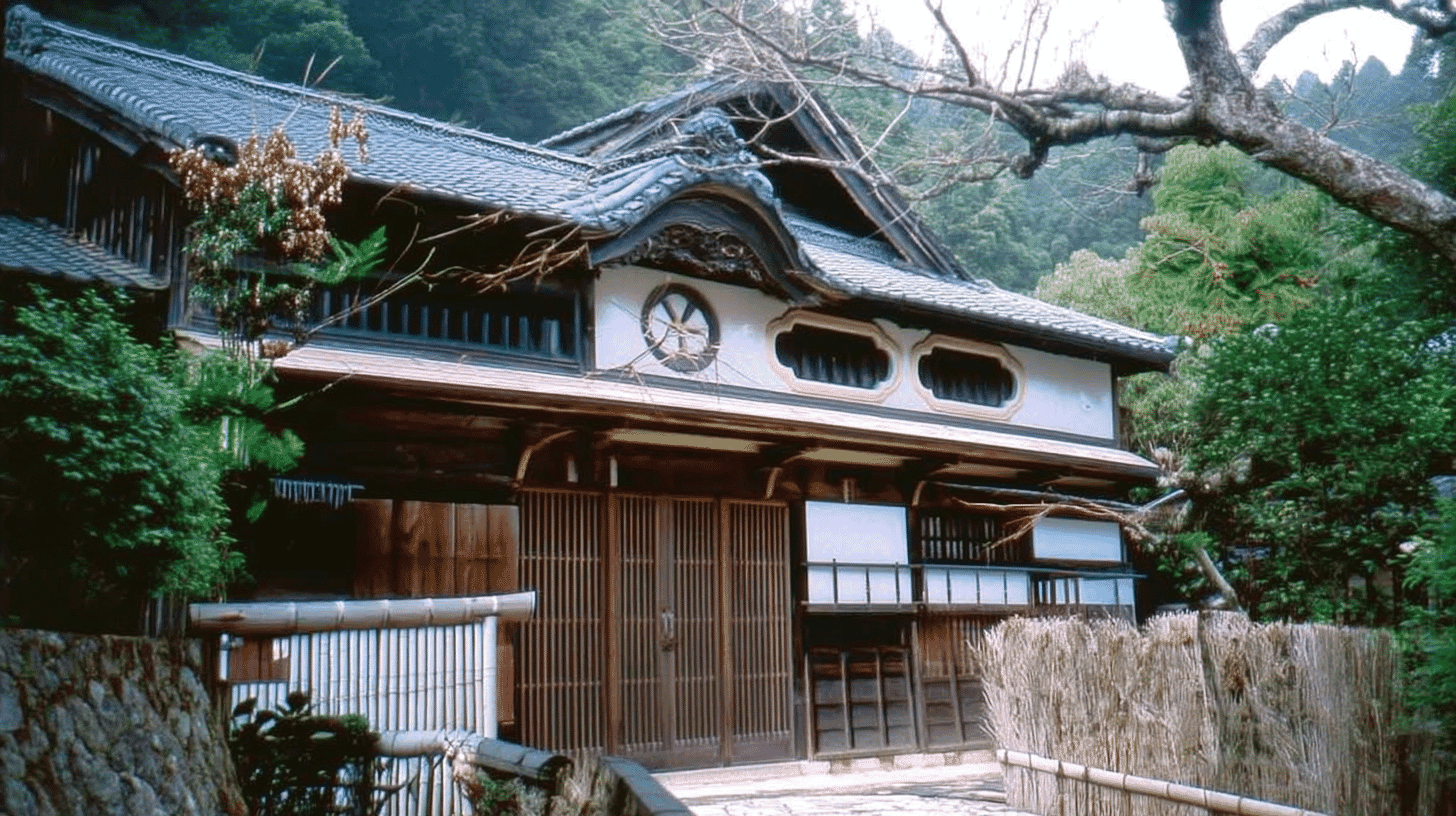
A Single-Storey House on High Ground, Registered in 2006
Hobo Family Main Building (保々家住宅主屋, Hobo-ke Jutaku Shuoku) stands at 402-1 Okute-cho, Mizunami City, Gifu Prefecture, entered on the national register of tangible cultural properties on 3 August 2006. The quantity is one building: timber, single storey, tiled roof, with a footprint of 161 square metres.
The Agency for Cultural Affairs records the date in two parts: Edo, 1661 to 1750, altered 1751 to 1829. The building spans ninety years and the alteration seventy-eight, neither narrowed to a year.
The Hobo Family Main Building served the Okute post station on the Nakasendo as its secondary official lodging, standing on high ground back from the west side of the road. Mizunami City records that it is reached by a slope some three metres wide rising from the road.
The Southern Entrance and Reception Rooms Are Gone
The Agency's account states plainly what has been lost.
The entrance and reception rooms that stood on the south side have been lost, but as the central building of the post station in its day it shapes the townscape.
The building carries its registration with part of it gone. Entrance and reception rooms are where guests would have been received, and they no longer stand.
The registration holds because the assessment rests on shaping the townscape. What is judged is not the completeness of the building alone but its part in the street it belongs to.
As with the armour whose fittings are lost, the tea bowl with a kiln crack, and the sword mounting with later replacements, a record of loss and a listing sit together here.
A Quatrefoil Window and a Bellflower Crest
The exterior is described as follows.
Facing southeast, gabled, pantiled, single storey, entered from the long side, with a quatrefoil window and a plaster bellflower crest set in the low wall above the front eaves.
That low wall rises above the eaves, and the window and plasterwork are placed on it. The quatrefoil takes its outline from a melon cut across, a shape also used in family crests.
The bellflower crest renders the flower as a device. It is worked in plaster and applied to the wall.
Though the house is single storey, it carries a decorative plane above the eaves. What the upper wall would hold in a two-storey townhouse is taken here by the low wall above the eaves. The Yoshida Family Residence solved the same problem differently, plastering its upper wall to the eaves.
From Principal to Secondary Lodging
Mizunami City records that the standing of the building changed part way through.
It is said to have been built at first as the principal official lodging and to have become the secondary one in 1725.
The change ran downwards in rank. The building stayed as it was while the role it carried changed. The Agency's record follows the later standing.
According to Mizunami City, the head of the house bore the name Hobo Chozaemon by succession and also served the Yamamura, the local lords, as village headman and as agent. One household held several offices at once.
Okute was first opened in the Tensho era, between 1573 and 1590, and formally established as a post station in 1604. The city records the Hobo family as having taken part in that founding.
Visiting
The Agency records nothing about public access and leaves the owner field blank. Registered properties are often buildings their owners go on using, and opening the interior is not assumed.
Check with Mizunami City or a similar source about whether it is open before planning a visit.
The exterior can be seen from the road. Standing on high ground up a slope some three metres wide, the Hobo Family Main Building is looked at from below. The quatrefoil window and plaster bellflower crest in the low wall above the front eaves read best from that angle.
The building is at 402-1 Okute-cho, Mizunami City, Gifu Prefecture.
Q&A
- When was the building registered?
- On 3 August 2006, on the national register of tangible cultural properties, as one building of timber, single storey, tiled, with a footprint of 161 square metres.
- When was it built?
- The Agency records the date in two parts: Edo, 1661 to 1750, altered 1751 to 1829. The building spans ninety years and the alteration seventy-eight, neither narrowed to a year.
- Has part of it been lost?
- Yes. The Agency records that the entrance and reception rooms on the south side have been lost, but that as the central building of the post station in its day it shapes the townscape. The assessment rests on that role rather than on the completeness of the building.
- What decorates the front?
- The Agency records a quatrefoil window and a plaster bellflower crest set in the low wall above the front eaves. The quatrefoil takes its outline from a melon cut across, and the bellflower crest renders the flower as a device worked in plaster.
- Did the role of the building change?
- Mizunami City records that it is said to have been built at first as the principal official lodging and to have become the secondary one in 1725. The building stayed as it was while its role changed. The head of the house also served as village headman and as agent.
Basic Information
| Name | Hobo Family Main Building (保々家住宅主屋, Hobo-ke Jutaku Shuoku) |
|---|---|
| Location | 402-1 Okute-cho, Mizunami City, Gifu Prefecture |
| Designation | Registered Tangible Cultural Property (structure) |
| Year Designated | 2006 (3 August), registered |
| Quantity | 1 building |
| Dimensions | Timber, single storey, tiled roof, footprint 161 square metres. It stands on high ground back from the west side of the road, facing southeast, gabled, pantiled, entered from the long side, with a quatrefoil window and a plaster bellflower crest in the low wall above the front eaves. The entrance and reception rooms on the south side have been lost. Edo period |
| Owner | The Agency's owner field is blank |
| Public Access | Nothing is recorded about public access. The exterior can be seen from the road |
References
- Cultural Heritage Online: Hobo Family Main Building
- https://bunka.nii.ac.jp/heritages/detail/142871
- Mizunami City: Hobo Family Main Building
- https://www.city.mizunami.lg.jp/kankou_bunka/bunkazai/1001296/1002385.html
- Agency for Cultural Affairs: the registration system for tangible cultural properties
- https://www.bunka.go.jp/seisaku/bunkazai/shokai/yukei_kenzobutsu/
- Agency for Cultural Affairs, National Cultural Properties Database
- https://kunishitei.bunka.go.jp/
Last verified: 2026.09.04