
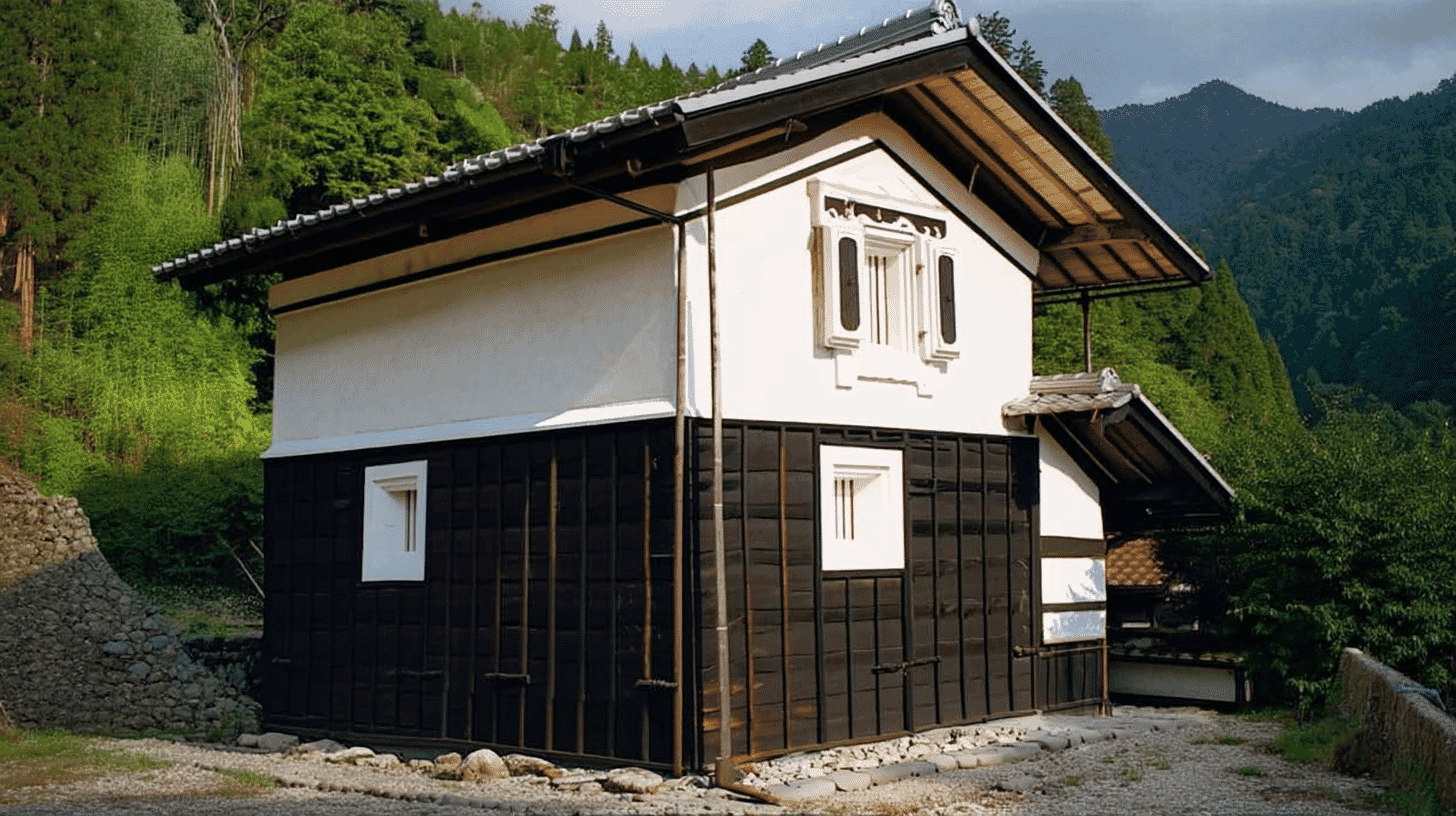
A Storehouse of 21 Square Metres, Registered in 2010
Suga Family Residence, North Storehouse (須賀家住宅北蔵, Suga-ke Jutaku Kitagura) stands at 334 Numa, Nakaro, Hagiwara-cho, Gero City, Gifu Prefecture, entered on the national register of tangible cultural properties on 15 January 2010. The quantity is one building: earth-walled construction, two storeys, tiled roof, with a footprint of 21 square metres.
The Agency for Cultural Affairs gives the date as Meiji, 1892. It measures 5.5 metres along and 4.5 metres deep and stands northwest of the main house, facing south.
This is a small building. Its 21 square metres come to a sixteenth of the 331 square metres of the main house on the same plot.
The Storehouses Came First
Three buildings on this plot were registered on the same day: the main house, the front storehouse and the north storehouse. The order in which they were built is not the order of the list.
The Agency gives their dates as 1879 for the front storehouse, 1892 for the north storehouse, and 1908 for the main house.
Two storehouses stood before the main house was raised. Twenty-nine years separate the front storehouse from the main house, and sixteen years the north storehouse from it.
The main house now standing dates from 1908, so an earlier one must have preceded it, though the Agency says nothing of that. Only the storehouses survive from the earlier phase.
The three differ greatly in size as well: 331 square metres for the main house, 55 for the front storehouse, 21 for the north storehouse.
Black Plaster Sharpening the White
What the Agency singles out is the handling of color.
The ground floor is finished in white plaster above a boarded skirt held by slender battens, and the black plaster along the lower edge of the wall band sharpens the exterior.
The wall band runs as a belt around the upper part of a storehouse wall. Only its lower edge is finished in black plaster, so a single dark line crosses the white wall high up.
Rather than white throughout, the black line pulls the outline tight. That is what the Agency means by sharpens.
The boarded skirt is held by slender battens laid over the boards. Boarding below, white plaster above: the wall divides in two.
Of the front storehouse on the same plot the Agency writes that red tiles, white plaster and black woodwork make a composed front. In both, the contrast of white and black is the axis of the assessment.
A Set-On Roof and a Sliding Door
The roof is recorded as a pantiled set-on roof with its ridge running east to west.
A set-on roof is a separate roof placed above the walls and ceiling of an earth-walled storehouse. The body of earth and the roof of tile stand apart, which keeps the fire resistance of the store while sheltering the earth walls from rain.
A working space is added on the south side, before the entrance, for moving goods in and out.
The south entrance carries a wooden door that slides back into the wall.
The front storehouse on the same plot hangs a pair of doors finished in black plaster with rebated edges. North storehouse and front storehouse close differently. Use or scale may account for it, but the Agency gives no reason.
Visiting
The Agency records nothing about public access and leaves the owner field blank. Registered properties are often buildings their owners go on using, and opening the interior is not assumed.
Check with Gero City or a similar source about whether it is open before planning a visit.
Outside, what repays looking at is the color: white plaster wall, one black line high across it, and the battened boarding below, all readable on the south front.
The building is at 334 Numa, Nakaro, Hagiwara-cho, Gero City, Gifu Prefecture.
Q&A
- When was the storehouse built and registered?
- The Agency for Cultural Affairs gives the date as Meiji, 1892. It was entered on the national register of tangible cultural properties on 15 January 2010, as one building of earth-walled construction, two storeys, tiled, with a footprint of 21 square metres.
- How does it relate to the other buildings on the plot?
- The main house, front storehouse and north storehouse were registered on the same day, but built in the order 1879, 1892 and 1908. Two storehouses stood before the main house was raised. Their sizes are 331, 55 and 21 square metres.
- What marks the exterior?
- The Agency records white plaster above a boarded skirt held by slender battens, with black plaster along the lower edge of the wall band sharpening the exterior. A single dark line crosses the white wall high up.
- What is a set-on roof?
- A separate roof placed above the walls and ceiling of an earth-walled storehouse. The body of earth and the roof of tile stand apart, keeping the fire resistance of the store while sheltering the earth walls from rain. This one is pantiled with its ridge running east to west.
- Can it be visited?
- The Agency records nothing about public access and leaves the owner field blank. Registered properties are often still in use by their owners, and opening the interior is not assumed. Check locally before planning a visit.
Basic Information
| Name | Suga Family Residence, North Storehouse (須賀家住宅北蔵, Suga-ke Jutaku Kitagura) |
|---|---|
| Location | 334 Numa, Nakaro, Hagiwara-cho, Gero City, Gifu Prefecture |
| Designation | Registered Tangible Cultural Property (structure); the main house and front storehouse are separate properties |
| Year Designated | 2010 (15 January), registered |
| Quantity | 1 building |
| Dimensions | Earth-walled construction, 2 storeys, tiled roof, footprint 21 square metres. 5.5 metres along and 4.5 metres deep, standing northwest of the main house and facing south, under a pantiled set-on roof with its ridge running east to west, with a working space on the south. The ground floor is white plaster above a battened boarded skirt, with black plaster along the lower edge of the wall band. The south entrance has a wooden sliding door. Built 1892 |
| Owner | The Agency's owner field is blank |
| Public Access | Nothing is recorded about public access |
References
- Cultural Heritage Online: Suga Family Residence, North Storehouse
- https://bunka.nii.ac.jp/heritages/detail/218839
- Cultural Heritage Online: Suga Family Residence, Front Storehouse
- https://bunka.nii.ac.jp/heritages/detail/163608
- Cultural Heritage Online: Suga Family Residence, Main House
- https://bunka.nii.ac.jp/heritages/detail/140917
- Agency for Cultural Affairs: registered tangible cultural properties (structures)
- https://www.bunka.go.jp/seisaku/bunkazai/shokai/yukei_kenzobutsu/toroku_yukei.html
Last verified: 2026.09.05