
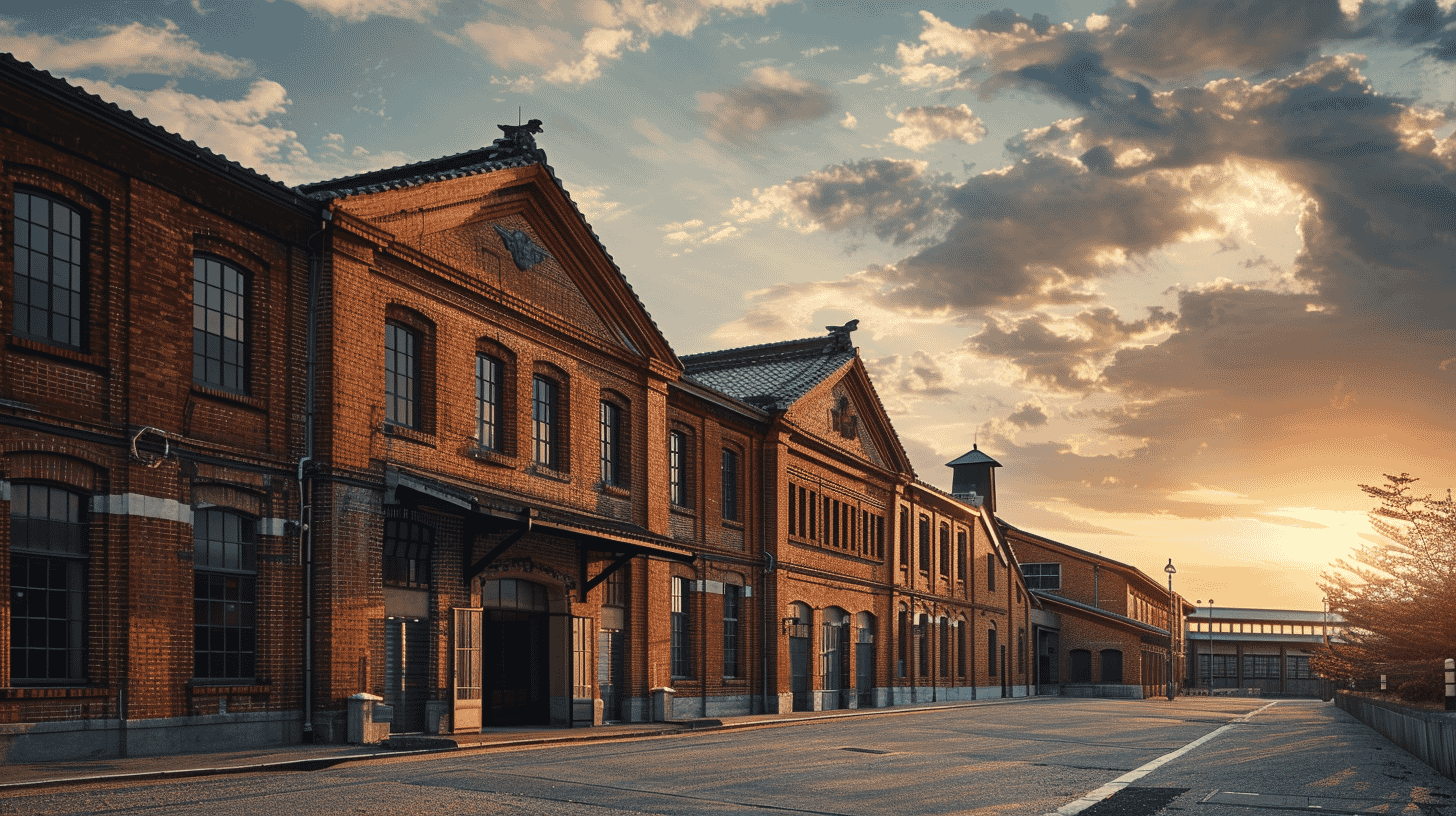
A Government Silk Mill of 1872: Three National Treasures and Six Important Cultural Properties
The Former Tomioka Silk Mill (旧富岡製糸場, Kyu Tomioka Seishijo) is a state-run machine reeling mill of 1872 at 1 Tomioka, Tomioka City, Gunma Prefecture. Nine of its buildings were designated Important Cultural Properties on 5 July 2006, and on 10 December 2014 three of them, the reeling mill and the east and west cocoon warehouses, were raised to National Treasure status. It belongs to the city of Tomioka.
The nine are the reeling mill, the east cocoon warehouse, the west cocoon warehouse, the director's house, the French instructors' house, the inspectors' house, the steam boiler house, the iron water tank, and the drainage culvert with its outfall. Three hold National Treasure status; six are Important Cultural Properties only. The site is a National Historic Site, and in June 2014 it was inscribed as a component of the World Heritage site Tomioka Silk Mill and Related Sites.
The Agency for Cultural Affairs sets out the history plainly. Founded as a model machine reeling mill under the Meiji government's policy of industrial promotion, it was begun in March 1871; the reeling mill and the two warehouses were completed in July 1872, and operations began on 4 October of that year. The French silk inspector Paul Brunat planned and supervised, the Yokosuka shipyard engineer Bastien drew the plans, and Japanese craftsmen carried out the building.
Timber-Framed Brick: A Japanese Frame with Western Walls
The three National Treasures share one construction. The Agency defines it as a timber frame with walls of laid brick.
In Western brick building the wall itself carries the load from above. Tomioka did not do that. The load is taken by a traditional Japanese frame of posts and beams, and the brick was laid as infill between the posts. Because French engineers drew the plans and Japanese carpenters built them, the two methods sit together in a single building. The bricks were fired in Japan and the joints pointed with lime plaster.
When the Agency credits the mill with conveying the structural techniques of the earliest Western-style building in Japan, and finds it of high scholarly value on that account, it is this hybrid construction that is meant.
The Three at Scale: 140 Metres and 104 Metres
The reeling mill stands at the centre of the site, the building where thread was drawn from cocoons. It runs 140 metres, an exceptional length, and a king-post truss roof, high ceiling and iron-framed glass windows make a bright open interior. A truss supports a roof through triangulated members, freeing the floor of columns. The long rows of reeling machines were possible because of that structure.
The east and west cocoon warehouses stand at right angles to the reeling mill, two-storey buildings of nearly identical form, each 104 metres long with a floor area of 1,486.60 square metres. They dried and stored cocoons, and carry many windows for the drying. The east warehouse faces the entrance, and the keystone of its arch bears the inscription Meiji 5.
The Agency concludes that the reeling mill and the two warehouses became the model for silk mill architecture in Japan. The techniques and plan used for these three were carried into mills across the country.
Why Nine Buildings Form One Item, at Two Levels
The reeling mill alone is a 140-metre factory. The director's house alone is one engineer's residence. Only with the nine in view does the working of a state mill as a single organisation become legible.
Thread was drawn in the reeling mill, cocoons dried and stored in the two warehouses, power and hot water raised in the boiler house, water held in the iron tank and drained through the culvert. Brunat lived in the director's house, the French women instructors in theirs, the silk inspectors in theirs. Production, power, water and housing survive together in something close to their state at opening. That completeness is what the Agency means in finding the main production facilities almost entirely intact and of high historical value.
Within that whole, only the three buildings at the heart of production were raised to National Treasure status. The reason given is that the mill introduced Western, and specifically French, technique to the Far East, fused it with Japanese practice to bring about an industrial revolution, and served as the base from which Japan's silk industry contributed to the development of silk culture worldwide. The Important Cultural Property designation values the integrity of the complex; the National Treasure designation values the architecture and historical significance of the three.
Visiting
The mill opens from 9:00 a.m. to 5:00 p.m., last entry 4:30 p.m., and closes from 29 to 31 December. Admission is 1,000 yen for adults, 250 yen for high school and university students and 150 yen for primary and junior high school students. Charges may change, so check before travelling.
Inside the reeling mill the king-post trusses run in succession down a 140-metre space, lit from both sides through iron-framed windows. The east warehouse faces the entrance; look up at the keystone reading Meiji 5 before going in. The west warehouse, restored, is now also used for lectures and concerts.
Guided tours run at set times and audio guides are available. Photography is allowed outdoors and inside some buildings but prohibited at marked points, so follow the signs.
From Joshu-Tomioka Station on the Joshin Electric Railway it is about 15 minutes on foot. By car the Tomioka interchange on the Joshin-etsu Expressway is about 10 minutes away, with municipal parking.
Q&A
- When was the Former Tomioka Silk Mill built and designated?
- Building began in March 1871 and the mill opened on 4 October 1872. Nine buildings were designated Important Cultural Properties on 5 July 2006, and three of them, the reeling mill and the east and west cocoon warehouses, became National Treasures on 10 December 2014. The site joined the World Heritage list the same year.
- What is the timber-framed brick construction of the Tomioka mill?
- A timber frame with walls of laid brick. Where Western brick walls carry the load, at Tomioka a Japanese frame of posts and beams takes it and the brick fills the gaps between the posts. French engineers drew the plans and Japanese carpenters built them, so the two methods sit together in one building.
- What are the three National Treasure buildings?
- The reeling mill is a single-storey building 140 metres long with a king-post truss roof and iron-framed windows making a bright open interior. The east and west cocoon warehouses are two-storey buildings of nearly identical form, 104 metres long with floor areas of 1,486.60 square metres each. The east warehouse keystone reads Meiji 5.
- Why are only three of the nine buildings National Treasures?
- The Important Cultural Property designation values the survival of the whole complex, production, power, water and housing together. The National Treasure designation values the architecture and historical significance of the three at the heart of production, which the Agency describes as the base where French technique was fused with Japanese practice to bring about an industrial revolution.
- What does it cost to visit, and when is it open?
- It opens 9:00 a.m. to 5:00 p.m. with last entry at 4:30 p.m., closed from 29 to 31 December. Admission is 1,000 yen for adults, 250 yen for high school and university students and 150 yen for younger students. It is about 15 minutes on foot from Joshu-Tomioka Station. Guided tours and audio guides are available.
Basic Information
| Name | Former Tomioka Silk Mill (旧富岡製糸場, Kyu Tomioka Seishijo) |
|---|---|
| Location | 1 Tomioka, Tomioka City, Gunma Prefecture |
| Designation | National Treasure (reeling mill, east and west cocoon warehouses, 3 buildings); Important Cultural Property (director's house, instructors' house, inspectors' house, boiler house, iron water tank, drainage culvert, 6 buildings). Site a Historic Site; component of the World Heritage site Tomioka Silk Mill and Related Sites |
| Year Designated | 2006 (5 July), 9 buildings as Important Cultural Properties; 2014 (10 December), 3 buildings as National Treasures |
| Quantity | 9 buildings |
| Dimensions | Timber-framed brick. Reeling mill: 140 m long, single storey, king-post trusses. East and west cocoon warehouses: 104 m long, 2 storeys, floor area 1,486.60 sq m each, tiled. Built 1872 |
| Owner | City of Tomioka |
| Public Access | 9:00 a.m. to 5:00 p.m., last entry 4:30 p.m. Closed 3 days at year end. Adults 1,000 yen, high school and university students 250 yen, younger students 150 yen |
References
- Cultural Heritage Online: Former Tomioka Silk Mill, reeling mill
- https://online.bunka.go.jp/heritages/detail/124804
- Cultural Heritage Online: Former Tomioka Silk Mill, east cocoon warehouse
- https://online.bunka.go.jp/heritages/detail/158535
- Cultural Heritage Online: Former Tomioka Silk Mill, director's house
- https://online.bunka.go.jp/heritages/detail/196660
- Gunma Prefecture: the National Treasure designation of the Former Tomioka Silk Mill
- https://www.pref.gunma.jp/page/5167.html
- Tomioka City: National Treasure designation of three buildings
- https://www.city.tomioka.lg.jp/www/contents/1418028474454/index.html
- Tomioka Silk Mill official site
- https://www.tomioka-silk.jp/_tomioka-silk-mill/
Last verified: 2026.09.28
Cultural Treasures in the Same Area
All are within walking distance in the same area, so we recommend visiting them together.
- Former Tomioka Silk Mill Silk reeling mill 0.00 km
- Former Tomioka Silk Mill Steam boiler plant 0.03 km
- Former Tomioka Silk Mill Iron water reservoir 0.05 km
- Former Tomioka Silk Mill Sewer pipe and outer pipe 0.06 km
- Former Tomioka Silk Mill Chief's House 0.09 km
- Former Tomioka Silk Mill East cocoon place 0.09 km
- Former Tomioka Silk Mill Onnakokan 0.09 km
- Former Tomioka Silk Mill West Cocoon Warehouse 0.10 km
- Former Tomioka Silk Mill Inspector's House 0.11 km