
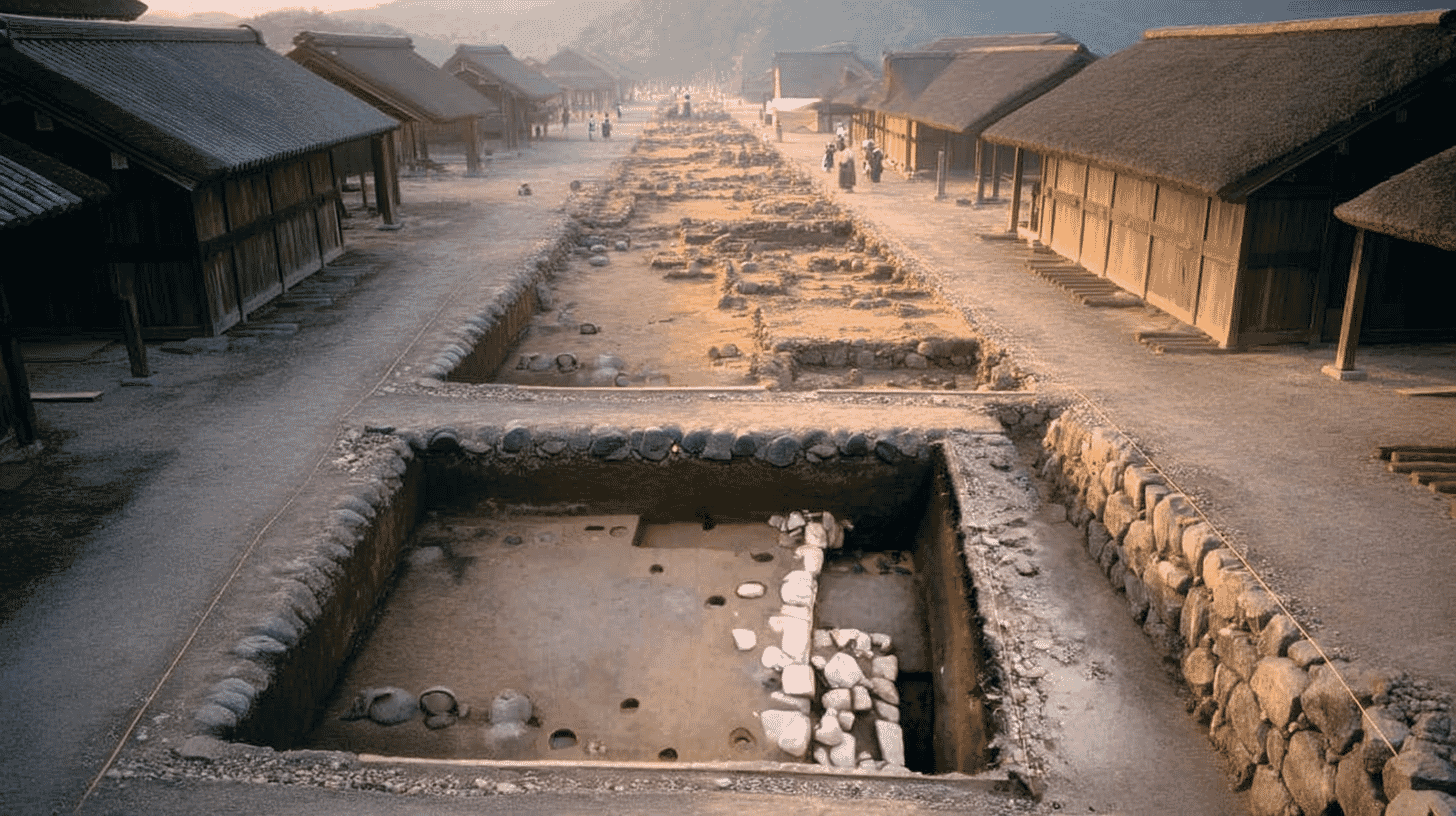
One Provincial Capital Site, Designated by the State in 2016
Bingo Provincial Capital Ruins (備後国府跡, Bingo Kokufu Ato) lie in Fuchu City, Hiroshima Prefecture, and were designated by the state on 3 October 2016. The category is that of historic sites, places of scenic beauty and natural monuments.
The managing body is Fuchu City.
The date field runs from the eighth century to the twelfth. The Agency records the seat of the ancient province of Bingo, in the south-east of the prefecture.
The Whole Course, from Rise to Decline
What is valued is not one moment but the change across time.
The Agency closes that the site shows the course of a provincial seat from its rise to its decline, across the 8th to the 12th centuries, and is of the first importance for understanding how the provinces were governed in ancient times.
Four hundred years of change can be read from the remains.
In one district, large post-in-ground buildings stood within a ditched enclosure roughly a block square, chiefly in the 8th century.
From the 9th century the enclosing ditch was lost, yet the large buildings were rebuilt on footing stones, and the place carried on to the end of the 10th.
The ditch goes; posts set in the ground give way to posts on stones; and both lie one over the other in the same ground. As a way of stating value this is the twenty-second met.
A Written Record Borne Out by Digging
What had been written down was confirmed by excavation.
The Agency records that an early dictionary names a district as holding the provincial seat, and that this place falls within that district, so the seat was supposed to lie here.
That work is a dictionary of the Heian period. A district it names as holding the seat is the one this place belongs to.
Excavation from 1967 onward, the record continues, gave the supposition its archaeological footing.
At Shimizuyama, excavation allowed the date of the site to be fixed. There it settles a time.
Here it settles a place: what a text records is matched to ground, and a supposition becomes a finding.
Tiles from One Mould Binding Places Apart
Separate districts are shown to belong together by their tiles.
The Agency records that eaves tiles from the same moulds, in the manner of the Nara palace, are shared between the principal district and the others: one where footing-stone buildings and a garden pond were found, another the site of a temple, and many more that yielded the goods of government offices.
Tiles from one mould can be told from others, so a match points to one source of supply.
It follows, the record says, that these are best understood as the varied parts of one provincial seat working together across a wide area.
At the Yoshibe kiln, tiles from one mould identified the kiln that supplied a palace. There they point to the maker.
Here they bind the receivers to one another. The same evidence serves in the opposite direction.
Visiting
The site lies in Fuchu City, Hiroshima Prefecture, managed by the city.
Finds include roof tiles of the provincial kind, belt fittings, ceramic inkstones, and serving vessels in stoneware and earthenware.
The record adds glazed domestic ware and imported ceramics in quantities unmatched elsewhere in the province, running without break to the 12th century.
From this it concludes that the principal district held one of the most formal establishments in the province, used for the business of documents, for provisioning and for entertaining.
This is an open-air site, and whether and how it may be visited follows the managing body's arrangements. Check before travelling.
Q&A
- When was the site designated?
- On 3 October 2016, by the state. The category is that of historic sites, places of scenic beauty and natural monuments.
- What is valued in it?
- That it shows the course of a provincial seat from rise to decline across the eighth to twelfth centuries, and is of the first importance for understanding how the provinces were governed.
- How was the place identified?
- An early dictionary names a district as holding the provincial seat, and this place falls within it. Excavation from 1967 onward gave that supposition its archaeological footing.
- How did the buildings change?
- In the eighth century, post-in-ground buildings within a ditched enclosure; from the ninth, the ditch lost and the large buildings rebuilt on footing stones, carrying on to the end of the tenth.
- What has been found there?
- Roof tiles of the provincial kind, belt fittings, ceramic inkstones and serving vessels, along with glazed domestic ware and imported ceramics in quantities unmatched in the province.
Basic Information
| Name | Bingo Provincial Capital Ruins (備後国府跡, Bingo Kokufu Ato) |
|---|---|
| Location | Fuchu City, Hiroshima Prefecture |
| Designation | Historic site, place of scenic beauty and natural monument; designated as an archaeological site rather than as a building or a work of art |
| Year Designated | 2016 (3 October), designated |
| Quantity | 1 provincial capital site, made up of several districts |
| Dimensions | In the principal district, a ditched enclosure roughly a block square in the 8th century. From the 9th century the ditch was lost, yet the large buildings were rebuilt on footing stones and the place carried on to the end of the 10th. The date field runs from the 8th century to the 12th |
| Owner | Managed by Fuchu City |
| Public Access | An open-air site; visiting follows the managing body's arrangements |
References
- Cultural Heritage Online: Bingo Provincial Capital Ruins
- https://bunka.nii.ac.jp/heritages/detail/221647
- Agency for Cultural Affairs, National Cultural Properties Database
- https://kunishitei.bunka.go.jp/
- Fuchu City: the provincial capital site
- https://www.city.fuchu.hiroshima.jp/soshiki/kyoiku_iinkai/kyoikuseisakuka/bingokokufu/901.html
- Fuchu City: the museum of history and folklore
- https://www.city.fuchu.hiroshima.jp/soshiki/kyoiku_iinkai/kyoikuseisakuka/bingokokufu/museum/798.html
Last verified: 2026.09.17