
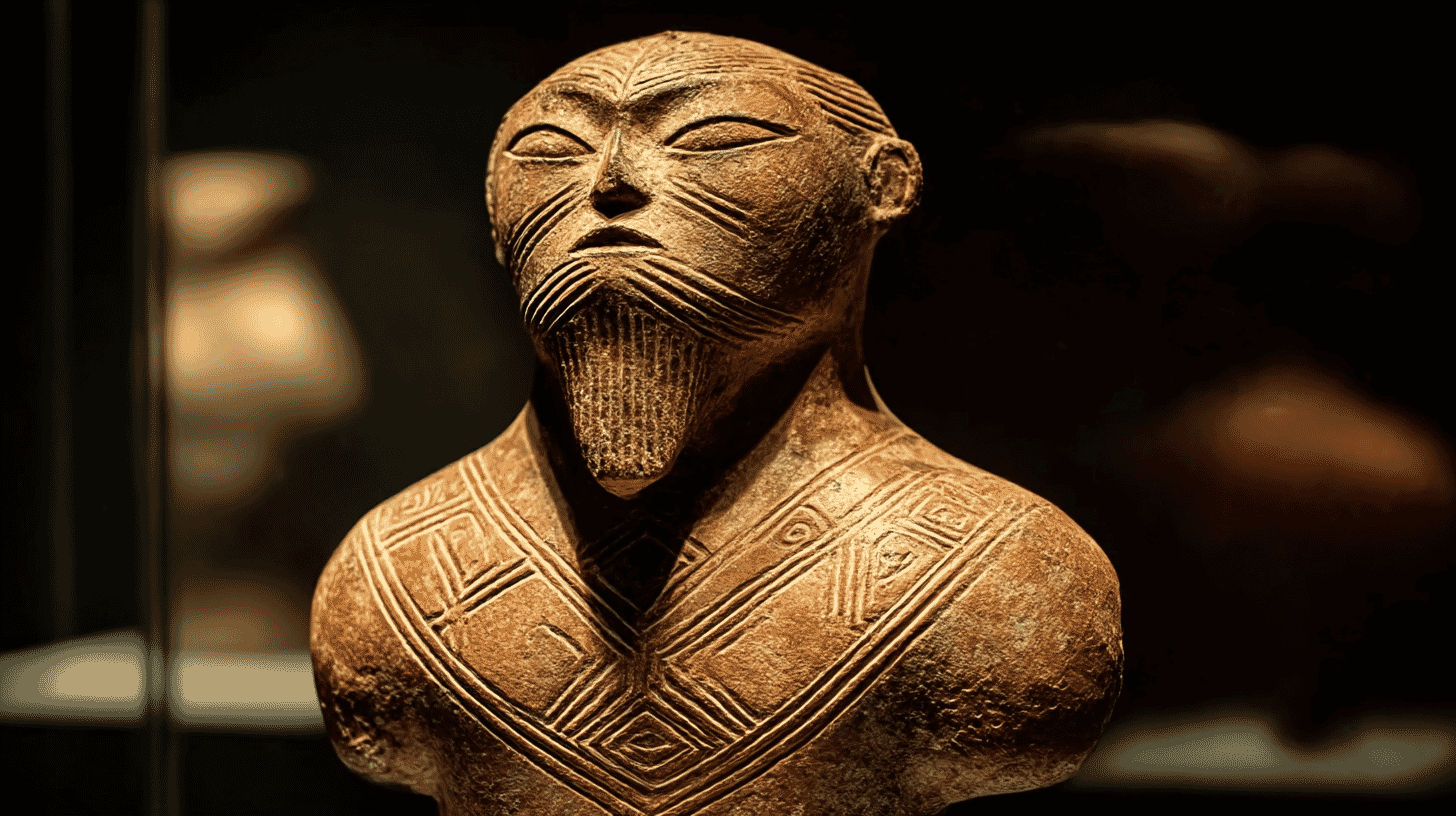
One Figurine, National Treasure since 2007
Clay Figurine Excavated from the Chobonaino Site, Hakodate City, Hokkaido (土偶, Dogu) is Jomon archaeological material at 551-1 Usujiri-cho, Hakodate City, made an Important Cultural Property on 6 June 1979 and designated a National Treasure on 8 June 2007. The quantity is one piece and the owner Hakodate City.
Twenty-eight years separate the two listings of this Clay Figurine (土偶). The figurine from the Kazabari 1 site in Aomori took twelve, from 1997 to 2009.
The designation of 8 June 2007 is among the later ones met here.
Formed to Stand, Yet It Does Not Stand
For the Clay Figurine 土偶/北海道函館市著保内野遺跡出土, two things that do not sit together are recorded in one sentence.
The shoulders spread wide, the waist narrows, and the legs are set side by side as if standing, but the figure does not stand on its own.
The legs are placed for standing. Set down, it will not stand.
What the form indicates and what the object can do are not the same.
With the Rishukyo on white-line paper, absent eyes and noses gave rise to the by-name of the eyeless sutra. At the Kongobuji Fudo hall, a veranda without a railing entered the structural description. Absences do get written down.
Here a present form and an absent capacity stand together in one sentence. The record offers no explanation.
The legs are described too: below the knees they are joined by a tube. Two legs connected.
A Second Figurine Owned by a City
The owner field for 土偶/北海道函館市著保内野遺跡出土 reads Hakodate City.
The figurine from the Kazabari 1 site belongs to Hachinohe City. A city owning a National Treasure now appears twice.
Both are clay figurines, both belong to cities, and both are counted with the same measure word.
The Koya cutting of the Kokin Wakashu belongs to Kochi Prefecture. Counting that, a local authority owns a National Treasure in three cases.
How they came to light is similar as well. This figurine, the record says, was found in the northern part of the Kameda Peninsula in 1975 during the working of a farmed plot.
The Kazabari figurine came out of emergency work occasioned by the planting of yams. Both were found in the course of farming.
Hollow Within
How 土偶/北海道函館市著保内野遺跡出土 was made is recorded.
It is what is called a hollow figurine, with a small projection at the crown.
Hollow means empty inside. It was not modelled as a solid mass of clay.
The Kazabari figurine had broken into four parts and been joined again with natural asphalt. That one bears the marks of breaking.
For this one no damage or repair is recorded. What is set down is that the inside is empty and that a small projection rises at the crown.
With the Hosoge sutra box, pattern was carried onto the inside of the lid. Work does reach unseen parts; here the unseen part being empty is itself the point.
Seeing It
The Clay Figurine (土偶) from the Chobonaino Site is at 551-1 Usujiri-cho, Hakodate City, owned by the city and kept in a municipal facility.
The period is given simply as Jomon, without a finer division. The Kazabari figurine was placed in the later part of the late Jomon.
No dimensions are recorded. The museum holding the Kazabari figurine gave a height of 19.8 centimetres and other measures; for this piece the Agency's record carries none.
Related entries include figurines from excavations in Yamagata, Nagano and Aomori, each named for the place it came out of.
Exhibition plans can change, so check the facility's information before travelling.
- 📍 Plan Your Visit to Hokkaido
- Find tours, activities & transport passes near Clay Figurine Excavated from the Chobonaino Site, Hakodate City, Hokkaido
- [ Explore Sapporo Snow Festivals & Lavender Fields ]
Q&A
- When was the figurine designated?
- It became an Important Cultural Property on 6 June 1979 and a National Treasure on 8 June 2007, twenty-eight years apart. The quantity is one piece and the owner Hakodate City.
- Will it stand up?
- No. The Agency records that the legs are set side by side as if standing but that the figure does not stand on its own. The form is that of standing while the capacity is absent.
- How was it made?
- The Agency records that it is what is called a hollow figurine, with a small projection at the crown. Hollow means empty inside, so it was not modelled as a solid mass of clay.
- How was it found?
- The Agency records that it was found in the northern part of the Kameda Peninsula in 1975 while a plot was being worked. The Aomori figurine also came to light through farming.
- Who owns it?
- Hakodate City. After the figurine owned by Hachinohe City, this is the second National Treasure owned by a city, and the third owned by a local authority if Kochi Prefecture's scroll is counted.
Basic Information
| Name | Clay Figurine Excavated from the Chobonaino Site, Hakodate City, Hokkaido (土偶, Dogu) |
|---|---|
| Location | 551-1 Usujiri-cho, Hakodate City, Hokkaido |
| Designation | National Treasure (archaeological material) |
| Year Designated | 1979 (6 June), Important Cultural Property; 2007 (8 June), National Treasure |
| Quantity | 1 piece |
| Dimensions | The Agency's record carries no measurements. It is a hollow figurine with a small projection at the crown and shoulders spreading wide. The legs are set side by side as if standing but the figure does not stand on its own, and below the knees they are joined by a tube. The period is Jomon |
| Owner | Hakodate City |
| Public Access | Kept in a municipal facility; exhibition plans can change |
References
- Cultural Heritage Online: the figurine from the Chobonaino site
- https://bunka.nii.ac.jp/heritages/detail/213229
- Hakodate City official site
- https://www.city.hakodate.hokkaido.jp/
- Jomon heritage of northern Japan
- https://jomon-japan.jp/
- Agency for Cultural Affairs, National Cultural Properties Database
- https://kunishitei.bunka.go.jp/
Last verified: 2026.09.06