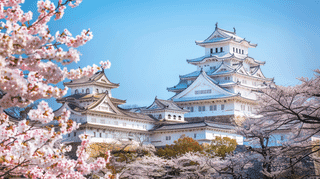
Himeji Castle: A White Keep Complex on Himeyama Hill
Himeji Castle (姫路城, Himeji-jō) is a hilltop castle in Honmachi, Himeji City, Hyogo Prefecture, whose main keep was completed in 1609; eight buildings of its keep complex are designated National Treasures and 74 turrets, gates and walls are designated Important Cultural Properties. Its walls and eaves are sealed in white Shikkui plaster, which earned it the nickname Shirasagi-jō, the White Heron Castle.
The castle crowns Himeyama, a low hill about 45.6 meters above sea level. On the stone base at the summit stand the five-roofed main keep and three smaller keeps, the West, Inui and East Small Keeps, joined into a closed square by four corridor turrets named I, Ro, Ha and Ni after the first letters of the old Japanese syllabary. Japanese castle historians call this arrangement a renritsu-shiki, or linked, Tenshu. Himeji City points to the stacked roofs and the mix of triangular chidori gables and curved kara gables as the features that give Himeji Castle its silhouette.
On 11 December 1993 Himeji Castle and the Buddhist monuments of the Horyuji area became Japan's first UNESCO World Cultural Heritage sites. The listing cited the aesthetic achievement of its timber architecture and the way its early 17th-century keeps, turrets, gates, walls, stone ramparts and moats survive together. The inscribed property covers 107 hectares, matching the protected castle site at the time, with a 143-hectare buffer zone around it.
History of Himeji Castle
According to Himeji City's chronology, the first fort on Himeyama dates to 1333, when Akamatsu Norimura raised troops, and Akamatsu Sadanori is said to have built a proper castle here in 1346. Later the site passed to the Kodera family, a branch of the Akamatsu, and to their retainers, the Kuroda.
In 1580 Kuroda Yoshitaka handed the castle to Hashiba Hideyoshi, the future Toyotomi Hideyoshi, who raised a three-storied keep. After the Battle of Sekigahara, Ikeda Terumasa became lord in 1600 and began rebuilding the castle the following year; the linked keep complex that survives was finished in 1609. Honda Tadamasa, who arrived in 1617, added the Third Bailey and the Nishi-no-maru (West Bailey), and Himeji Castle reached roughly its present extent.
Lords changed often. The Sakai family held the domain from 1749 until the Meiji Restoration, and the city counts 48 lords from 13 families in all. The castle became state property in 1869.
Himeji City describes Himeji Castle as a castle that was never fought over and never burned. No battle reached it and it escaped the air raids of the Second World War, so the turrets, gates and earthen walls survived alongside the keeps. Systematic repair began after heavy rain in 1934 brought down part of the West Bailey's corridor turrets together with their stone base. The Showa Restoration of 1956 to 1964 dismantled and rebuilt the main keep, and the Heisei Restoration, begun in 2009, replastered its roofs and walls before reopening in 2015.
National Treasures and Important Cultural Properties at Himeji Castle
The Agency for Cultural Affairs records the buildings of Himeji Castle under six designations: five National Treasure designations covering eight buildings, and one Important Cultural Property designation, simply titled Himeji Castle, covering 74 buildings.
- Himeji Castle Main Keep: five roofs, six floors and a basement. National Treasure.
- Himeji Castle West Small Keep: three roofs, three floors and two basement levels. National Treasure.
- Himeji Castle Inui Small Keep: three roofs, four floors and a basement, the largest of the three small keeps. National Treasure.
- Himeji Castle East Small Keep: three roofs, three floors and a basement. National Treasure.
- Himeji Castle I, Ro, Ha and Ni Corridor Turrets: the four corridor buildings that close the keep square, with the kitchen block north of the main keep included as an appended structure. National Treasure.
- Himeji Castle (Important Cultural Property): 27 turrets and corridor turrets, 15 gates, 31 earthen walls and 1 tsuiji wall, 74 buildings in total.
The eight keep-complex buildings were first listed on 19 January 1931 and were designated National Treasures under the Law for the Protection of Cultural Properties on 9 June 1951. The other 74 buildings were designated Important Cultural Properties on 14 December 1931. Some of the 74 carry names such as the I Corridor Turret or the Ro Corridor Turret; they are separate buildings from the National Treasure corridor turrets of the keep square. The grounds themselves are protected as the Special Historic Site of Himeji Castle Ruins.
The Spiral Plan of Himeji Castle and How to Walk It
The plan of Himeji Castle is a spiral. The inner moat starts northeast of Himeyama, wraps the baileys counterclockwise and carries on outward as the middle and outer moats. Himeji City notes that only Edo Castle in Tokyo had a comparable layout. The inner enclosure alone covers about 23 hectares; samurai residences and domain offices lay inside the middle moat, and townhouses and temples inside the outer one.
Visitors enter through the ticket gate on the north side of the Sannomaru Square. Beyond the Hishi Gate the path divides. One branch leads into the West Bailey, with the long corridor known as the Hyakken Roka and the Keshō Yagura associated with Princess Sen; the other climbs through the I, Ro, Ha and Ni gates toward the keeps. The closer you get to the keeps, the tighter the turns, the smaller the gates and the narrower the passages. Walking it is the clearest way to understand how Himeji Castle was meant to be defended.
The castle office suggests about an hour for the keep complex alone and 1.5 to 2 hours for the whole paid area including the West Bailey. It takes about 15 minutes on foot from the ticket gate to the entrance of the main keep. Slopes and steps are continuous, and stairs inside the buildings are steep and narrow even with handrails. What to look for at each building, and whether its interior is open, is covered on the page for that building.
Visiting Himeji Castle: Hours, Admission and Access
Himeji Castle opens at 9:00 a.m. and closes at 5:00 p.m., with last admission at 4:00 p.m. To climb the main keep you need to reach its entrance by 4:10 p.m.; the windows of the main keep and the West Bailey corridor are closed in turn from 4:30 p.m. The castle is closed on 29 and 30 December and may close without notice in severe weather.
Admission changed on 1 March 2026. Visitors aged 18 and over pay 2,500 yen, while residents of Himeji City pay 1,000 yen on showing an ID with their address, such as a My Number card or a driver's license. Admission is free for everyone under 18. A combined ticket with the neighboring Kōkoen Garden costs 2,600 yen, and an annual pass allowing unlimited visits for a year costs 5,000 yen. Holders of a disability certificate and one companion enter free.
At busy times, a date-and-time digital ticket bought in advance speeds you through the gate. Entry to the main keep, though, is capped at 1,000 people an hour to protect the building, so a digital ticket does not guarantee you will skip the line at the keep entrance.
Himeji Castle is about a 20-minute walk from JR Himeji Station and Sanyo Himeji Station. From the north exit of Himeji Station, Shinki buses run to the Ōtemon-mae stop, about 5 minutes on foot from the ticket gate. Drivers can use the Ōtemon parking lot, the closest, about 10 minutes' walk from the gate.
Tripods, monopods and selfie sticks are not allowed inside the buildings, and re-entry is not permitted. Since 1 March 2026 pets are not allowed in the paid area, although guide dogs and hearing dogs are welcome. Shoes come off inside the main keep and the West Bailey corridor; a shoulder bag for carrying them is handed out at entry. The castle is lit up every night from sunset until about midnight.
From early July 2026 until about late July 2027, conservation work is under way on buildings around the main keep, including the Ni Turret and the first and second Mizu Gates. Scaffolding affects views of the main keep and the night illumination, and parts of the visitor route are narrower than usual.
References
- Agency for Cultural Affairs, Database of National Cultural Properties: Himeji Castle Main Keep
- https://kunishitei.bunka.go.jp/bsys/maindetails/102/2264
- Agency for Cultural Affairs, Database of National Cultural Properties: Himeji Castle West Small Keep
- https://kunishitei.bunka.go.jp/bsys/maindetails/102/2265
- Agency for Cultural Affairs, Database of National Cultural Properties: Himeji Castle Inui Small Keep
- https://kunishitei.bunka.go.jp/bsys/maindetails/102/2266
- Agency for Cultural Affairs, Database of National Cultural Properties: Himeji Castle East Small Keep
- https://kunishitei.bunka.go.jp/bsys/maindetails/102/2267
- Agency for Cultural Affairs, Database of National Cultural Properties: Himeji Castle (Important Cultural Property)
- https://kunishitei.bunka.go.jp/bsys/maindetails/102/2298
- Himeji City: World Heritage Himeji Castle (Japanese)
- https://www.city.himeji.lg.jp/kanko/0000001645.html
- Himeji City: I, Ro, Ha and Ni Corridor Turrets with the Kitchen (Japanese)
- https://www.city.himeji.lg.jp/kanko/0000001656.html
- Himeji City: Himeji Castle, Important Cultural Property (Japanese)
- https://www.city.himeji.lg.jp/kanko/0000001875.html
- Himeji City: Himeji Castle Ruins, Special Historic Site (Japanese)
- https://www.city.himeji.lg.jp/kanko/0000001665.html
- Himeji Castle Official Site: History of Himeji Castle (Japanese)
- https://www.city.himeji.lg.jp/castle/0000007750.html
- Himeji Castle Official Site: Photographs of the Showa Restoration (Japanese)
- https://www.city.himeji.lg.jp/castle/category/10-2-2-0-0-0-0-0-0-0.html
- Himeji Castle Official Site: Scale of Himeji Castle (Japanese)
- https://www.city.himeji.lg.jp/castle/0000007746.html
- Himeji Castle Official Site: Visitor Route (Japanese)
- https://www.city.himeji.lg.jp/castle/0000007738.html
- Himeji Castle Official Site: Visitor Information (Japanese)
- https://www.city.himeji.lg.jp/castle/0000007671.html
- Himeji Castle Official Site: Admission from 1 March 2026 (Japanese)
- https://www.city.himeji.lg.jp/castle/0000030746.html
- Himeji Castle Official Site: Conservation Work (Japanese)
- https://www.city.himeji.lg.jp/castle/0000033820.html
- Himeji Castle Handbook: Frequently Asked Questions (Japanese)
- https://www.himejicastle.jp/faq.html
Last verified: 2026.10.21
Basic Information
| Name | Himeji Castle |
|---|---|
| Location | Honmachi, Himeji City, Hyogo Prefecture |
| Owner | Government of Japan (Ministry of Education, Culture, Sports, Science and Technology) |
| Designation | National Treasure (5) · Important Cultural Property (1) |
| Coordinates | 34.83945, 134.69390 |