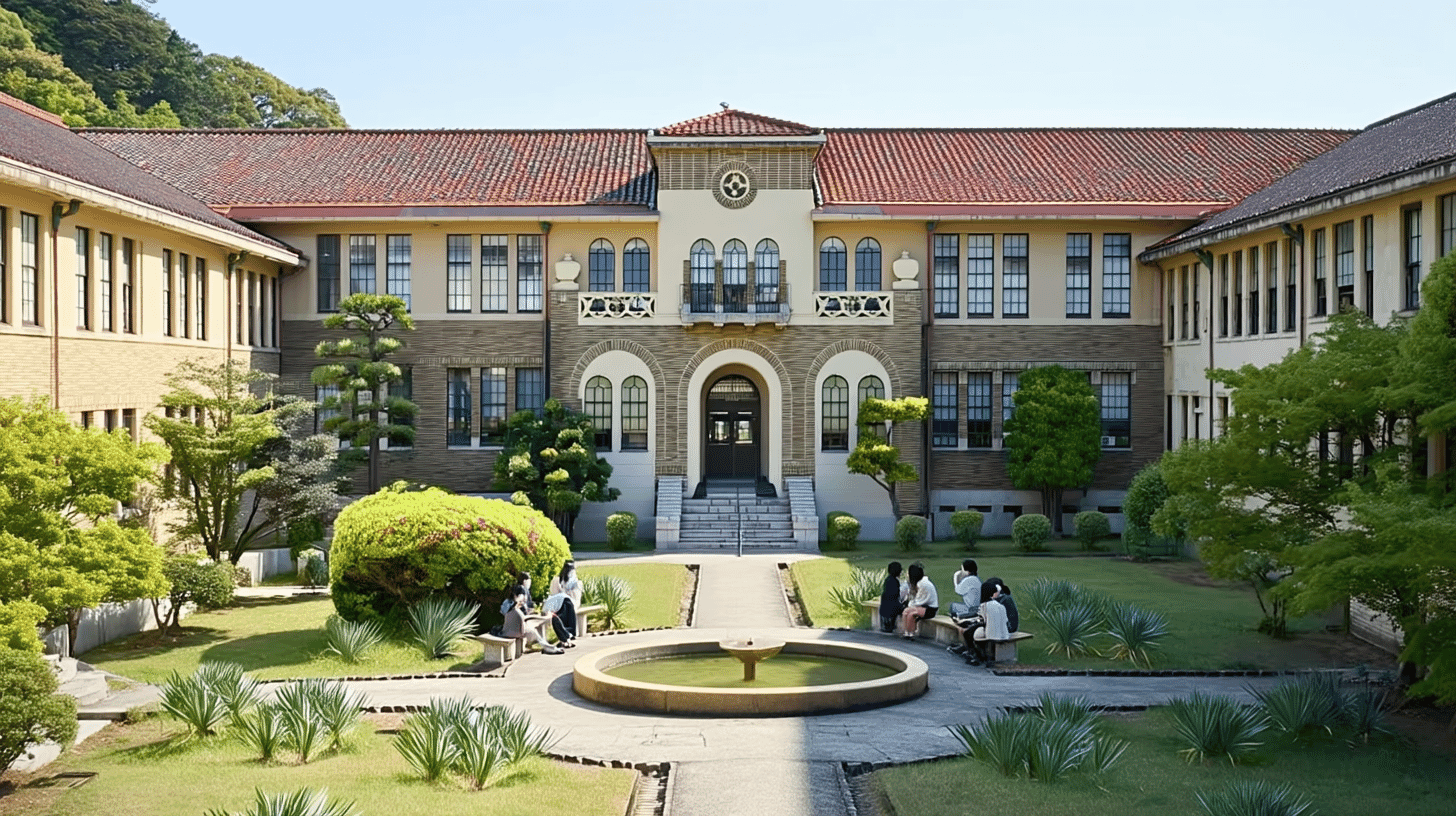
Kobe College: Japan's Only Complete Vories Campus Designated as Important Cultural Property

Discover Kobe College's stunning Okadayama Campus, featuring 12 Spanish Mission-style buildings designed by William Merrell Vories in 1933. This rare architectural masterpiece—the only complete Vories campus designated as Japan's Important Cultural Property—survived WWII and the Great Hanshin Earthquake. Learn about visiting opportunities, architectural highlights, and nearby attractions.

Kobe College: Where Beauty Becomes Education

Nestled atop Okadayama Hill in Nishinomiya City, Hyogo Prefecture, stands one of Japan's most extraordinary architectural treasures—Kobe College. In 2014, twelve buildings on this campus received the rare distinction of being designated as Important Cultural Properties of Japan, making it the only educational institution in the country where nearly the entire original campus holds this prestigious status.

What makes this campus truly remarkable is not merely its designation, but the philosophy behind its creation. American architect William Merrell Vories, who designed these buildings in 1933, believed that "buildings themselves exert a positive influence on students." Every archway, every window, every carefully placed tile was crafted with the intention of nurturing beautiful hearts and minds.

The Architect: William Merrell Vories and His Masterpiece

William Merrell Vories (1880-1964) came to Japan in 1905 as an English teacher, but his legacy would be defined by architecture. Despite having limited formal architectural training, Vories went on to design over 1,500 buildings across Japan, including churches, schools, hospitals, and commercial buildings such as the famous Daimaru Department Store in Osaka.

Among all his works, Kobe College holds special significance. Vories's wife, Makiko Hitotsuyanagi, was an alumna of the college's music department. This personal connection inspired Vories to pour extraordinary care into the campus design. Architectural historian Masaaki Yamagata, who serves on Kobe College's Cultural Property Preservation Committee, has stated that among all Vories buildings, "in terms of beauty, this is the finest."

The campus was completed in 1933 when the college relocated from its original location on Yamamoto Street in Kobe. Vories was given complete creative freedom to design not only the individual buildings but the entire campus layout, harmonizing architecture with the natural hillside landscape. The dedication ceremony in 1934 featured a hymn composed by Vories himself, while the college president Charlotte DeForest celebrated the achievement with a poem titled "Beauty Becomes a College."

Why Kobe College Became an Important Cultural Property

The designation of Important Cultural Property recognizes objects or structures of high historical or artistic value under Japan's Cultural Properties Protection Law. What sets Kobe College apart is the comprehensive nature of its designation—not just individual buildings, but virtually the entire original Vories campus was recognized as a unified cultural treasure.

The official recognition cites several key factors. First, the buildings demonstrate outstanding design quality, achieving both aesthetic harmony and practical functionality. The Spanish Mission style unifies the campus through consistent use of scratch tiles and S-shaped roof tiles, while each building maintains its own distinctive character through unique spatial compositions and detailed ornamentation.

Second, the campus represents an exemplary model of early Showa period educational architecture. The rational campus planning respects the natural topography and surrounding greenery, creating a harmonious environment that embodies the ideals of women's higher education.

Third, and perhaps most remarkably, these buildings have survived both World War II and the devastating 1995 Great Hanshin-Awaji Earthquake while maintaining their original form. This resilience stands as testament to the quality of their construction and the dedication of those who have preserved them.

The Twelve Designated Buildings

Each of the twelve Important Cultural Property buildings serves a distinct purpose while contributing to the unified campus aesthetic. Understanding these individual structures reveals the depth of Vories's vision.

Music Hall (Ongakukan)

Positioned strategically along the hillside approach to campus, the Music Hall demonstrates Vories's attention to acoustic design. The rear slope serves as a natural sound barrier, preventing instrument sounds from disturbing other campus activities. The building's exterior features distinctive scratch tiles, and a charming statue of a "boy playing flute" adorns its roof—a playful touch typical of Vories's humanistic approach.

Library (Toshokan)

The four-story library building showcases Vories's understanding of practical needs. All major windows face north, protecting books from direct sunlight while ensuring ample natural illumination throughout the day. The interior features stunning stenciled ceiling patterns and an elegant stone staircase that speaks to the architect's belief in creating inspiring learning environments. A scale model of the entire campus greets visitors in the entrance hall.

Administration Hall, Auditorium, and Chapel (Soumukan, Kodo, and Searle Chapel)

These interconnected structures form the heart of campus life. The Moses Smith Memorial Auditorium seats over 800 and features a dramatic proscenium arch framing the stage, flanked by circular arabesque-patterned windows. Adjacent to it, the Searle Chapel honors the college's fourth president. This intimate worship space follows a basilica design with a side aisle, wooden roof trusses, and walls finished to resemble travertine stone. A carved clover motif on the balcony railing—matching the school emblem—connects to the chapel's origins at Japan's oldest congregational church in Kobe.

Literature Hall (Bungakukan)

This building includes an innovative stepped lecture hall with a stage, designed for engaging educational presentations. Corridors and staircases throughout feature Vories's characteristic half-round arched windows that cast beautiful light patterns.

Science Hall (Rigakukan)

Serving the natural sciences, this building maintains the campus aesthetic while accommodating laboratory requirements. The Western-facing structure helps balance temperature for sensitive scientific work.

Hoko Hall (Hokokan)

Named after a building from the college's original Yamamoto Street campus, Hoko Hall serves the junior and senior high school division. The name itself carries forward the institution's historical memory.

Social Hall (Shakokan)

This building facilitates community gatherings and social activities, embodying Vories's belief that education extends beyond the classroom.

Gymnasium (Taiikukan)

The gymnasium includes a second-floor observation gallery and benefits from the campus-wide central heating system, ensuring comfortable conditions even in winter.

Boiler Room (Kikanshitsu)

This utilitarian structure housed the steam boilers for the campus's central heating system—an advanced feature for its time. Now used for storage, it represents the practical infrastructure that supported campus life.

Kenwood Hall and Edgewood Hall

These two buildings originally served as residences for foreign missionary teachers. Of three such residences originally built, one (Greenwood Hall) was lost to the 1995 earthquake. Kenwood Hall now functions as a guesthouse, while both buildings display a somewhat simpler design compared to the academic structures—befitting their residential purpose. A charming tea house stands near Kenwood Hall.

Main Gate and Gatehouse (Seimon and Moneisha)

The journey into this architectural wonderland begins at the main gate, where visitors are welcomed by the gatehouse attendant before ascending the scenic approach to the hilltop campus. The gate is currently undergoing restoration work, scheduled for completion in September 2025.

Architectural Features and Design Philosophy

The Spanish Mission style chosen for Kobe College reflects both aesthetic and philosophical considerations. This architectural tradition, with its roots in the Mediterranean and Spanish colonial Americas, emphasizes harmony with nature, indoor-outdoor connectivity, and a sense of spiritual serenity—values perfectly aligned with the college's Christian educational mission.

Throughout the campus, visitors encounter distinctive design elements. The exterior walls feature "scratch tiles"—decorative tiles with linear patterns—many believed to be Taizan tiles, prized Japanese ceramic tiles known for their unique kiln variations and fabric-like textures. The roofs are covered with S-shaped tiles in a bronze-red color that has weathered beautifully over nine decades.

Vories incorporated what he called "play spaces" throughout the campus—unexpected delights like the flute-playing boy statue, decorative window treatments, and carefully framed views. The central courtyard, enclosed by four main buildings connected by covered walkways, creates an intimate world apart—a green sanctuary where students can escape the outside world and focus on their studies.

The attention to material is equally impressive. Rather than typical Japanese school flooring, Vories specified cut marble—chosen not for luxury but for its superior heat absorption, keeping buildings cooler in summer. The original radiator heating system remains functional in many buildings, a testament to both engineering quality and careful maintenance.

Survival and Preservation

The campus's survival through two major catastrophes adds another layer to its significance. During World War II, the buildings escaped destruction that befell many Japanese cities. Then, in 1995, the Great Hanshin-Awaji Earthquake struck with devastating force. While the wooden roof trusses of the Literature Hall collapsed and required replacement with steel, the reinforced concrete structures largely held firm.

Ongoing preservation efforts maintain the buildings' original character. When roof tiles required replacement after the earthquake, the distinctive color and shape proved challenging to reproduce. Exterior restoration carefully maintains the original scratch tiles, Lisoid walls, and S-shaped tiles. Interior renovations, such as seismic reinforcement of corridor walls in the Literature and Science Halls, have been executed from the classroom side to preserve original hallway appearances.

The college community plays an active role in preservation. Students are encouraged to wear indoor shoes, umbrella stands and umbrella bags protect floors from water damage, and a culture of respect for this architectural heritage pervades daily campus life.

Visiting Kobe College

As an active educational institution, Kobe College is not ordinarily open to the public. However, several opportunities exist for architecture enthusiasts and cultural tourists to experience this remarkable campus.

The college organizes official "Vories Architecture Public Tours" several times per year. These guided tours, led by student "Tour Meisters," provide access to the Library, Literature Hall, Auditorium, Chapel, and central courtyard. Advance registration is required and spots fill quickly—interested visitors should monitor the college website and register promptly when applications open.

The annual Okadayama Festival (university festival) in late October allows free entry without reservation, offering opportunities to view building exteriors and enter some structures being used for festival activities. The Aikō Bazaar, typically held on the last Saturday of May, similarly opens the campus to outside visitors for a modest entry fee.

Photography policies vary by event—tours generally permit photography while other events may restrict it. Visitors should always confirm current guidelines before attending.

Surrounding Attractions

A visit to Kobe College can be combined with other cultural experiences in the area. Just a ten-minute walk from Mondoyakujin Station lies Toko-ji Temple, popularly known as Mondoyakujin. This Shingon Buddhist temple, founded in 829, is famous throughout the Kansai region for its "Yakujin Myoo" deity said to ward off all forms of misfortune. The annual Yakuyoke Taisai festival on January 18-19 draws tens of thousands of visitors.

Nishinomiya itself offers numerous attractions. The city is famous for Nishinomiya Shrine (Nishinomiya Ebisu), considered the head shrine of all Ebisu shrines in Japan, and hosts the famous "Lucky Man Race" each January. The Hanshin area is also renowned for its sake breweries, with several offering tours and tastings.

Architecture enthusiasts may wish to explore other Vories buildings in the region. Nearby Kwansei Gakuin University, also in Nishinomiya, features a campus designed by Vories in a similar Spanish Mission style, allowing for interesting comparisons.

A Living Legacy

What distinguishes Kobe College from museum pieces is its continued use as an active educational institution. For over ninety years, students have walked these corridors, attended classes in these halls, and worshipped in this chapel. The buildings are not preserved in amber but live and breathe with each new generation.

Vories believed that beautiful architecture could shape beautiful souls. The countless alumnae who speak with deep affection about their time on this campus—among them prominent figures like broadcaster Yumiko Udo—suggest his philosophy continues to bear fruit. The designation as Important Cultural Property ensures this legacy will endure, protecting not just buildings but an educational philosophy made manifest in brick, tile, and stone.

For visitors fortunate enough to experience this campus, Kobe College offers something increasingly rare in our modern world: a place where aesthetic beauty, spiritual purpose, and educational mission unite in perfect harmony. As Dean DeForest wrote nearly a century ago, here truly "Beauty Becomes a College."

📍 Plan Your Visit to Hyogo
Find tours, activities & transport passes near Kobe College
[ Himeji Castle & Kobe Night View Cruise ]

Q&A

QCan I visit Kobe College as a tourist?
AAs an active school, regular visits are restricted. However, the college offers official "Vories Architecture Public Tours" several times yearly (advance registration required), and the campus opens during the Okadayama Festival (late October, free entry) and Aikō Bazaar (late May, ¥300 entry). Check the official website for current schedules and registration information.
QWhat makes Kobe College's Important Cultural Property designation unique?
AKobe College is the only educational institution in Japan where twelve buildings—nearly the entire original campus—have been designated as Important Cultural Properties as a unified group. While individual Vories buildings elsewhere are registered as tangible cultural properties, only Kobe College holds the higher Important Cultural Property designation for an entire campus.
QHow do I get to Kobe College?
ATake the Hankyu Imazu Line to Mondoyakujin Station, then walk 7-10 minutes to the main gate. From Osaka-Umeda, take the Hankyu Kobe Line to Nishinomiya-Kitaguchi Station (about 12 minutes), then transfer to the Imazu Line (1 stop, about 2 minutes). Note that the path from the main gate to the campus involves a steep uphill walk with stairs.
QIs photography allowed on campus?
APhotography policies vary depending on the event. Official tours generally permit photography, while other events like the university festival may prohibit it. Always confirm current guidelines when registering for visits or arriving at events.
QWhat other Vories buildings can I see in the area?
ANearby Kwansei Gakuin University features another Vories-designed campus in Spanish Mission style. In Osaka, the Daimaru Shinsaibashi store is another famous Vories work. For those willing to travel further, the Vories Memorial Museum in Omihachiman, Shiga Prefecture, offers comprehensive information about the architect's life and works.

Basic Information

Official Name Important Cultural Property: Kobe College (重要文化財 神戸女学院)
Designation Date September 18, 2014
Architect William Merrell Vories (Vories Architectural Office)
Construction Company Takenaka Corporation
Completion 1933 (Showa 8)
Architectural Style Spanish Mission
Structure Reinforced concrete with seismic walls
Number of Designated Buildings 12 buildings (plus ancillary structures)
Location 4-1 Okadayama, Nishinomiya City, Hyogo Prefecture 662-8505
Access 7-10 minute walk from Hankyu Mondoyakujin Station
Public Access Limited to designated events (advance registration usually required)
Contact Kobe College General Affairs: 0798-51-8505
Official Website https://www.kobe-c.ac.jp/foundation/nicp/

References

Important Cultural Property Kobe College - Kobe College Foundation
https://www.kobe-c.ac.jp/foundation/nicp/
Kobe College Vories Architecture Public Tours - Kobe College University
https://www.kobe-c.ac.jp/event/vories/
Kobe College - Cultural Heritage Online (Agency for Cultural Affairs)
https://bunka.nii.ac.jp/heritages/detail/209077
Kobe College - Wikipedia
https://en.wikipedia.org/wiki/Kobe_College
Merrell Vories Hitotsuyanagi - Wikipedia
https://en.wikipedia.org/wiki/Merrell_Vories_Hitotsuyanagi
William Merrell Vories - Visit Omi
https://visit-omi.com/people/article/william-merrell-vories
BELCA Award - Kobe College School Buildings
https://www.belca.or.jp/l74.htm
Mondoyakujin Toko-ji Temple - Hyogo Tourism Official Site
https://www.hyogo-tourism.jp/spot/0212

Last verified: 2026.01.13

Nearby heritages