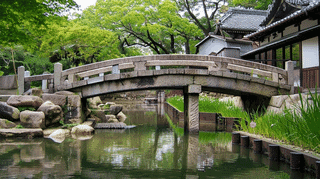
Zuihō Bridge at Nishinomiya Shrine: A Meiji-Era Registered Cultural Property Stone Drum Bridge at Japan's Head Ebisu Shrine

Zuihō Bridge is a graceful granite drum bridge spanning the sacred pond of Nishinomiya Shrine, Japan's foremost Ebisu shrine, in Hyogo Prefecture. Donated in 1907 by the founder of Hakutaka Sake Brewery and enhanced with bronze balustrades in 1922, this Registered Tangible Cultural Property embodies the deep connection between Nishinomiya's renowned Nada sake-brewing heritage and its most sacred place of worship.

Zuihō Bridge: A Stone Drum Bridge at Japan's Foremost Ebisu Shrine

Nestled within the sacred grounds of Nishinomiya Shrine in Hyogo Prefecture, the Zuihō Bridge (瑞寶橋) is a graceful arched stone bridge that spans the shrine's tranquil sacred pond. Registered as a National Tangible Cultural Property in 2013, this Meiji-era bridge embodies the deep ties between Nishinomiya's thriving sake-brewing industry and its most revered place of worship — the head shrine of over 3,500 Ebisu shrines across Japan.

The bridge was donated in 1907 by Tatsuma Essō, the founder of Hakutaka Sake Brewery, one of the Nada Gogō region's most prestigious sake producers. Later enhanced with bronze balustrades by his successor in 1922, Zuihō Bridge stands today as an elegant testament to the generosity of the local sake merchants who helped shape both the spiritual and cultural landscape of Nishinomiya.

History and Construction of the Bridge

The Zuihō Bridge was originally constructed and donated to Nishinomiya Shrine in 1907 (Meiji 40) by Tatsuma Essō, the retired first-generation head of the Hakutaka sake-brewing family. Born as Tatsuma Etsuzō, he had founded Hakutaka Brewery in 1862 after branching out from the prestigious Tatsuma main house (known for its Hakushika brand). After retiring from active management in 1897, he took the name Essō and devoted himself to civic and religious philanthropy.

The bridge was built using granite quarried from the nearby Rokkō Mountains — the same celebrated Mikage stone that has been prized in Japanese architecture for centuries. However, certain aspects of the original construction did not fully satisfy Essō's vision. His successor, the second-generation Tatsuma Etsuzō, honored the founder's wishes by commissioning a major renovation in 1922 (Taishō 11), during which the distinctive bronze balustrades were added and the bridge was refined into the elegant arched form seen today.

The bridge also survived the devastating 1995 Great Hanshin-Awaji Earthquake and underwent significant restoration work in 2010 — the first major repair since 1743 (Kanpō 3) — ensuring its continued preservation for future generations.

Why Zuihō Bridge Is a Registered Tangible Cultural Property

Zuihō Bridge was officially registered as a National Tangible Cultural Property (Registered Tangible Cultural Property – Building) on March 29, 2013. This designation recognizes the bridge's architectural and historical significance as a fine example of Meiji-era stone craftsmanship and its role within the broader cultural landscape of Nishinomiya Shrine.

The bridge is classified as a stone girder bridge with a total length of 5.5 meters and a width of 2.5 meters. Its construction demonstrates exceptional stonework: the arc-shaped girder stones are divided into seventeen equal sections with precisely fitted paving stones laid on top. The addition of bronze railings — a relatively unusual feature for a stone drum bridge of this period — elevates the structure beyond a simple functional crossing into a work of refined artistry.

Positioned directly in front of the worship hall across the sacred pond, the bridge occupies a ceremonial position within the shrine precinct. It was designed specifically as a ritual drum bridge (taiko-bashi), a type of arched bridge traditionally found at important Shinto shrines and Buddhist temples throughout Japan, symbolizing the passage from the everyday world to the sacred realm.

Highlights and What to See

The Elegant Arched Form

The bridge's strongly curved silhouette is one of its most striking features. The steep arc of a taiko-bashi is designed to be admired rather than casually crossed — in fact, visitors are not permitted to walk over the Zuihō Bridge. Instead, it can be appreciated from the surrounding pathways, where its graceful curve is reflected beautifully in the still waters of the sacred pond below.

Granite and Bronze Craftsmanship

The use of Rokkō Mountain granite (Mikage stone) gives the bridge a warm, natural appearance that harmonizes with the shrine's lush garden setting. The bronze balustrades added in 1922 have developed a rich patina over the past century, lending the bridge an air of dignified antiquity. The parent pillars (oyabashira) of the balustrade bear inscriptions noting the original construction date of November 1907.

The Sacred Pond (Shinchi)

The bridge spans Nishinomiya Shrine's sacred pond, which dates back to the Muromachi period (14th–15th century). The pond features three islands arranged in a sanzan-suisui (three-mountain, connected-water) configuration associated with the Hōrai landscape tradition of East Asian garden design. Visitors can enjoy the sight of ducks, koi, and turtles in the pond, surrounded by seasonal flowers including Japanese iris, spirea, and water plants that change with the seasons.

Seasonal Beauty

The bridge and pond area are particularly beautiful in spring, when cherry blossoms frame the stone arch, and in autumn, when the surrounding trees display vibrant foliage. The seasonal flora around the pond — including Japanese water iris in early summer — provides constantly changing backdrops for this historic structure.

Nishinomiya Shrine: The Head Shrine of Ebisu Worship

Nishinomiya Shrine is the foremost of approximately 3,500 Ebisu shrines throughout Japan. Ebisu, one of the Seven Gods of Fortune, is widely worshipped as a deity of fishing, sea safety, and commercial prosperity. The shrine's origins trace back to the Heian period, when, according to legend, a fisherman from nearby Naruo pulled a sacred image from Osaka Bay and enshrined it at this location following a divine revelation.

The shrine compound houses several structures of cultural importance, including the Omote Daimon gate and the Ōneribei wall, both designated as Important Cultural Properties. The annual Tōka Ebisu festival held each January 9–11 draws over one million visitors. The event's famous Fukuotoko-erabi (Lucky Man Race), in which participants dash 230 meters from the main gate to the worship hall at 6 AM on January 10, is broadcast nationwide and has become one of Japan's most recognizable New Year traditions.

The Sake Heritage Connection

The story of Zuihō Bridge is inseparable from the history of sake brewing in Nishinomiya. The city lies within the Nada Gogō, Japan's most famous sake-producing district, and the donor of the bridge — the Tatsuma family — played a pivotal role in shaping this tradition.

Tatsuma Etsuzō (later Essō) founded Hakutaka Brewery in 1862, breaking away from the main Tatsuma house to pursue his own vision of uncompromising quality. His support for rice cultivation improvements in the Yoshikawa area of Hyogo Prefecture contributed to the development of Yamada Nishiki, now considered the finest sake-brewing rice in Japan. Hakutaka remains the sole provider of sacred sake (goryōshu) to Ise Grand Shrine, an honor held continuously since 1924.

Visitors interested in the sake connection can explore the Hakutaka Rokusui-en complex, located a short walk from Nishinomiya Shrine, which includes a sake museum, tasting bar, and cultural event space operated by the Tatsuma family.

Surrounding Attractions

A visit to Zuihō Bridge and Nishinomiya Shrine can easily be combined with exploring the wider cultural attractions of the area:

  • Rokueido Hall — A relocated section of statesman Iwakura Tomomi's former residence, located within the shrine grounds. This building once hosted meetings of six key figures of the Meiji Restoration.
  • Kaei Bridge — Another Registered Tangible Cultural Property stone bridge within the shrine's garden, donated by the Hachima family during the late Edo period.
  • Ebisu Shinkō Shiryō-shitsu (Ebisu Faith Exhibition Room) — Located inside the shrine's administrative office, this room displays artifacts and dioramas related to the history of Ebisu worship across Japan.
  • Hakutaka Rokusui-en — A sake-themed cultural complex featuring the Hakutaka Shūko-kan museum, a sake bar, and event spaces, approximately 10 minutes on foot from the shrine.
  • Nada Gogō Sake Brewery District — The surrounding area is home to several historic sake breweries offering tours and tastings, making for an excellent half-day cultural excursion.
📍 Plan Your Visit to Hyogo
Find tours, activities & transport passes near Nishinomiya Shrine Zuiho Bridge
[ Himeji Castle & Kobe Night View Cruise ]

Q&A

QCan visitors walk across Zuihō Bridge?
ANo, the bridge is not open for crossing. As a ceremonial drum bridge (taiko-bashi) and Registered Tangible Cultural Property, it is preserved for viewing only. Visitors can admire it from the paths surrounding the sacred pond, where its elegant arch is beautifully reflected in the water.
QIs there an admission fee to see Zuihō Bridge at Nishinomiya Shrine?
ANo. Nishinomiya Shrine is free to enter, and the bridge and sacred pond can be viewed at any time during the shrine's opening hours. The shrine is generally open from 5:00 AM to 6:00 PM (hours vary slightly by season).
QWhat is the best time of year to visit?
AThe bridge and pond area are especially scenic during cherry blossom season (late March to early April) and autumn foliage season (mid-November to early December). The annual Tōka Ebisu festival in January (9th–11th) is also a highlight, though the shrine grounds become extremely crowded during this period. For a peaceful visit, spring and autumn weekday mornings are ideal.
QHow do I get to Nishinomiya Shrine from Osaka or Kobe?
AThe shrine is a 5-minute walk from Nishinomiya Station on the Hanshin Main Line. From central Osaka (Umeda), the journey takes approximately 15 minutes by Hanshin Railway. From Kobe (Sannomiya), it takes about 15 minutes as well. JR Sakura-Shukugawa Station is also within a 10-minute walk.
QIs English-language information available at the shrine?
ASignage within the shrine is primarily in Japanese, but the shrine's official website provides some information in English. The surrounding Nishinomiya city area, being located between Osaka and Kobe, is generally tourist-friendly with English signage at railway stations and nearby attractions.

Basic Information

Name Nishinomiya Jinja Zuihō-bashi (西宮神社瑞寶橋)
Type Stone arch drum bridge (taiko-bashi)
Cultural Property Designation Registered Tangible Cultural Property (Building), registered March 29, 2013
Construction 1907 (Meiji 40); renovated with bronze balustrades in 1922 (Taishō 11)
Material Rokkō Mountain granite (Mikage stone) with bronze railings
Dimensions Bridge length: 5.5 m; Width: 2.5 m
Donor First generation: Tatsuma Essō (Hakutaka Brewery); Renovation: Second generation Tatsuma Etsuzō
Location Nishinomiya Shrine, 1-17 Shake-chō, Nishinomiya, Hyogo Prefecture
Owner Religious Corporation Nishinomiya Shrine
Access 5-minute walk from Hanshin Nishinomiya Station; 10-minute walk from JR Sakura-Shukugawa Station
Admission Free (shrine grounds)
Hours 5:00 AM – 6:00 PM (varies by season; extended hours during Tōka Ebisu)

References

西宮神社瑞寶橋 — 文化遺産オンライン
https://bunka.nii.ac.jp/heritages/detail/230591
西宮神社瑞寶橋 — 日本遺産ポータルサイト
https://japan-heritage.bunka.go.jp/ja/culturalproperties/result/5207/
国指定文化財等データベース — 文化庁
https://kunishitei.bunka.go.jp/heritage/detail/101/00009518
西宮神社について — えびす宮総本社 西宮神社 公式サイト
https://nishinomiya-ebisu.com/about/
会社概要 — 白鷹株式会社
https://hakutaka.jp/company.html
西宮神社 — Wikipedia
https://ja.wikipedia.org/wiki/%E8%A5%BF%E5%AE%AE%E7%A5%9E%E7%A4%BE

Last verified: 2026.03.07

Nearby heritages