
Historic Sites, Places of Scenic Beauty, and Natural Monuments of Ishikawa
石 川 県 の 史 跡 名 勝 天 然 記 念 物Ishikawa · Historic Sites, Places of Scenic Beauty, and Natural Monuments
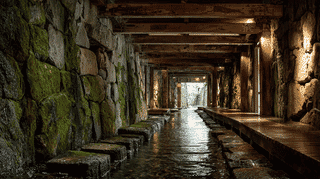
Discover Kanazawa's Tatsumi Yousui Canal, a National Historic Site featuring 17th-century tunnel engineering and gunpowder manufacturing heritage. Explore one of Japan's Three Great Canals and its connection to samurai-era military technology.

On the summit ridges of Mount Bijo in Nakanoto, Ishikawa, the Amenomiya Kofun Group preserves around 36 ancient tombs built between the mid-4th and early 5th centuries. Centered on the largest square-back keyhole mound in Hokuriku and a classic round-back keyhole tomb, the site is believed to hold powerful chieftains who ruled the Noto region. Designated a National Historic Site in 1982.
The Former Matsunami Castle Garden in Noto-cho, Ishikawa, is the ruin of a karesansui dry-landscape garden from the late Muromachi to Sengoku period. Built using flat round pebbles set on edge in a unique kobadate technique, paired with nineteen carefully placed landscape stones, the garden was designated a National Place of Scenic Beauty in 2012. Sealed in place when the castle fell in 1577, it survived almost intact for nearly 450 years.
Kenrokuen Garden in central Kanazawa is one of the Three Great Gardens of Japan, alongside Kairakuen in Mito and Korakuen in Okayama. Originating in 1676 with the Renchi-tei garden built by Maeda Tsunanori, fifth lord of the Kaga Domain, it was shaped over roughly 180 years by successive Maeda lords and substantially completed in 1851. Designated a Special Place of Scenic Beauty in 1985, this approximately 11.7-hectare stroll garden features the iconic Kotoji stone lantern, Kasumigaike Pond, Karasaki Pine, the Hisagoike Pond with its 1774 Yūgao-tei teahouse, and what is considered the oldest fountain in Japan. With cherry blossoms in spring, irises in early summer, brilliant autumn maples, and the geometric beauty of winter snow-protection ropework, Kenrokuen offers an unforgettable encounter with the refined aesthetics of Edo-period daimyo garden design and remains an essential stop on any visit to Kanazawa.
Found in 1978, the Jike Site in Hakui is an 8th- to 9th-century ritual ground buried in dunes, where burnt-earth features and inked pottery reveal ancient worship.
The Cherry Tree of Shogetsu-ji, standing in the grounds of Shogetsu-ji Temple in Kanazawa's Teramachi district, is an approximately 400-year-old veteran cherry designated a National Natural Monument of Japan in 1943. Tradition holds that it was gifted in 1648 by Maeda Toshitsune, the third lord of Kaga Domain, and it is affectionately known as the Ozakura (Great Cherry) or Goten-zakura (Palace Cherry). A variant of Yamazakura called Shogetsu-zakura, its massive trunk pushes through the temple wall onto the public street and has been celebrated in classical Chinese poetry by Muro Kyuso and in modern fiction by Izumi Kyoka. Discover one of Kanazawa's most iconic springtime sights.
Shiroyone Senmaida in Wajima City, Ishikawa Prefecture, is a nationally designated scenic beauty where 1,004 small rice paddies cascade down a steep slope toward the Sea of Japan. A symbol of the GIAHS-recognized 'Noto's Satoyama and Satoumi,' this 400-year-old landscape preserves traditional hand-cultivation methods. Visitors can enjoy spectacular views in every season — spring's mirror-like flooded paddies, summer's vibrant green, autumn's golden harvest, and winter's magical LED illumination event 'Aze no Kirameki.'
Over forty medieval kilns at the tip of the Noto Peninsula fired Suzu ware from the late 12th to the late 15th century, supplying ports along the Japan Sea coast.
Mt. Sekidō in Ishikawa was a major center of mountain worship, holding over 360 lodgings before the 1868 Shinto-Buddhist separation edict ended its long history.
The Tokikuni Family Garden in Wajima, Ishikawa, is an early-Edo hillside garden. Three upright stones, seen from the shoin, form a dry cascade. It is now closed.
On the north side of Natadera's Shoin hall in Komatsu sits a small Edo-period dry garden of stepping stones and moss, designated a Place of Scenic Beauty in 1929.
A National Historic Site on the Noto Peninsula, this hilltop fortress was the Hatakeyama clan's seat for 169 years. Its old stone walls still rise above Nanao Bay.
On five hills in Nomi City, Ishikawa, the Nomi Kofun Group holds 62 burial mounds built across three centuries, including the keyhole tomb of Akitsuneyama No.1.
On Noto's Uchiura coast, the Mawaki Site was a Jomon settlement lived in for some 4,000 years, leaving a chestnut post ring, dolphin bones and 219 designated finds.
The Yoshizaki-Sueba Site in Hakui, Ishikawa, is a large Yayoi village whose layered pottery set Hokuriku's dating standard and yielded Noto's only Yayoi mirror.
More from Ishikawa
Ishikawa’s registered properties across designations, with featured heritage and travel notes.
The complete kokuhō catalogue — browse by prefecture, period, and category.
Nationwide jūyō bunkazai — architecture, sculpture, painting, crafts, and documents.