
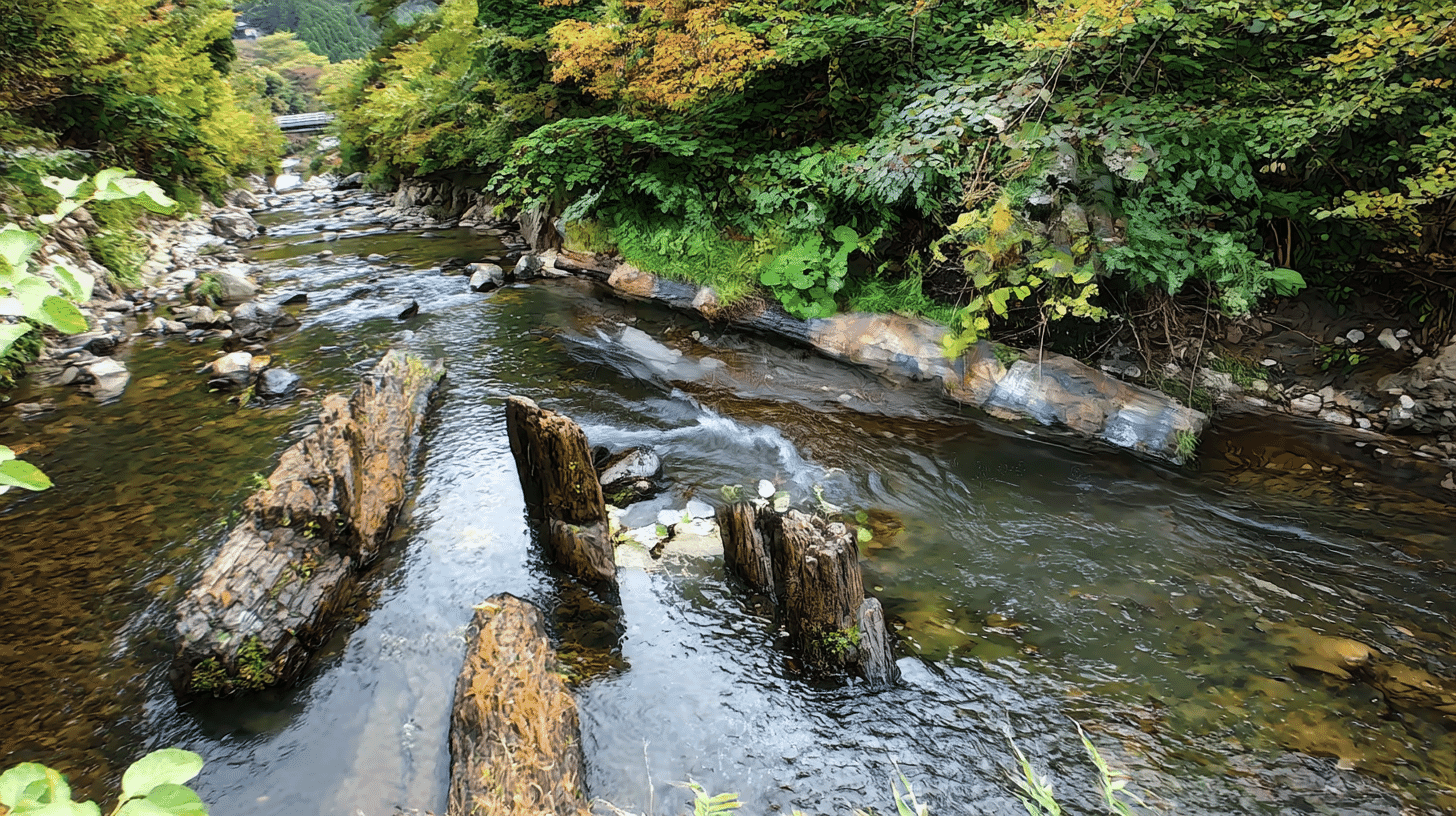
Fossil Wood Exposed in Riverbeds, Natural Monument since 1941
Petrified Wood Area of Anetai, Kozuya and Nezori (姉帯小鳥谷根反の珪化木地帯) lies in Ichinohe Town, Ninohe County, Iwate Prefecture, designated a national Natural Monument on 21 February 1941. Ichinohe Town is the managing body.
Petrified wood forms when silica held in volcanic ash dissolves into groundwater and penetrates timber buried in the ground, turning the wood to stone.
The commentary held by the Agency for Cultural Affairs survives in the language of 1941. It is written in the formal style of the period, in katakana with older character forms, so the record is itself a document of its time.
The Fossil Species Match the Living Forest
The weightiest line in the Agency's commentary concerns the species.
The species are chiefly cedar, oak, chestnut and maple, showing that the stand of that time was roughly the same as the present one.
The forest that turned to stone was made of much the same trees as the forest growing there now. A woodland of about 17 million years ago had a composition no different from today's.
Fossils generally record what has been lost. This petrified wood records what did not change. The reason for designation rests on that, which is what marks this site.
The Agency continues with its assessment: that the petrified wood is well preserved, that its distribution is wide, and that it is present in numbers, are rarely seen together in this country. Preservation, extent and quantity are set out as three points.
The Trunks Lie on Their Sides
How the wood survives is recorded too.
Most of it is exposed in the beds of the Mabechi River and its tributaries, the Hiranuka and the Nezori, and the stumps generally lie on their sides.
Lying on their sides means the trees did not petrify standing. They had fallen before they were buried.
What is exposed is the riverbed. The current cuts into the volcanic ash and the buried wood emerges. The stratum is the Tertiary formation distributed along the upper Mabechi.
Ichinohe Town notes that the riverbeds are what carries the designation, while fossil forest remains buried in the hills around them. What is visible is part of a wider distribution.
The Area Is Defined by Distance Along the Rivers
Ichinohe Town sets out the extent precisely.
From the confluence of the Mabechi and the Hiranuka, 5,000 metres upstream along the main river and 3,000 metres upstream along the Hiranuka; and from the confluence of the Nezori and the Mabechi, 5,500 metres upstream along the Nezori. The riverbeds within those limits are what is designated.
The extent is set by distance along three rivers. Not by area or boundary line but by how far upstream from a confluence, an arrangement that answers to the long, narrow form of a river.
The town also gives a caution: collecting petrified wood within the designated area, in the beds of the Mabechi, the Hiranuka and the Nezori, is prohibited. The wood lies exposed and is easily carried off, but taking it is not permitted.
The Great Petrified Wood of Nezori, in the same town, carries its own designation. The area and one tree within it are treated separately.
Visiting
What is designated is riverbed. There is no facility, so no opening hours and no admission.
How much of the wood shows depends on the water. High water can put it out of reach, so check the weather and the state of the river before setting out.
Collecting is prohibited. The wood can be looked at but not taken away.
The site is in Ichinohe Town, Ninohe County, Iwate Prefecture. Check the town's information for exact locations and current conditions.
- 📍 Plan Your Visit to Iwate
- Find tours, activities & transport passes near Petrified Wood Area of Anetai, Kozuya and Nezori
- [ Visit Hiraizumi & Chusonji Temple World Heritage ]
Q&A
- When was the area designated?
- On 21 February 1941, as a national Natural Monument, with Ichinohe Town as managing body. The town records a further addition to the designated area on 10 March 2015.
- What is petrified wood?
- Ichinohe Town explains that silica held in volcanic ash dissolves into groundwater and penetrates timber buried in the ground, turning the wood to stone. The Agency for Cultural Affairs records the Tertiary formation along the upper Mabechi River as holding it in quantity.
- What is valued about the site?
- The Agency records that the species are chiefly cedar, oak, chestnut and maple, showing that the stand of that time was roughly the same as the present one, and adds that the preservation, the extent of distribution and the quantity are rarely seen together in this country.
- How far does the designated area extend?
- Ichinohe Town gives 5,000 metres upstream along the Mabechi and 3,000 metres along the Hiranuka from their confluence, and 5,500 metres upstream along the Nezori from its confluence with the Mabechi, covering the riverbeds within those limits. The extent is set by distance along three rivers.
- Can petrified wood be taken from the site?
- No. Ichinohe Town states that collecting petrified wood within the designated area, in the beds of the Mabechi, the Hiranuka and the Nezori, is prohibited. It lies exposed in the riverbed, but taking it is not permitted.
Basic Information
| Name | Petrified Wood Area of Anetai, Kozuya and Nezori (姉帯小鳥谷根反の珪化木地帯) |
|---|---|
| Location | Ichinohe Town, Ninohe County, Iwate Prefecture |
| Designation | Natural Monument (monuments); the Great Petrified Wood of Nezori carries its own designation |
| Year Designated | 1941 (21 February), Natural Monument |
| Quantity | The Agency's quantity field is blank |
| Dimensions | The designated area covers the riverbeds within 5,000 metres upstream along the Mabechi and 3,000 metres along the Hiranuka from their confluence, and 5,500 metres upstream along the Nezori from its confluence with the Mabechi (as given by Ichinohe Town) |
| Owner | Managing body: Ichinohe Town |
| Public Access | Riverbed rather than a facility. Collecting petrified wood within the designated area is prohibited |
References
- Cultural Heritage Online: the petrified wood area of Anetai, Kozuya and Nezori
- https://bunka.nii.ac.jp/heritages/detail/162011
- Ichinohe Town: the petrified wood area of Anetai, Kozuya and Nezori
- https://www.town.ichinohe.iwate.jp/soshikikarasagasu/sekaiisanka/bunkazaikakari/1/01/958.html
- Ichinohe tourism association: petrified wood
- https://www.ichinohekankou.jp/sightseeing/history-2/keikaboku-2/
- Agency for Cultural Affairs, National Cultural Properties Database
- https://kunishitei.bunka.go.jp/
Last verified: 2026.09.04