
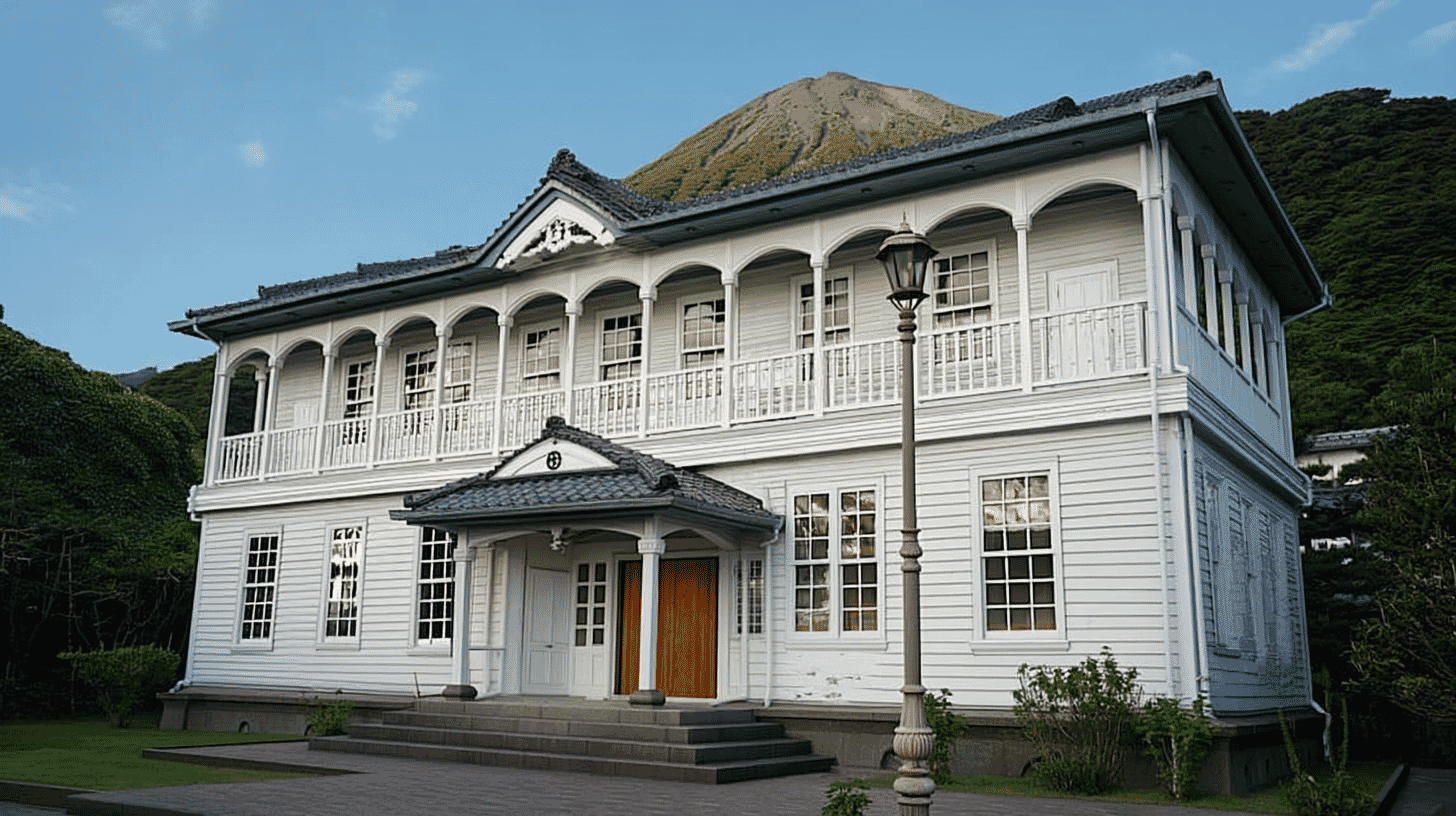
One Office Building, a Registered Tangible Cultural Property since 1999
Former Shimazu Serigano Gold Mine Mining Office (旧島津家芹ヶ野金山鉱業事業所) stands at 9688-1 Yoshinocho, Kagoshima City, Kagoshima Prefecture, a Meiji-period office building entered on the register of tangible cultural properties on 23 August 1999. It is a registered property rather than a designated one.
The quantity is one building. The owner is the company Shimazu Limited.
The structure is timber, two-storeyed, tiled, with a floor area of 158 square metres. The date field reads Meiji and the year field 1904, with removals in 1923 and 1986.
A Building Moved Twice
It has twice been taken from where it stood.
The Agency records it as the Shimazu family's gold mine office, formerly in a village to the west. The date field gives building in 1904 and removals in 1923 and 1986.
Built in that village, it was moved once in 1923 and again in 1986 to its present site.
The former Kadowaki main house came from a mountain hamlet to a town, and the annex at the Tani Yutaka residence from a neighbouring town. Each was moved once.
The Obaraya shop storehouse was drawn back on rollers within its own plot, without being taken apart.
This one was carried across villages twice. Its date field holds two removals.
A Veranda of Continuous Arches on the Upper Front
The front of the building is set out in Western manner.
The Agency records clapboarded outer walls and a veranda of continuous arches across the upper front.
Clapboarding lays boards horizontally, each overlapping the one below. A veranda is a roofed walk projecting outside the building; here arches run along it.
The Ota power station throws out an octagonal tower at its southern corner: that one is of stone, and shows its height in a tower.
This one is of timber, and shows a row of arches across its upper front.
The Yoshino forestry office, moved to the same grounds, also carries a veranda of distinctive design.
A Western Exterior Under Japanese Roofs
The front and the roofs belong to different traditions.
The Agency records a two-storeyed main block under a hipped roof, with an entrance under a half hip-and-gable roof and a projection under a convex roof.
A hipped roof slopes on all four sides; a half hip-and-gable roof is hipped and gabled on one side only; a convex roof swells gently outward. All are Japanese forms.
The record closes that it keeps a distinctive form in which a Western exterior carries Japanese roofs.
Uno Pharmacy gives a tiled front to a three-storeyed timber building, and the Makita Gumi head office lays brick over a timber frame. Both show the Western in the finish of the wall.
Here veranda and clapboard show the Western while the roofs combine three Japanese forms. The record calls the result distinctive.
Visiting
The building stands at 9688-1 Yoshinocho, Kagoshima City, owned by the company Shimazu Limited.
The words former Shimazu family in the name mark it as the family's office. The Ota power station was also built for a mine run by the family, but bears the name of a later operator.
The former Shimazu Yoshino forestry office, in the same district, was registered on the same day.
Serigano is the name of the gold mine at its former site.
The building belongs to a company, so opening and terms follow the owner's arrangements. Check before travelling.
Q&A
- When was the office registered?
- On 23 August 1999, as a registered tangible cultural property. It is registered rather than designated, and the quantity is one building.
- Where did it stand before?
- It was the Shimazu family's gold mine office in another village, and was moved in 1923 and again in 1986.
- What is notable outside?
- Clapboarded walls and a veranda of continuous arches across the upper front.
- What are the roofs like?
- A hipped roof over the main block, with an entrance under a half hip-and-gable roof and a projection under a convex roof.
- What is valued in it?
- That it keeps a distinctive form in which a Western exterior carries Japanese roofs.
Basic Information
| Name | Former Shimazu Serigano Gold Mine Mining Office (旧島津家芹ヶ野金山鉱業事業所) |
|---|---|
| Location | 9688-1 Yoshinocho, Kagoshima City, Kagoshima Prefecture |
| Designation | Registered tangible cultural property (structure, modern other); registered rather than designated |
| Year Designated | 1999 (23 August), registered |
| Quantity | 1 building |
| Dimensions | Timber, 2-storeyed, tiled, with a floor area of 158 square metres. A hipped main block with an entrance under a half hip-and-gable roof and a projection under a convex roof; clapboarded walls and a veranda of continuous arches across the upper front. The date field reads Meiji and the year field 1904, moved in 1923 and 1986 |
| Owner | Shimazu Limited |
| Public Access | Opening and terms follow the owner's arrangements |
References
- Cultural Heritage Online: the mine office
- https://bunka.nii.ac.jp/heritages/detail/138591
- Agency for Cultural Affairs, National Cultural Properties Database: the mine office
- https://kunishitei.bunka.go.jp/bsys/maindetails/101/00001321
- Cultural Heritage Online: the Yoshino forestry office
- https://bunka.nii.ac.jp/heritages/detail/166632
- Agency for Cultural Affairs, National Cultural Properties Database
- https://kunishitei.bunka.go.jp/
Last verified: 2026.09.24
