
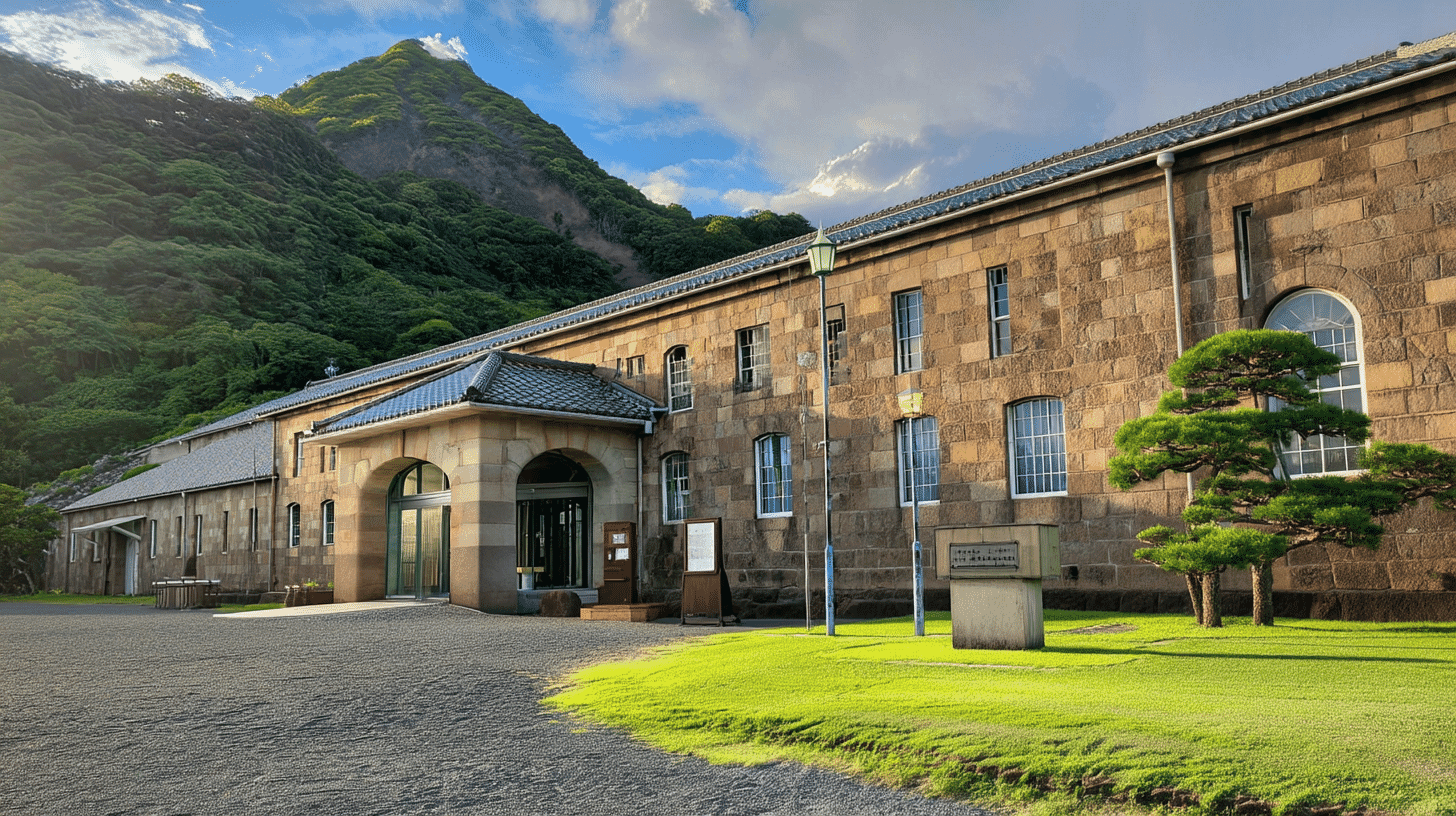
One Building, an Important Cultural Property since 1962
Former Shuseikan Machinery Factory (旧集成館機械工場, Shuseikan Kikai Kojo) stands at 9698-1 Yoshino-cho, Kagoshima City, Kagoshima Prefecture, an Edo-period structure listed as an Important Cultural Property on 21 June 1962. The listing is as an Important Cultural Property, not a National Treasure, and the owner is Shimadzu Limited.
The quantity is one building: stone-built, 977.5 square metres, single-storeyed, roofed in pantiles. The date field gives 1865.
After the Yatsusawa power station, the Yoichi distillery and the former Konishi residence, this is the fourth Important Cultural Property met here in company ownership.
One Site Listed Twice, as a Building and as a Historic Site
Two systems overlap on one piece of ground.
This property is listed as a structure, on 21 June 1962.
The same ground is also listed as a historic site, together with a charcoal kiln site and a water channel, on 25 February 1959: three years earlier.
At the Chikugo lift bridge, the property moved from registration to designation, one status following another.
Here the two listings stand side by side in different categories. At the Fukuda residence, storehouses and land were added to an existing listing, which is an addition within one category.
The historic site's name carries a term marking things listed as attached to a main property, and its reading separates the parts with centre dots.
The Two Records Are Opposite in Length
For one object, one commentary is empty and the other full.
The record as an Important Cultural Property carries nothing in its commentary field.
The record as a historic site runs long. It opens that Shuseikan was founded and named by Shimazu Nariakira, run to strengthen armaments and promote industry, and might be called a comprehensive group of factories whose technique followed Western models.
It lists a reverberatory furnace, a blast furnace and a boring machine, then factories for glass, ceramics, farm tools, blades, refined sugar, land mines and sea mines. Trials of gas and electricity were carried out as well.
At the Kuwanomidera main hall the commentary field was empty; at the Kubiki district map it held only a pointer.
Here a record under another system fills the gap. The structural listing says nothing, but the historic site listing sets out the whole history.
The Dimensions Come in Two Different Units
The size of the building is written differently in each record.
The structural listing gives stone construction, 977.5 square metres, single-storeyed, roofed in pantiles.
The historic site listing calls it a single-storey stone building with a hipped roof, about forty-two bays along the front and about seven bays deep, an exceedingly long and narrow building.
Square metres in one, traditional bays in the other. The second is qualified as approximate.
At the Wakato Bridge, the dimensions field and the commentary gave the span to different precisions in the same unit.
Here the units themselves differ. The roof is described too: pantiles in one record, a hipped form in the other, each naming a different aspect.
Visiting
The factory stands at 9698-1 Yoshino-cho, Kagoshima City. The historic site record notes that the grounds lie west of a villa, with hills behind and the sea in front.
The circumstances of building are recorded. In the seventh month of 1863, in the war with the British fleet, everything but the reverberatory furnace burned.
A machine factory was then planned; building began in the tenth month of 1864, and by the fourth month of 1865 the lathes, planers and other equipment had been installed.
At the Imose residence, a house was rebuilt after fire spread from the village. Here a building went up after war destroyed what stood before.
The interior comprises two rooms, a broad space and a further space divided from it by a partition. The building now serves as a museum, and access follows the owner's arrangements. Check before travelling.
Q&A
- When was the factory listed?
- On 21 June 1962, as an Important Cultural Property rather than a National Treasure. The quantity is one building and the owner Shimadzu Limited.
- Is it also a historic site?
- Yes. The same ground was listed as a historic site on 25 February 1959, together with a charcoal kiln site and a water channel, three years before the structural listing.
- How large is it?
- The units differ by record. The structural listing gives 977.5 square metres; the historic site listing gives about forty-two bays along the front and about seven deep.
- When was it built?
- Building began in the tenth month of 1864 and the equipment was installed by the fourth month of 1865, after the works burned in the war of 1863.
- What was Shuseikan?
- The historic site record calls it a comprehensive group of factories founded and named by Shimazu Nariakira, run to strengthen armaments and promote industry, following Western technique.
Basic Information
| Name | Former Shuseikan Machinery Factory (旧集成館機械工場); the same ground is also listed as a historic site |
|---|---|
| Location | 9698-1 Yoshino-cho, Kagoshima City, Kagoshima Prefecture |
| Designation | Important Cultural Property (structure, modern); not a National Treasure; the same ground was listed as a historic site in 1959 |
| Year Designated | 1962 (21 June), Important Cultural Property |
| Quantity | 1 building |
| Dimensions | The structural listing gives stone construction, 977.5 square metres, 1-storeyed, roofed in pantiles. The historic site listing calls it a single-storey stone building with a hipped roof, about 42 bays along the front and about 7 bays deep, comprising 2 rooms. The date is 1865 |
| Owner | Shimadzu Limited |
| Public Access | Serving as a museum; access follows the owner's arrangements |
References
- Cultural Heritage Online: the former Shuseikan machinery factory
- https://bunka.nii.ac.jp/heritages/detail/163192
- Cultural Heritage Online: the Shuseikan historic site
- https://bunka.nii.ac.jp/heritages/detail/139834
- Shoko Shuseikan museum
- https://www.shuseikan.jp/about/
- Agency for Cultural Affairs, National Cultural Properties Database
- https://kunishitei.bunka.go.jp/
Last verified: 2026.09.07