
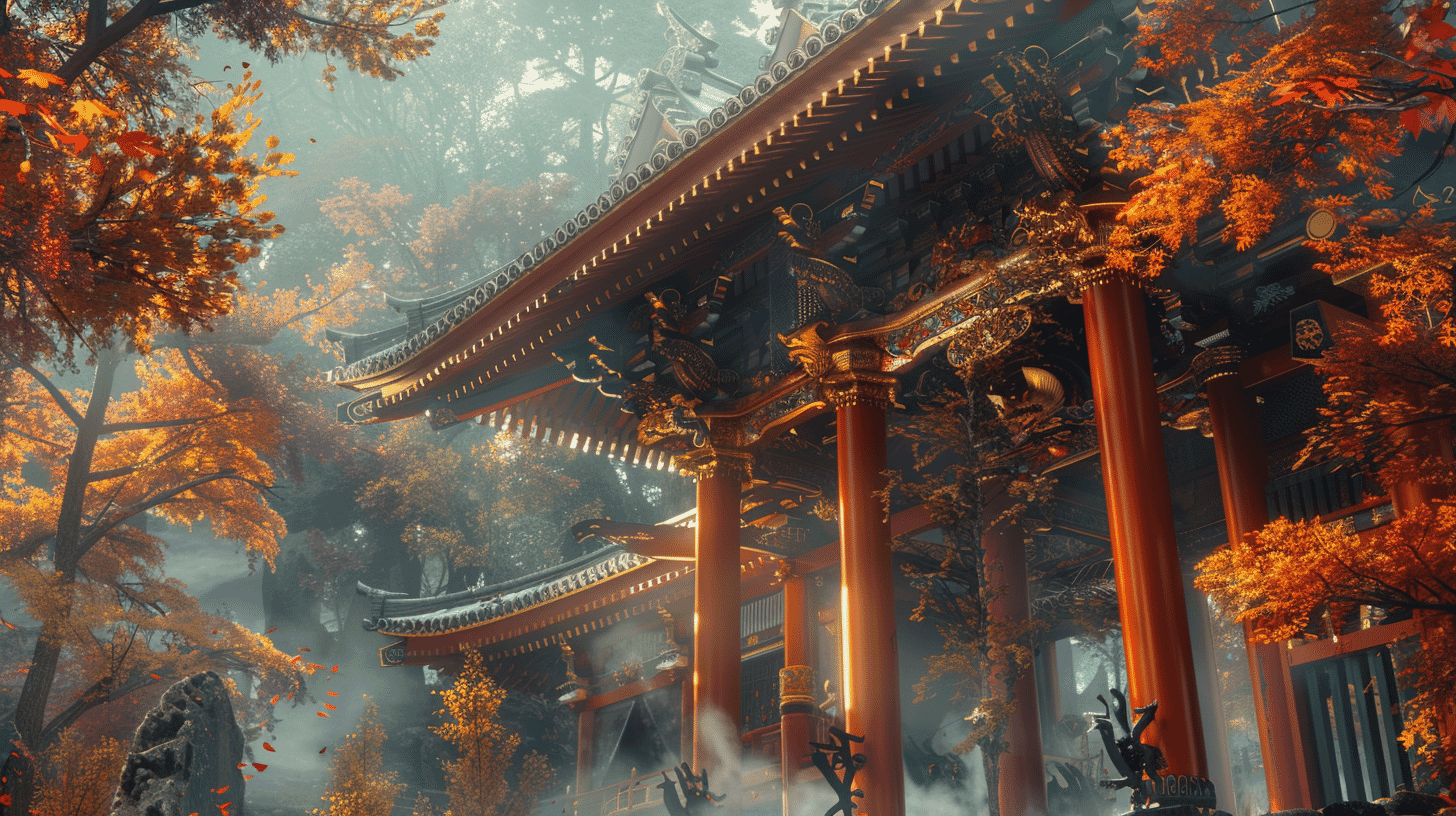
One Structure, National Treasure since 2022
Kirishima Shrine Main Hall, Heiden Hall, and Worship Hall (霧島神宮 本殿・幣殿・拝殿, Kirishima Jingu Honden, Heiden, Haiden) is a middle Edo structure at 2608-5 Kirishima Taguchi, Kirishima City, Kagoshima Prefecture, made an Important Cultural Property on 19 May 1989 and designated a National Treasure on 9 February 2022. The quantity is one structure and the owner the shrine as a religious corporation.
Thirty-three years separate the two listings. The designation of 9 February 2022 is the most recent met here after the Shirataki finds of 2023.
The date field gives 1715. The Agency records that the present shrine buildings were raised again in that year by Shimazu Yoshitaka.
Three Buildings Named, Counted as One
The name and the quantity do not agree in number.
The title names three buildings: the main hall, the offering hall and the worship hall.
The structural field describes each separately. The main hall is five bays by four, single-storeyed, hip-and-gable, with a one-bay porch and a rain guard. The offering hall is two bays by three, single-storeyed, with a roof sloping both ways. The worship hall is seven bays by three, single-storeyed, hip-and-gable, with a gable at the front and a one-bay porch.
Then comes a single phrase for the roofing of the whole, in copper sheet, and the quantity: one structure.
Three buildings stand in a row, their roofs joined, and they are counted as one.
At Senjuji, the Nyorai hall and the founder's hall were each counted as one. At Aoi Aso Shrine, five buildings were counted separately. Here three in a row make one.
Four Ways of Punctuating the Same Kind of Title
Set the related entries side by side and the titles are written differently.
One shrine's three halls are separated by centre dots, as here.
Another shrine's three are separated by commas.
At two further shrines, a comma joins the first two and the word for and joins the third.
And the first shrine appears again in another entry with its three halls separated by spaces, with appended structures listed after. One shrine, two ways of writing.
All of these gather the same three buildings, and the punctuation runs to centre dots, commas, a conjunction and spaces. The style of the records is not uniform.
Distributed across East Asia, Transmitted in Southern Kyushu
The assessment names two ranges, one within the other.
The dragon pillars, it says, belong to a form distributed across East Asia and transmitted in Japan in southern Kyushu, and this is a representative example, of deep significance in cultural history.
A wide range comes first, East Asia; then a narrow one, southern Kyushu.
The Jodoji main hall was measured against the shores of the Inland Sea, the Seihakuji Buddha hall against the Kanto region. Both are ranges within Japan.
At the Sofukuji first gate, timbers were carved at Ningbo in China and shipped over: an object crossing a border.
Here the distribution of a form is itself described across borders, and then the reach within Japan is given as limited.
Visiting
The buildings stand at 2608-5 Kirishima Taguchi, Kirishima City, Kagoshima Prefecture, owned by the shrine. They stand in the precinct and their exteriors can be seen on a visit.
The layout is recorded by height: from the imperial envoy's hall, by way of a covered stair, through the worship hall and the offering hall, the main hall stands at the highest point.
The record adds that the rise from the worship hall to the main hall is taken by a steep stair, giving the composition its difference of level and its energy.
The ground climbs as one moves inward. The main hall sits highest.
Of ornament: the principal points are decorated with fully rounded carving and with painting, and finished in full colour, lacquer and vermilion, a sumptuous specification that gathers up the decorative design developed in the early modern period. Access to the interior follows the shrine's own arrangements. Check before travelling.
Q&A
- When were the buildings designated?
- They became an Important Cultural Property on 19 May 1989 and a National Treasure on 9 February 2022, thirty-three years apart. The owner is the shrine as a religious corporation.
- Why is the quantity one when three buildings are named?
- The three stand in a row with their roofs joined and are counted as one. The structural field describes each separately, then gives a single phrase for the roofing of the whole.
- When were they built?
- The Agency records that the present buildings were raised again in 1715 by Shimazu Yoshitaka. The date field gives the same year.
- What are the dragon pillars?
- The Agency records a form distributed across East Asia and transmitted in Japan in southern Kyushu, calling these a representative example. The wide distribution narrows sharply within Japan.
- How is the precinct laid out?
- The Agency records that from the imperial envoy's hall, by way of a covered stair, through the worship hall and the offering hall, the main hall stands at the highest point. The ground climbs inward.
Basic Information
| Name | Kirishima Shrine Main Hall, Heiden Hall, and Worship Hall (霧島神宮 本殿・幣殿・拝殿); the shrine's envoy hall and covered stair are recorded separately |
|---|---|
| Location | 2608-5 Kirishima Taguchi, Kirishima City, Kagoshima Prefecture |
| Designation | National Treasure (structure, religious architecture) |
| Year Designated | 1989 (19 May), Important Cultural Property; 2022 (9 February), National Treasure |
| Quantity | 1 structure, the three halls counted together |
| Dimensions | The main hall is 5 bays by 4, single-storeyed, hip-and-gable, with a 1-bay porch and a rain guard. The offering hall is 2 bays by 3, single-storeyed, sloping both ways. The worship hall is 7 bays by 3, single-storeyed, hip-and-gable, with a gable at the front and a 1-bay porch. The whole is roofed in copper sheet. The date field gives 1715. The period is the middle Edo |
| Owner | Kirishima Jingu, as a religious corporation |
| Public Access | Standing in the precinct; the exteriors can be seen on a visit, while the interiors follow the shrine's own arrangements |
References
- Cultural Heritage Online: the Kirishima Jingu halls
- https://bunka.nii.ac.jp/heritages/detail/148831
- Kirishima Jingu: the National Treasure designation
- https://kirishimajingu.or.jp/national-treasure/
- Kirishima City: cultural properties
- https://www.city-kirishima.jp/bunka/kyoiku/rekishi/bunkazai/shitebunkazai/bunka-kirishima.html
- Agency for Cultural Affairs, National Cultural Properties Database
- https://kunishitei.bunka.go.jp/
Last verified: 2026.09.06