
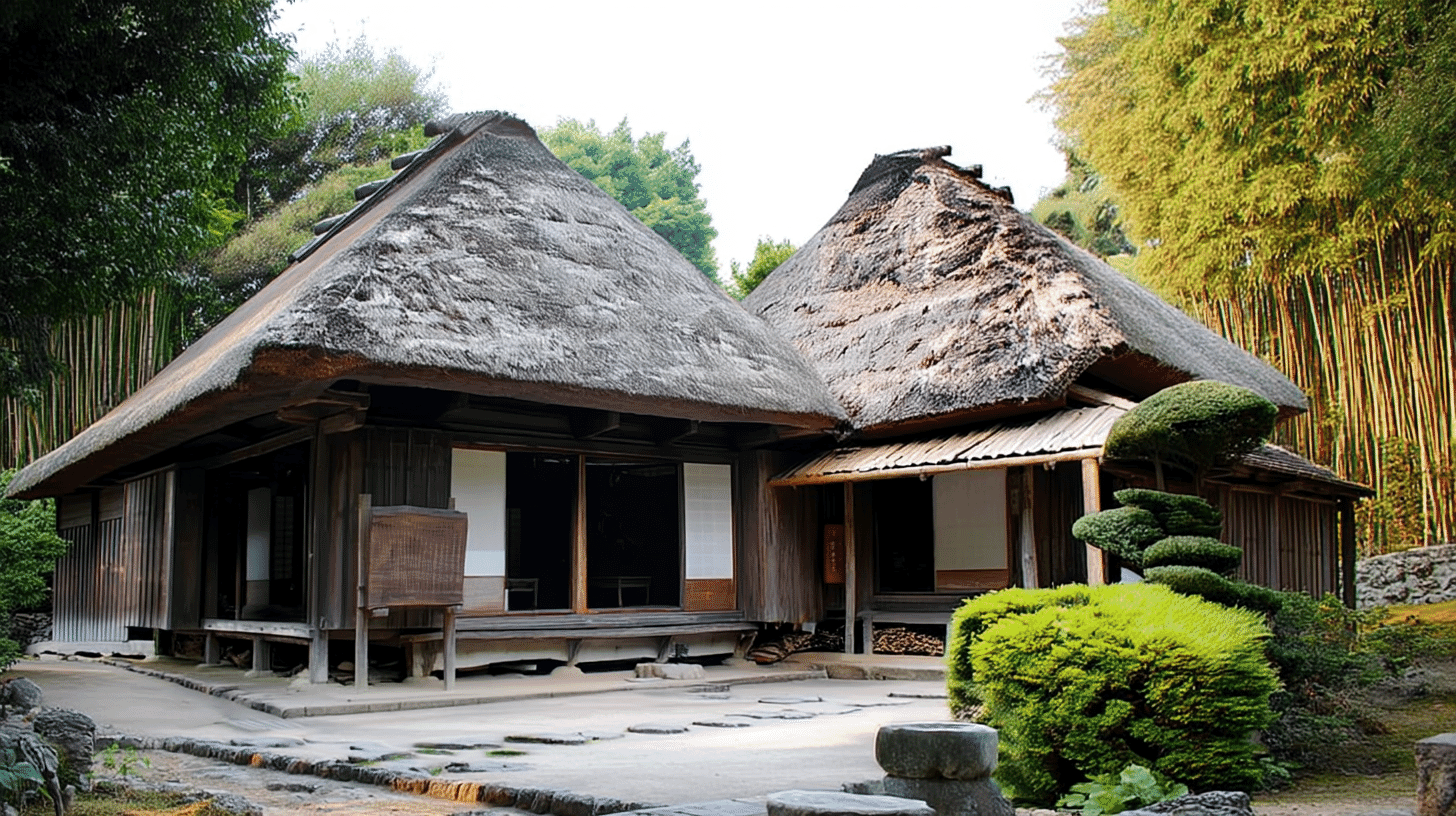
Two Buildings, an Important Cultural Property since 1975
Nikaido Family Residence (Kimotsuki District, Kagoshima Prefecture) (二階堂家住宅) stands at 5595-1 Morinoshita, Shintomi, Kimotsuki Town, Kimotsuki District, Kagoshima Prefecture, listed as an Important Cultural Property on 23 June 1975. The listing is as an Important Cultural Property, not a National Treasure.
The quantity is two buildings. The name is also recorded with the two buildings named after it, separated by full-width spaces, and the reading field reproduces those spaces as well.
Kimotsuki Town is recorded as the owner, though this site's owner field is empty.
Ninety Years Between the Two Buildings
Within one residence, the years run across a change of era.
Cultural Heritage Online dates the front building to 1809 and the rear to 1899.
Ninety years apart. The first falls in the Edo period, the second in the Meiji.
And yet the period field reads Edo. The rear building's year is Meiji, but the period recorded for the property remains Edo.
At the Fukuda residence, the main house was of the early seventeenth century and the storehouses of 1818 and about 1823, some two hundred years apart. All of those fall within the Edo period.
At the Imose residence, two parts of one main house were twenty-seven years apart. Here the division is by building, and it crosses between eras.
Three Accounts of When the Front Building Went Up
The records disagree over the year.
Cultural Heritage Online gives 1809 for the front building, as a fixed year.
Kimotsuki Town writes instead that the year of building is not clearly known, but that it is said to date from about 1810.
Not known, and then a tradition of about 1810. The two years differ by one, and one of them is qualified as approximate.
At the Seianji guest hall, a heading and its own text differed by half a century. At the Haba residence, the spans given were ninety years and twelve.
Here three things stand together: a fixed year, a statement that the date is unknown, and an approximation. With the Kumedera pagoda, the Agency gave a tradition and the pilgrimage association a fixed year. That is two.
Angle Brackets Divide the Structure by Building
The structural field is set out in two parts.
For the front building, the record gives 8.9 metres along the front and 7.0 metres deep, hipped and thatched, with eaves on the south and east sides in bamboo, and an appended eave on the north in bamboo as well.
For the rear building: 8.9 metres along the front and 6.0 metres deep, hipped and thatched, including the section where it meets the front building.
Angle brackets enclose the name of each building, with its measurements and structure following. The frontages are equal at 8.9 metres; the depths differ, 7.0 against 6.0.
With the Rai Kunimitsu blade, angle brackets enclosed an inscription. With the Nihon Shoki volumes, they marked how the work was made up.
Here they enclose the name of a building. As a use of angle brackets this is the fourth met. The roofs are thatched while the eaves are in bamboo, so one building carries two roofing methods.
Visiting
The residence stands at 5595-1 Morinoshita, Shintomi, Kimotsuki Town, Kagoshima Prefecture. The district named in brackets after the name matches the address field.
At the Imose residence, the bracketed place was an older name no longer current. Here brackets and address agree.
How the two buildings meet is recorded as well: the structure of the rear building is said to include the section where it joins the front, so that junction is counted with the rear.
Kimotsuki Town describes the house as made up of a front and a rear building set at right angles, in a staggered arrangement of two hipped ranges.
The town sets admission and opening hours: 300 yen for adults, 150 yen for children, free for pre-school children, open from 8.30 in the morning until 5 in the afternoon and closed over the new year. Charges and hours can change, so check before travelling.
Q&A
- When was the residence listed?
- On 23 June 1975, as an Important Cultural Property rather than a National Treasure. The quantity is two buildings.
- When was it built?
- The buildings differ. Cultural Heritage Online dates the front to 1809 and the rear to 1899, ninety years apart.
- Does the town's record differ?
- Yes. Kimotsuki Town writes that the year of building is not clearly known, but that it is said to date from about 1810.
- What is the structure?
- The front building is 8.9 metres by 7.0, the rear 8.9 by 6.0. Both are hipped and thatched, with eaves in bamboo.
- Can it be visited?
- Yes. The town charges 300 yen for adults and 150 yen for children, with pre-school children free, opening from 8.30 to 5 and closing over the new year.
Basic Information
| Name | Nikaido Family Residence (Kimotsuki District, Kagoshima Prefecture) (二階堂家住宅); the 2 buildings are named after it, separated by full-width spaces |
|---|---|
| Location | 5595-1 Morinoshita, Shintomi, Kimotsuki Town, Kimotsuki District, Kagoshima Prefecture |
| Designation | Important Cultural Property (structures, domestic architecture); not a National Treasure |
| Year Designated | 1975 (23 June), Important Cultural Property |
| Quantity | 2 buildings |
| Dimensions | The front building is 8.9 metres along the front and 7.0 metres deep, hipped and thatched, with eaves on the south and east in bamboo and an appended eave on the north in bamboo. The rear building is 8.9 metres along the front and 6.0 metres deep, hipped and thatched, including the junction with the front building. The front dates from 1809 and the rear from 1899 |
| Owner | Kimotsuki Town; this site's owner field is empty |
| Public Access | Admission 300 yen for adults and 150 yen for children, free for pre-school children; open 8.30 to 17.00, closed over the new year |
References
- Cultural Heritage Online: the Nikaido family residence
- https://bunka.nii.ac.jp/heritages/detail/177793
- Kimotsuki Town: the Nikaido family residence
- https://kimotsuki-town.jp/soshiki/rekishiminzoku/1/2/1649.html
- Kimotsuki Town museum of history and folklore
- https://kimotsuki-town.jp/soshiki/rekishiminzoku/
- Agency for Cultural Affairs, National Cultural Properties Database
- https://kunishitei.bunka.go.jp/
Last verified: 2026.09.10