
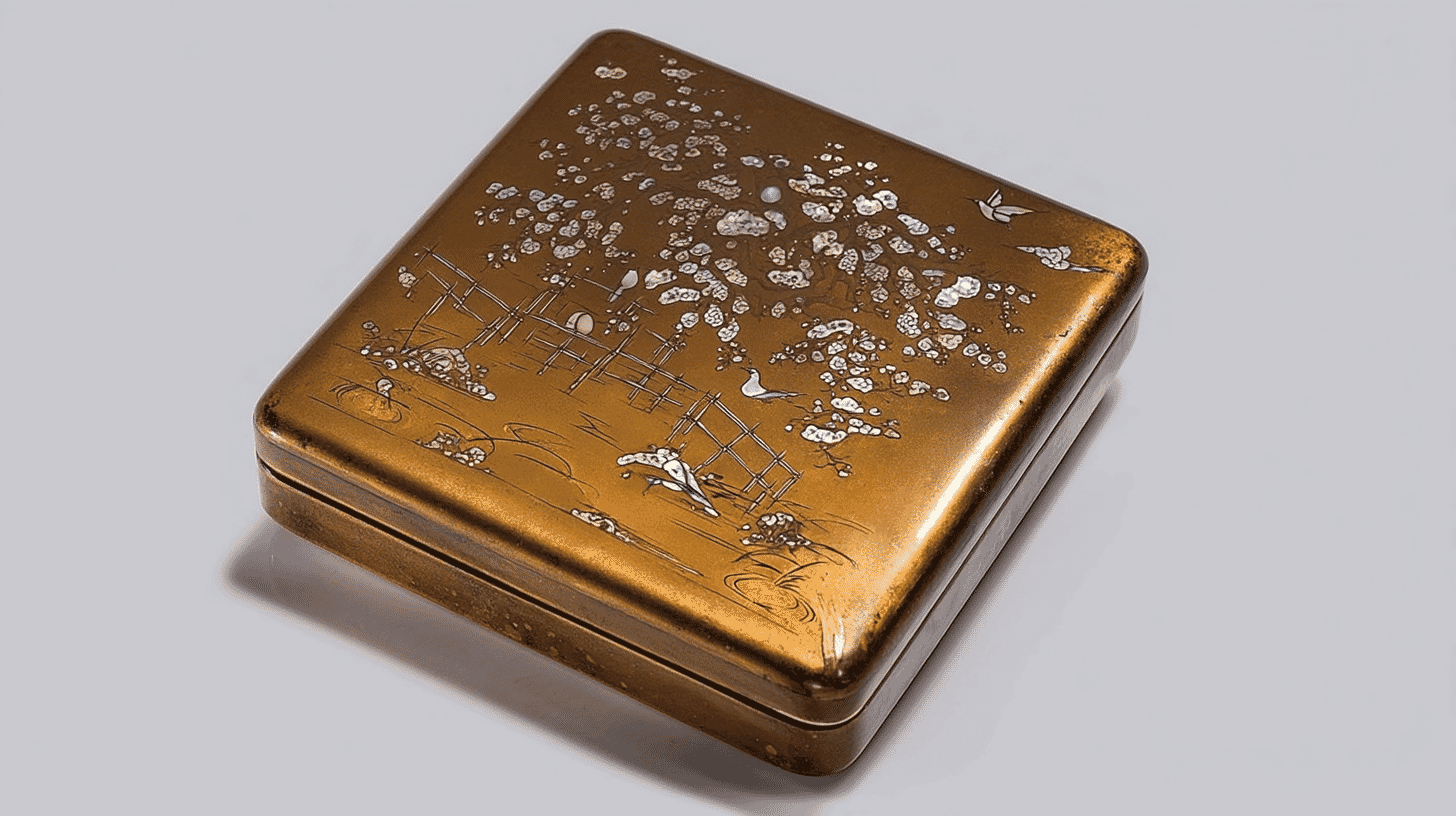
One Box, National Treasure since 1951
Inkstone Box with Chrysanthemums by a Hedge in Mother-of-Pearl and Makie (籬菊螺鈿蒔絵硯箱, Magaki ni Kiku Raden Makie Suzuribako) is a Kamakura-period craft object owned by Tsurugaoka Hachimangu in Kanagawa Prefecture, made an Important Cultural Property on 1 August 1899 and designated a National Treasure on 9 June 1951. The quantity is one box.
It measures 28.8 centimetres deep, 24.2 centimetres wide and 5.5 centimetres high. The address field in the Agency's database is blank, the fourth such case after the Hosoge sutra box, the red-laced armour and the Tenjukoku embroidery.
9 June 1951 is the day of the Koya cutting, both Yohen Tenmoku bowls and the Mikazuki Munechika.
A Stray Letter and an Inconsistent Spelling
Two lapses appear in the field for form and condition.
The first comes in the description of the lid: after the account of the hedge, chrysanthemums, rocks, grasses and small birds, a single Roman letter stands at the head of the following sentence.
A letter of the Latin alphabet has strayed into Japanese text.
In the butterfly hand box, a Roman letter stood where the word for butterfly belonged. This is the second such case.
The second lapse concerns the silver rim. Within one record the term is written one way in one place and another way in another, the second character differing.
The two spellings are mixed. This article reads both as the same term.
The Same Design on a Floor No One Sees
How far the decoration reaches is set down closely.
The underside of the lid and the inner faces of the box are entirely in gold-flecked ground, with the design of the lid repeated in burnished lacquer.
Within stands an inkstone with a silver rim at the centre and a water dropper of gilt silver carrying chrysanthemum sprays in relief, with brush trays to either side, each rimmed in silver and lacquered inside with the hedge and chrysanthemum design.
Then: the floor of the box beneath the tray carries the same design in lacquer.
The tray is a shallow inset that sits in the upper part of the box. Only by lifting it out does that floor appear, and the design reaches there too.
With the Hosoge sutra box, the pattern extended to the inside of the lid. Here it goes a step further, past a part that has to be removed.
A Lost Companion Box Survives as a Painting
A related property is a painting.
A painted handscroll of the Edo period, on sixteen sheets of paper, 39.0 centimetres high and 27.3 centimetres wide, was listed by Kamakura City on 13 February 2015.
Its address is 2-1-1 Yukinoshita, Kamakura City, the address of the shrine. The owner is Kamakura City.
It carries the same name as the inkstone box but depicts a toilet box. It is not the object itself.
With the Gobu Shinkan scroll, the original was lost and a copy survived; with the Soranjo, no original hand survives and a copy holds the designation. Those are substitutions within one field.
Here the inkstone box is a National Treasure and the painting of the companion box is a city listing: different categories, different fields. An object and a picture of an object are listed separately.
Seeing It
The box belongs to Tsurugaoka Hachimangu. It is a shrine holding, not kept on permanent display.
The form is a slightly domed box with rounded corners and an overlapping lid.
Techniques are layered: the design is worked in mother-of-pearl, with the shell cut through in places or engraved and then lacquered, so that petals and feathers can be rendered in detail.
Shell is cut away or incised to make the fine parts. With the butterfly hand box, technique answered to colour; with the Hosoge sutra box, metals divided by part. Here techniques are layered within one element.
The assessment reads that it is a representative work of early Kamakura lacquer and shell inlay and, at the same time, valuable as one of the few inkstone boxes to survive. Exhibition plans can change, so check before travelling.
Q&A
- When was the box designated?
- It became an Important Cultural Property on 1 August 1899 and a National Treasure on 9 June 1951. The quantity is one box and the owner Tsurugaoka Hachimangu.
- Are there errors in the record?
- A stray Roman letter stands at the head of one sentence in the field for form and condition, and the term for the silver rim is written two different ways within one record. This article reads both spellings as the same term.
- Is there decoration on parts that cannot be seen?
- Yes. The Agency records that the floor of the box beneath the tray carries the same design in lacquer. That floor appears only when the inset tray is lifted out.
- Is there a property of the same name?
- Yes. An Edo-period painted handscroll of the same name was listed by Kamakura City in 2015. It depicts a toilet box rather than being the object itself.
- What is valued in it?
- The Agency calls it a representative work of early Kamakura lacquer and shell inlay and valuable as one of the few inkstone boxes to survive, naming both the technique and the rarity of the type.
Basic Information
| Name | Inkstone Box with Chrysanthemums by a Hedge in Mother-of-Pearl and Makie (籬菊螺鈿蒔絵硯箱, Magaki ni Kiku Raden Makie Suzuribako); a painting of the same name is listed by Kamakura City |
|---|---|
| Location | The address field in the Agency's database is blank; the owner is given as Tsurugaoka Hachimangu |
| Designation | National Treasure (craft) |
| Year Designated | 1899 (1 August), Important Cultural Property; 1951 (9 June), National Treasure |
| Quantity | 1 box |
| Dimensions | 28.8 centimetres deep, 24.2 centimetres wide and 5.5 centimetres high. A slightly domed box with rounded corners and an overlapping lid, rimmed in silver. The lid bears a hedge and chrysanthemums in mother-of-pearl on a dense gold ground, and the inner faces are in gold-flecked ground with burnished lacquer. Within are an inkstone, a water dropper and brush trays. The period is Kamakura |
| Owner | Tsurugaoka Hachimangu |
| Public Access | A shrine holding, not on permanent display |
References
- Cultural Heritage Online: the inkstone box
- https://bunka.nii.ac.jp/db/heritages/detail/197350
- Cultural Heritage Online: the painted handscroll listed by Kamakura City
- https://bunka.nii.ac.jp/heritages/detail/274416
- Tsurugaoka Hachimangu: treasures
- https://www.hachimangu.or.jp/sightseeing/homotsu/
- Agency for Cultural Affairs, National Cultural Properties Database
- https://kunishitei.bunka.go.jp/
Last verified: 2026.09.06