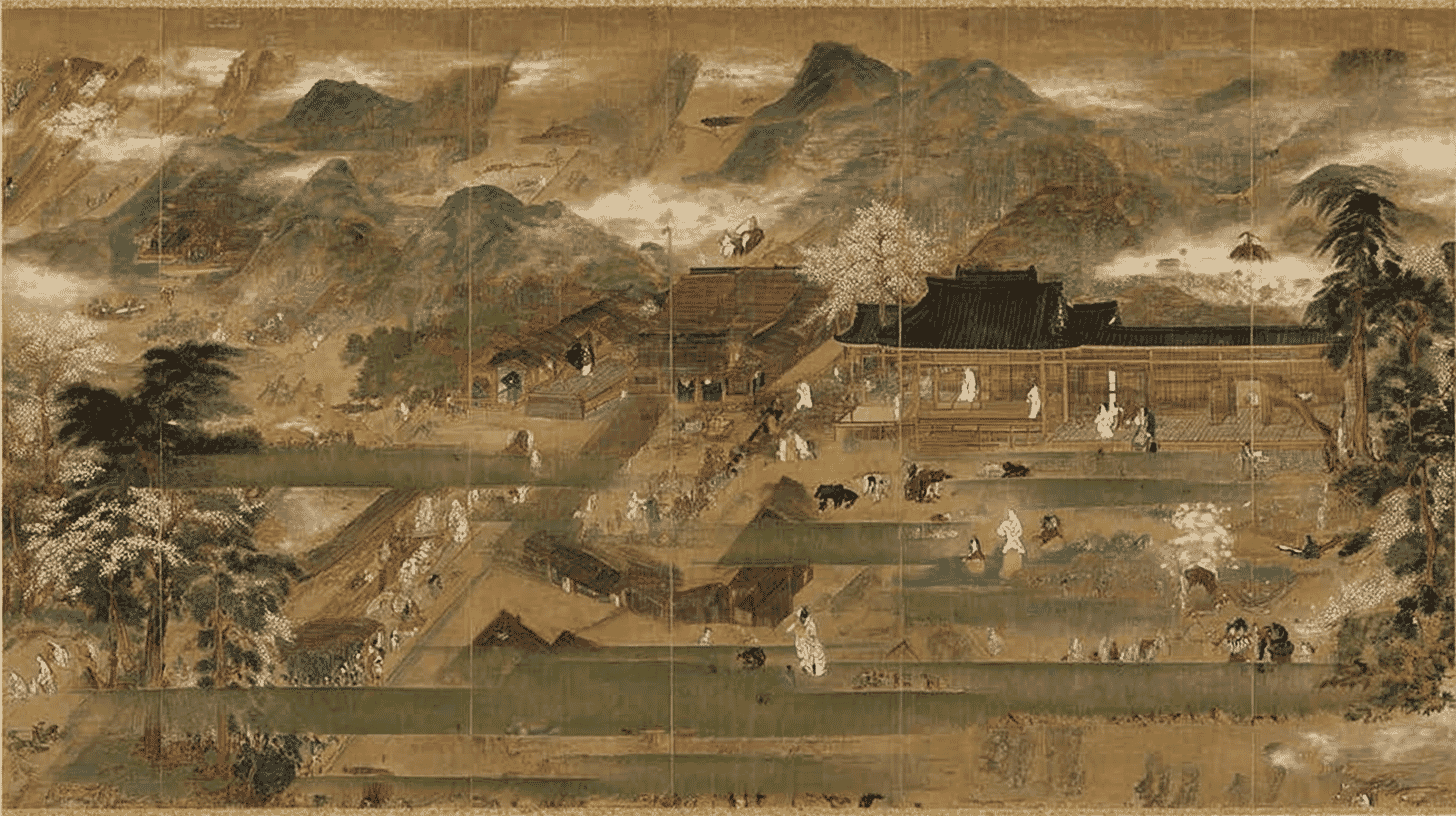
Ippen Hijiri-e: A National Treasure That Brings Medieval Japan to Life

Imagine unrolling a painting over eight meters long and stepping into 13th-century Japan—mist-shrouded mountain passes, bustling Kyoto streets, and sacred shrines visited by a wandering monk who believed that salvation was for everyone. This is the experience offered by the Ippen Hijiri-e (Illustrated Biography of the Priest Ippen), one of the most celebrated emakimono (narrative picture scrolls) in all of Japanese art. Designated as a National Treasure of Japan, this remarkable work fuses delicate traditional yamato-e painting with bold influences from Chinese Song dynasty landscape art, creating a visual record of medieval Japan that is unmatched in its beauty and documentary value.

What Is the Ippen Hijiri-e?

The Ippen Hijiri-e, formally designated as Kenpon Chakushoku Ippen Shōnin Eden (Illustrated Biography of Priest Ippen, Color on Silk, by Hōgen En'i), is a set of twelve handscroll paintings created in 1299 during the Kamakura period. The scrolls chronicle the life and travels of the Buddhist monk Ippen (1239–1289), who founded the Ji-shū (Time Sect) of Pure Land Buddhism. The text, or kotobagaki, was composed by Shōkai, believed to be Ippen's younger brother and close disciple, while the paintings were executed by En'i, a painter-monk who held the prestigious court rank of Hōgen.

Completed on the tenth anniversary of Ippen's death, the scroll set comprises twelve volumes with forty-eight illustrated sections—a number that symbolically corresponds to Amida Buddha's forty-eight great vows. The work is also known by alternative titles including "Ippen Shōnin Eden" and the "Rokujō Engi" (Six Conditions Chronicle).

Today, eleven volumes of the original scrolls are held by Shōjōkō-ji Temple (commonly known as Yugyō-ji) in Fujisawa, Kanagawa Prefecture, while the famous Volume 7 is housed separately at the Tokyo National Museum. Both sets are independently designated as National Treasures.

The Life of Ippen: A Monk Who Walked All of Japan

Born in Iyo Province (modern-day Ehime Prefecture) in 1239, Ippen lost his mother at the age of ten and entered the Buddhist priesthood on his father's advice. He initially trained in the Jōdo (Pure Land) tradition before experiencing a profound spiritual awakening that led him to develop his own approach to Buddhist practice.

Ippen's great innovation was the practice of odori nenbutsu—ecstatic dancing while chanting "Namu Amida Butsu" (Hail to Amida Buddha). He also distributed sacred talismanic slips called fusan, printed with the nenbutsu prayer, to all who would receive them. Unlike other Buddhist leaders of his time, Ippen made no distinction between believers and non-believers, offering his blessings freely to everyone he encountered.

For the last sixteen years of his life, Ippen traveled the length of Japan on foot—from Kyushu in the south to the northern reaches of the Tōhoku region—spreading the nenbutsu teaching. His followers joined him on these journeys, and the movement he inspired eventually became the Ji-shū sect. Ippen passed away in 1289 at the age of fifty, having never established a permanent temple or institutional base, embodying his belief that spiritual practice should be carried out in the world, not in cloistered monasteries. Interestingly, this tradition of dancing nenbutsu is considered by many scholars to be one of the origins of Japan's bon odori folk dances, still performed at summer festivals across the country today.

Why Was It Designated a National Treasure?

The Ippen Hijiri-e was designated as a National Treasure on March 29, 1952, for several compelling reasons that reflect its extraordinary artistic, historical, and cultural significance.

First, the scroll is remarkable as the oldest and most authentic illustrated biography of Ippen. Created just ten years after his death by individuals who knew him personally, it serves as a near-contemporary document of one of medieval Japan's most important religious figures.

Second, the artistic achievement of the work is extraordinary. The paintings blend the traditional Japanese yamato-e style with techniques derived from Song dynasty Chinese landscape painting. This fusion creates a unique visual language: the rolling mountains, pine forests, and atmospheric mist effects show a mastery of spatial composition that was unprecedented in the emakimono tradition. The calligraphic text sections, written on silk dyed in five colors, are themselves works of art, executed by four different master calligraphers of the period.

Third, the scroll is an invaluable historical document. Because Ippen traveled throughout Japan, the paintings provide remarkably detailed depictions of medieval Japanese landscapes, architecture, customs, and daily life. The scenes of Kamakura, Kyoto, and numerous shrines and temples constitute some of the only visual records of these places from the 13th century. Historians, architects, and cultural researchers continue to study the scroll for its unparalleled documentation of medieval Japanese society.

Fourth, the scroll is unique among emakimono for its use of silk rather than paper as a painting surface, indicating the high prestige and significant resources devoted to its creation.

Highlights and Artistic Treasures

A Revolutionary Painting Style

One of the most striking features of the Ippen Hijiri-e is its treatment of landscape. Unlike most emakimono of the period, which focus on large-scale human figures and interior scenes, this scroll deliberately renders its human subjects small against vast, meticulously detailed natural settings. Mountain ranges recede into atmospheric haze, rivers wind through valleys, and cherry blossoms or autumn leaves mark the changing seasons. This approach transforms the biography into a meditation on humanity's relationship with nature and the sacred landscape of Japan.

Volume 7: The Kyoto Masterpiece at Tokyo National Museum

Volume 7, the scroll held by the Tokyo National Museum, is widely regarded as one of the finest individual sections of the entire work. It depicts Ippen's activities in the year 1284, including his visit to Seki-dera Temple in Ōtsu (modern Shiga Prefecture) and his remarkably successful preaching campaigns on Shijō Avenue and at the marketplace in Kyoto. The scenes of Kyoto's bustling streets, with merchants, aristocrats, monks, and ordinary people mingling together, provide an extraordinary window into the life of Japan's medieval capital.

Odori Nenbutsu: Dance as Devotion

Several volumes contain vivid depictions of Ippen's signature odori nenbutsu, showing crowds of monks and lay followers dancing together on raised wooden platforms. These scenes, capturing the energy and communal joy of the practice, are among the most iconic images in all of Japanese art. They show people of all social classes—samurai, merchants, farmers, and women—united in spiritual ecstasy, reflecting Ippen's radical message of universal salvation.

Seasonal Poetry in Paint

As Ippen's journey spans years and traverses the entire Japanese archipelago, the scroll painter took the opportunity to depict the beauty of all four seasons. Spring cherry blossoms, summer greenery, autumn maples, and winter snow create a visual rhythm that echoes the classical Japanese poetic tradition of meisho-e (paintings of famous places) and shiki-e (paintings of the four seasons).

The Scroll's Remarkable Journey Through History

The twelve volumes were originally housed at Kankikō-ji Temple in Kyoto, a temple associated with the "Rokujō faction" of Ji-shū Buddhism. At some point during the Edo period (1615–1868), Volume 7 became separated from the rest of the set. It passed through several distinguished collections, including those of the Kyoto magistrate Asano Baidō (1816–1880), Viscount Saisho, Misaki Kamenosuke (1858–1906), and the celebrated Meiji-era industrialist and art collector Hara Sankei. After Hara's death, the Tokyo National Museum acquired Volume 7 from the Hara family in 1950.

The remaining volumes were transferred from Kankikō-ji to Shōjōkō-ji (Yugyō-ji) in Fujisawa. Today, those scrolls are deposited at the Kyoto National Museum and the Nara National Museum for conservation and occasional exhibition. The Volume 7 held at Shōjōkō-ji contains paintings that were later supplementary additions, with Edo-period calligraphic text added to complement them.

Where to See the Ippen Hijiri-e

Tokyo National Museum (Volume 7)

The Tokyo National Museum in Ueno Park, Tokyo, houses Volume 7 of the Ippen Hijiri-e. As a National Treasure painted on silk, this scroll requires careful conservation and is displayed only periodically—typically once every two to three years—in the museum's special National Treasure Gallery (Room 2 of the Honkan/Japanese Gallery). The museum also occasionally lends it to special exhibitions at other institutions.

When Volume 7 is on display, it offers a rare opportunity to see a masterpiece of Kamakura-period painting up close. The museum provides English-language captions and multilingual exhibition information. Check the museum's official website before your visit to confirm whether the scroll is currently on exhibition.

Shōjōkō-ji Temple (Yugyō-ji), Fujisawa

The head temple of the Ji-shū sect in Fujisawa, Kanagawa Prefecture, is the spiritual home of the complete Ippen Hijiri-e set. While the original scrolls are deposited at national museums for conservation, Yugyō-ji's treasure hall (Hōmotsukan) features related exhibits and reproductions that provide context for understanding the scrolls and the life of Ippen. The temple grounds themselves are beautiful, with a famous 700-year-old ginkgo tree, cherry-lined approach paths, and a serene atmosphere that evokes the world depicted in the scrolls.

Surrounding Attractions

If you visit the Tokyo National Museum, Ueno Park offers a wealth of other cultural institutions within walking distance, including the National Museum of Western Art (a UNESCO World Heritage Site designed by Le Corbusier), the National Museum of Nature and Science, and the Tokyo Metropolitan Art Museum. The park is also famous for its cherry blossoms in spring and lotus blossoms in summer at Shinobazu Pond.

If you travel to Yugyō-ji in Fujisawa, you are perfectly positioned to explore the nearby coastal city of Kamakura, with its Great Buddha, Tsurugaoka Hachimangū Shrine, and numerous Zen temples. The charming Enoshima Electric Railway (Enoden) connects Fujisawa to Kamakura, passing through picturesque seaside neighborhoods. Enoshima Island, with its botanical garden, shrine, and ocean views, is also easily accessible from Fujisawa Station.

📍 Plan Your Visit to Kanagawa
Find tours, activities & transport passes near Illustrated Biography of Shonin in Color on Silk (written by
[ Kamakura Buddha Hakone Onsen & Yokohama Tours ]

Q&A

QWhen can I see the Ippen Hijiri-e at the Tokyo National Museum?
ABecause the scroll is painted on silk and is over 700 years old, it is displayed only periodically to preserve its condition—typically once every two to three years. Check the Tokyo National Museum's official website or exhibition schedule for current display information. When exhibited, it is usually shown in Room 2 (National Treasure Gallery) of the Honkan (Japanese Gallery).
QIs there English-language information available at the museums?
AYes. The Tokyo National Museum provides English captions for all exhibited works, and floor guides are available in English, Chinese, and Korean. The museum's e-Museum website also offers high-resolution images and multilingual descriptions of the scroll. Audio guides in English are available for rent.
QWhat is the difference between the scroll at the Tokyo National Museum and the ones at Yugyō-ji?
AThe Tokyo National Museum holds Volume 7 of the original twelve-volume set, which depicts Ippen's activities in Kyoto in 1284. The remaining eleven volumes (plus a later supplementary Volume 7) are owned by Shōjōkō-ji (Yugyō-ji) in Fujisawa, though they are typically deposited at the Kyoto and Nara National Museums for conservation. Both the TNM scroll and the Yugyō-ji set are independently designated as National Treasures.
QCan I see high-resolution images of the scroll online?
AYes. The e-Museum website operated by the National Institutes for Cultural Heritage provides detailed, zoomable high-resolution images of Volume 7 with descriptions in Japanese, English, Chinese, and Korean. Visit emuseum.nich.go.jp and search for "Ippen" to access these resources.
QIs photography allowed when the scroll is on display?
APhotography policies vary by exhibition. For the permanent collection galleries at the Tokyo National Museum, personal photography without flash or tripod is generally permitted unless otherwise indicated. However, special exhibition rooms and certain works on loan may prohibit photography. Always check the posted guidelines at the entrance of each gallery.

Basic Information

Official Name Kenpon Chakushoku Ippen Shōnin Eden (Hōgen En'i hitsu / Maki Dai-Nana) — 絹本著色一遍上人絵伝〈法眼円伊筆/巻第七〉
English Name Illustrated Biography of the Priest Ippen, Volume 7 (Ippen Hijiri-e)
Category National Treasure (Painting)
Date of Creation 1299 (Shōan 1), Kamakura period
Artist En'i (円伊), rank of Hōgen; text by Shōkai (聖戒)
Medium Color on silk (kenpon chakushoku)
Dimensions (Vol. 7) 37.8 cm × 802.0 cm
National Treasure Designation March 29, 1952
Owner (Vol. 7) Tokyo National Museum
Owner (Vols. 1–12) Shōjōkō-ji (Yugyō-ji), Fujisawa, Kanagawa
Tokyo National Museum Address 13-9 Ueno Park, Taitō-ku, Tokyo 110-8712
Museum Hours 9:30 AM – 5:00 PM (last entry 4:30 PM); closed Mondays (open if Monday is a holiday, closed the following day)
Admission (TNM Collection) Adults: 1,000 yen / University students: 500 yen / Under 18 and over 70: free
Access (TNM) 10-minute walk from JR Ueno Station (Park Exit); 15-minute walk from Tokyo Metro Ueno Station
Yugyō-ji Address 1-8-1 Nishitomi, Fujisawa-shi, Kanagawa 251-0001
Access (Yugyō-ji) 15-minute walk from JR Fujisawa Station (North Exit)

References

Cultural Heritage Online — 絹本著色一遍上人絵伝〈法眼円伊筆/巻第七〉
https://bunka.nii.ac.jp/heritages/detail/149621
e-Museum — Illustrated Biography of the Priest Ippen: Volume 7
https://emuseum.nich.go.jp/detail?langId=en&content_base_id=100156
Tokyo National Museum — National Treasure Gallery: Illustrated Biography of Priest Ippen, Vol. 7
https://www.tnm.jp/modules/r_exhibition/index.php?controller=item&id=2890&lang=en
Wikipedia — Ippen Shōnin Eden
https://en.wikipedia.org/wiki/Ippen_Sh%C5%8Dnin_Eden
Wikipedia — 一遍聖絵
https://ja.wikipedia.org/wiki/%E4%B8%80%E9%81%8D%E8%81%96%E7%B5%B5
Kyoto National Museum — Priest Shinkyō 700th Memorial Special Exhibition: Art of the Ji Shū
https://www.kyohaku.go.jp/old/eng/special/koremade/jishu_2019.html
WANDER 国宝 — 国宝-絵画|一遍上人絵伝(一遍聖絵)[東京国立博物館]
https://wanderkokuho.com/201-00032/
Tokyo National Museum — Visitor Information
https://www.tnm.jp/modules/r_free_page/index.php?id=156&lang=en
藤沢市観光公式ホームページ — 遊行寺(清浄光寺)
https://www.fujisawa-kanko.jp/spot/fujisawa/03.html

Last verified: 2026.02.17