
Meiji
Kochi · 明治Browse Kochi’s cultural heritage from the Meiji period (1868 – 1912). Filter by type and keyword, with concise stories, maps, and travel tips.
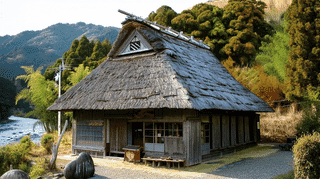
Discover the Former Kadowaki Family Residence, a nationally registered cultural property in Shimanto Town. This beautifully preserved 1875 thatched-roof farmhouse showcases traditional mountain village architecture along the pristine Shimanto River. Free admission.

A late Meiji gate 2.4 metres wide on a village lane in Konan City, Kochi. Unusually thick timbers, a gently curved tile roof, and short walls to either side.
A late Meiji house of 206 square metres in Konan City, Kochi. Farmhouse rooms to the west, formal zashiki to the east, registered in 2024 as a model of design.
A two storey plastered storehouse of 52 square metres in Konan City, Kochi. Projecting tile courses throw off the rain and the roof uses left handed pantiles.
A late Meiji boundary running 20 metres in Konan City, Kochi. Built on large undressed stones and roofed with tile, it ties three gates into a single frontage.
A small late Meiji gate 1.8 metres wide inside a compound in Konan City, Kochi. Copper roofed, it closes the dog-legged approach and opens on the eastern garden.
A plain late Meiji gate 2.0 metres wide in Konan City, Kochi. Boarded on one side, latticed slider on the other, it led the household to its own entrance.
Located in Akebono-cho, Kochi City, the Former Imperial Japanese Army 44th Infantry Regiment Auditorium is a single-storey wooden hall built around 1898-1900 and registered as a national Tangible Cultural Property in 2023. Together with a surviving ammunition depot, it preserves the physical memory of the regiment that sent generations of Kochi men to war for nearly half a century, with king-post trusses and lap-siding walls largely intact.
Located in the Asakura district of Kochi City, the Former Imperial Japanese Army Infantry 44th Regiment Ammunition Depot is a single-story brick building from the Meiji era, registered as a National Registered Tangible Cultural Property in February 2023. With its 50-centimeter-thick brick walls, iron-clad segmental-arch double doors, raised wooden floor for humidity control, and surviving earthen embankment, it stands as one of Japan's rarest surviving examples of late-19th-century military storage architecture. Together with the regiment's Lecture Hall, nearby Asakura Shrine, Asakura Castle ruins, and Kochi University campus, it forms a compelling half-day heritage walk for travelers interested in modern Japanese history.
The Main Hall of Kuwaze Shrine, a National Registered Tangible Cultural Property built in the early Meiji era, stands on a steep mountainside beside Tsubute Falls in Ino Town, Kochi Prefecture. Despite its compact 6.2 m² footprint, the hall features vivid polychrome carvings of dragons, baku, and phoenixes, showcasing remarkable craftsmanship cherished by the local community for generations.
A late Meiji storehouse on Sakawa's sake-brewery street in Kochi, registered in 2018. Its plastered walls carry three tiers of Tosa water-shedding tiles.
Built about 1892 in Tosa City, Kochi, this single-storey house became a national Registered Tangible Cultural Property in 2019 and still works as a clinic.
This 1874 merchant house in Tano, Kochi, keeps the layered shopfront of a Tosa market town: a lattice screen, lean-to eaves and a lime-plastered half-storey.
In Aki's Doi Kakuchu quarter, Kochi, this two-storey earthen storehouse shows the Tosa manner: a boarded base, lime plaster, and two tiers of drip tiles. Registered 2005.
In Aki's Doi Kakuchu quarter, Kochi, this late-Meiji house was both doctor's home and clinic, its waiting and consulting rooms beside the family rooms. Registered 2005.
At the southwest corner of this Aki residence, Kochi, a nagayamon joins gate and building, with a passage at one end and four rooms alongside. Registered 2005.
Behind the main house of this Aki residence, Kochi, a small wing stands by the storehouse: an earthen floor, a raised floor, and eaves sheltering a well. Registered 2005.
Along the west edge of this Aki residence, Kochi, the wall joins a Tosa-plaster section and a neribei of river cobbles with old tiles at each end. Registered 2005.
Built in 1890 and relocated around 1917, this 201-square-metre Kochi house wears a hipped tile roof stepped down at the eaves. Registered in 2003, now a guesthouse.
The east wing of the Fukoe Residence in Tano, Kochi, is an early Meiji merchant house moved in 1924. Three tile bands shed rain from its plastered east gable.