
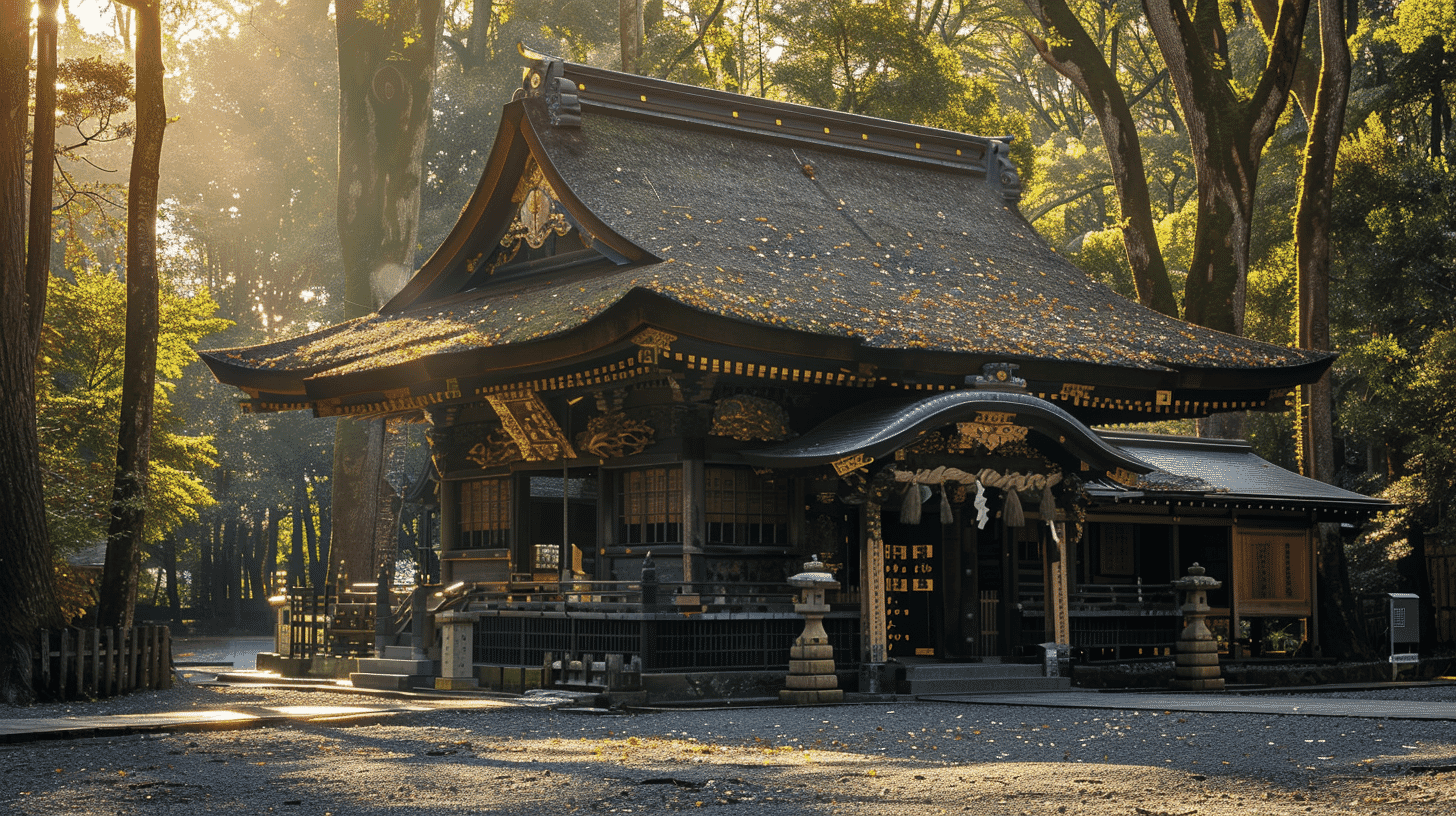
Five Buildings, National Treasure since 2008
Aoi Aso Shrine (青井阿蘇神社, Aoi Aso Jinja) is a group of shrine buildings at Kami-Aoi-machi, Hitoyoshi City, Kumamoto Prefecture, made an Important Cultural Property on 23 January 1933 and designated a National Treasure on 9 June 2008. The owner is the shrine itself.
Five buildings hold the designation: the main hall, the offering hall, the worship hall, the connecting corridor and the two-storey gate. Each is recorded separately as one building.
Seventy-five years separate the two listings, falling between the hundred and nine years for the Five Wisdom Buddhas and the sixty-six for the four commanders.
A National Treasure and a Registered Property in One Precinct
Buildings under different systems stand together within this precinct.
The five shrine buildings are a National Treasure. The shrine's purification bridge, by contrast, is a registered tangible cultural property, registered on 27 October 2017.
That bridge dates from 1921, in the Taisho era. It is recorded as a three-arch concrete bridge, 27 metres long and 3.8 metres wide.
Around the Jittoku painting stood an Important Cultural Property and a registered art object; around the Yohen Tenmoku bowl, a National Treasure and an Important Art Object. Those were properties in different places.
Here it is otherwise. Within one precinct, Momoyama shrine buildings are designated and a Taisho bridge is registered. Designation and registration stand side by side on one site.
The Same Commentary Attached to All Five
How the commentary is attached is distinctive too.
The record for the main hall and the record for the gate carry exactly the same text, beginning with the shrine's patronage by the Sagara, lords of the district from medieval times onward.
With the four commanders, only the record for Sanetoki's portrait carried a commentary; the other three had none. One item stood for the group.
Here the reverse holds. Every building carries the same text, so whichever record is opened, the account of the whole complex can be read.
That commentary assesses the buildings together: they carry forward the strongly individual manner developed in the medieval Kuma district while readily taking up the showy manner of the Momoyama period, are highly accomplished, and set the standard for shrine and temple building in the early modern Kuma district.
Roofing Material Differs from Building to Building
The individual records show differences in construction.
The main hall is recorded as a three-bay flowing-roof structure with a copper-plate roof, dated 1610. The gate is a three-bay, single-doorway two-storey gate with a hipped thatched roof, dated 1613.
Copper plate on one, thatch on the other, and three years between them.
The commentary states that the present buildings were raised from 1610 into 1613. They did not go up at once but over several years.
Accounts elsewhere call this the first thatched National Treasure in Japan. The Agency's record makes no comparison with other National Treasures, and this article does not make the claim.
Visiting
The shrine stands at Kami-Aoi-machi, Hitoyoshi City, Kumamoto Prefecture, and owns the buildings. They stand in the precinct and their exteriors can be seen on a visit.
The commentary sets out the arrangement: at the back of the precinct the main hall runs continuously through to the worship hall, with the two-storey gate standing in front.
The buildings are finished chiefly in black lacquer, with fine carving and metal fittings placed throughout the main hall and the offering hall, while the gate is in a fully worked Zen style.
Access to interiors follows the shrine's own arrangements. Check before travelling.
Q&A
- When was the shrine designated?
- On 9 June 2008, seventy-five years after it became an Important Cultural Property on 23 January 1933. Five buildings hold the designation: main hall, offering hall, worship hall, corridor and gate.
- Is there another listed structure in the precinct?
- Yes. The purification bridge is a registered tangible cultural property, registered on 27 October 2017. Built in 1921, it is a three-arch concrete bridge 27 metres long and 3.8 metres wide, so designation and registration stand together in one precinct.
- When were the buildings raised?
- The Agency records that the present buildings were raised from 1610 into 1613. The main hall is dated 1610 and the gate 1613, so construction ran over several years.
- Are all the roofs thatched?
- No. The main hall has a copper-plate roof in the flowing style, while the gate has a hipped thatched roof. Roofing material differs from building to building.
- What is valued in them?
- The Agency writes that they carry forward the individual manner of the medieval Kuma district while taking up Momoyama ornament, are highly accomplished, set the standard for building in the early modern Kuma district, and show influence across southern Kyushu.
Basic Information
| Name | Aoi Aso Shrine (青井阿蘇神社, Aoi Aso Jinja) |
|---|---|
| Location | Kami-Aoi-machi, Hitoyoshi City, Kumamoto Prefecture |
| Designation | National Treasure (structure); the purification bridge in the same precinct is a registered tangible cultural property |
| Year Designated | 1933 (23 January), Important Cultural Property; 2008 (9 June), National Treasure |
| Quantity | 5 buildings: main hall, offering hall, worship hall, corridor and two-storey gate |
| Dimensions | The main hall is a three-bay flowing-roof structure with a copper-plate roof, dated 1610; the gate is a three-bay, single-doorway two-storey gate with a hipped thatched roof, dated 1613. The buildings are finished chiefly in black lacquer, the gate in Zen style. The period is Momoyama |
| Owner | Aoi Aso Shrine |
| Public Access | Standing in the precinct; exteriors can be seen on a visit, while interiors follow the shrine's own arrangements |
References
- Cultural Heritage Online: Aoi Aso Shrine, the two-storey gate
- https://bunka.nii.ac.jp/heritages/detail/187716
- Cultural Heritage Online: Aoi Aso Shrine, the main hall
- https://bunka.nii.ac.jp/heritages/detail/176802
- Cultural Heritage Online: the shrine's purification bridge, a registered property
- https://bunka.nii.ac.jp/heritages/detail/245798
- Aoi Aso Shrine official site
- https://aoisan.jp/
Last verified: 2026.09.05
Cultural Treasures in the Same Area
All are within walking distance in the same area, so we recommend visiting them together.
- Aoi Aso Shrine Tower gate 0.00 km
- Aoi Aso Shrine worship hall 0.03 km
- Aoi Aso Shrine Heiden 0.04 km
- Aoi Aso Shrine Corridor 0.05 km
- Aoi Aso Shrine Main shrine 0.05 km