
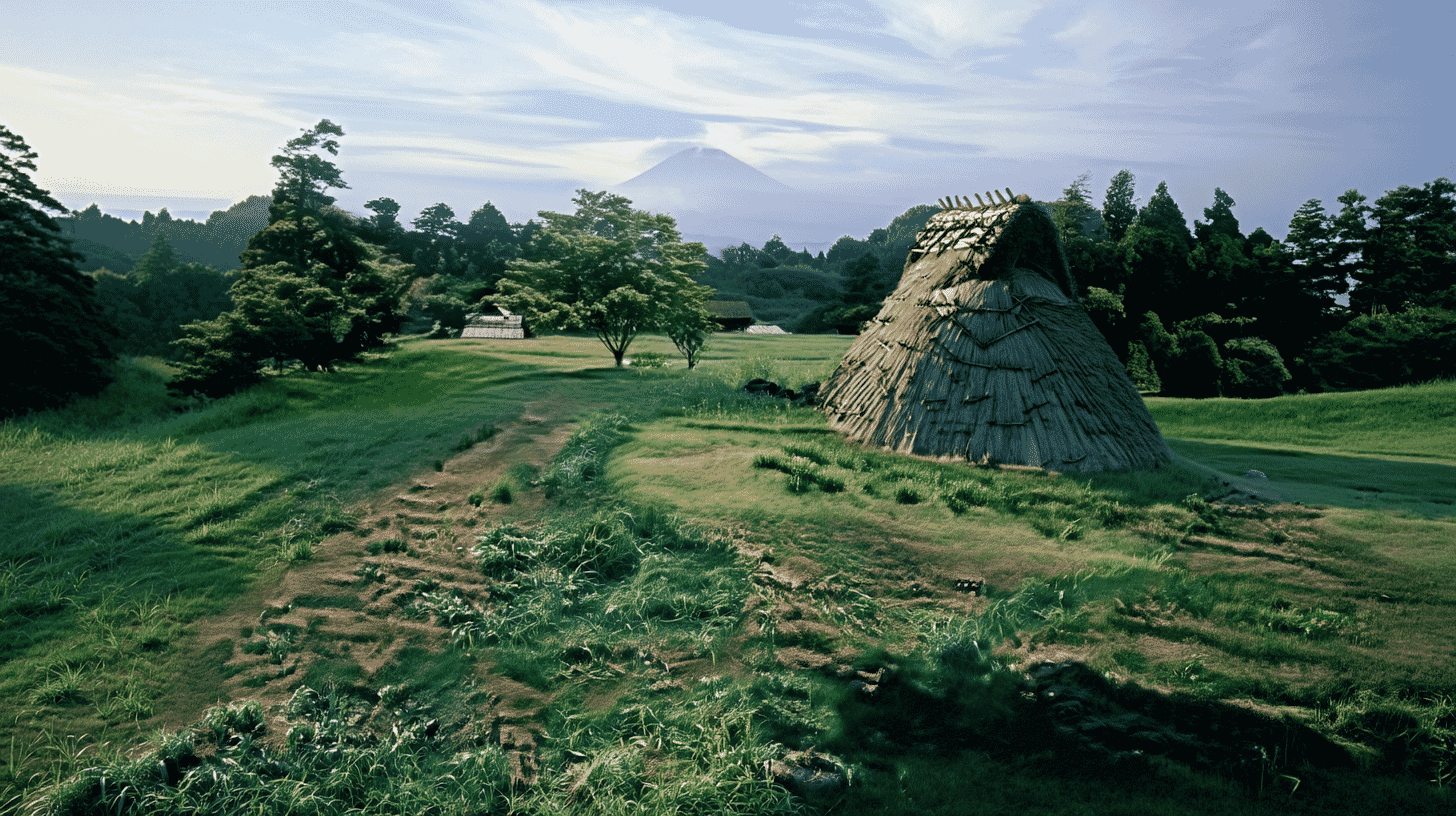
A Stone Tool Workshop, Designated in 1972
Futagoyama Stone Tool Manufacturing Ruins (二子山石器製作遺跡, Futagoyama Sekki Seisaku Iseki) is a site at Koshi City, Kumamoto Prefecture, designated on 23 March 1972. The category is historic site, place of scenic beauty and natural monument.
It stands on a low hill about 70 metres above sea level, formed by the Koshi River. Finds are scattered over an area about 170 metres east to west and about 130 metres north to south.
The field for a managing body is empty. The Okichimozuku habitat and the Ataka and Kurohashi shell mounds both carried a town's name there; this record does not.
The Filename Was Not an Accident
The Agency's commentary opens with a catalogue code, the name of the site, a file extension and a colon.
The Ataka and Kurohashi shell mounds, covered immediately before, carried a filename at the head of the commentary in the same way, under a different code.
Two in a row. One alone would look like a slip, but the codes follow the same pattern. This is most likely a trace left when the records were converted in bulk to electronic form.
In the shell mound record the character for mound was replaced by a substitute mark. There is no such substitution here: the filename remains, but the characters of the text come through.
One further slip appears. The text speaks of flakes struck from the parent rock, but writes the second occurrence of that term with a wrong character, evidently a mistake for the form used just before.
Few Finished Pieces, and That Is the Point
What was found has a distinctive make-up.
Around the parent rock, stone material, flakes, unfinished pieces and hammerstones are found in quantity, but finished pieces are few.
Raw material, waste, work in progress, and stones for striking: plenty of these. Of completed tools, hardly any.
What was made did not stay. It was carried elsewhere. Absence is what shows that this place was a place of manufacture.
At the Ataka and Kurohashi shell mounds, quantities of shell, fish and animal bone showed how people lived. Here the reverse holds. Not what is present but what is missing gives the site its character.
Sixty Destinations Counted
Where the tools went has been traced.
Chipped stone axes supplied from this site are distributed from the Shirakawa in the south to the Kikuchi River in the north, and about sixty sites have so far been identified.
The receiving sites are counted, and the range is given by the names of rivers. One site is linked to about sixty others.
The grounds are stated as well: the stone and the form of the axes are identical, and the pottery excavated here is of an early type of the Goryo style, so this is taken to be a place where axes were made in that period.
The material and shape of the tools, and the pottery type fixing the date: the two together support the conclusion.
Accounts elsewhere call this the only Jomon workshop site designated nationally. The Agency's record makes no comparison with other sites, and related entries include another manufacturing site, for pottery. This article does not make the claim.
Visiting
The site lies at Koshi City, Kumamoto Prefecture. It is an outdoor site, with the fields for owner and managing body both empty.
The stone is named: the parent rock is an exposed basaltic andesite. Rock lying open at the surface served directly as material.
As to date, the record says that the sites concerned all belong to the second half of the late Jomon period through the first half of the final Jomon. The sixty receiving sites fall in the same span.
The assessment closes: a valuable site showing productive activity of this period, of high scholarly value.
As an outdoor site, conditions for visiting differ from those for a building. Check the city's information before travelling.
Q&A
- When was the site designated?
- On 23 March 1972. The category is historic site, place of scenic beauty and natural monument, the location is Koshi City, Kumamoto Prefecture, and the field for a managing body is empty.
- What is the string at the head of the commentary?
- The name of the document the text came from. The Ataka and Kurohashi shell mounds carry one in the same form, and the codes follow the same pattern, so this is most likely a trace of bulk conversion to electronic form.
- What was found there?
- The Agency records stone material, flakes, unfinished pieces and hammerstones in quantity, but few finished pieces. Raw material, waste and work in progress are plentiful; completed tools are not.
- Where did the finished tools go?
- The Agency records that axes supplied from here are distributed from the Shirakawa in the south to the Kikuchi River in the north, and that about sixty sites have been identified.
- Is it the only such workshop site?
- The Agency's record makes no comparison with other sites, and related entries include a manufacturing site for pottery. This article does not repeat that claim.
Basic Information
| Name | Futagoyama Stone Tool Manufacturing Ruins (二子山石器製作遺跡, Futagoyama Sekki Seisaku Iseki) |
|---|---|
| Location | Koshi City, Kumamoto Prefecture |
| Designation | Historic site, place of scenic beauty and natural monument (historic site) |
| Year Designated | 1972 (23 March), designated |
| Quantity | No quantity field |
| Dimensions | Finds are scattered over about 170 metres east to west and about 130 metres north to south, on a hill about 70 metres above sea level, where the parent rock is an exposed basaltic andesite. The period runs from the second half of the late Jomon into the first half of the final Jomon |
| Owner | The Agency's fields for owner and managing body are both empty |
| Public Access | An outdoor site; conditions for visiting differ from those for a building |
References
- Cultural Heritage Online: the Futagoyama stone tool manufacturing site
- https://bunka.nii.ac.jp/heritages/detail/211540
- Koshi City: the Futagoyama stone tool manufacturing site
- https://www.city.koshi.lg.jp/kiji00320209/index.html
- Agency for Cultural Affairs, National Cultural Properties Database
- https://kunishitei.bunka.go.jp/
- Agency for Cultural Affairs: introduction to monuments
- https://www.bunka.go.jp/seisaku/bunkazai/shokai/kinenbutsu/
Last verified: 2026.09.05