
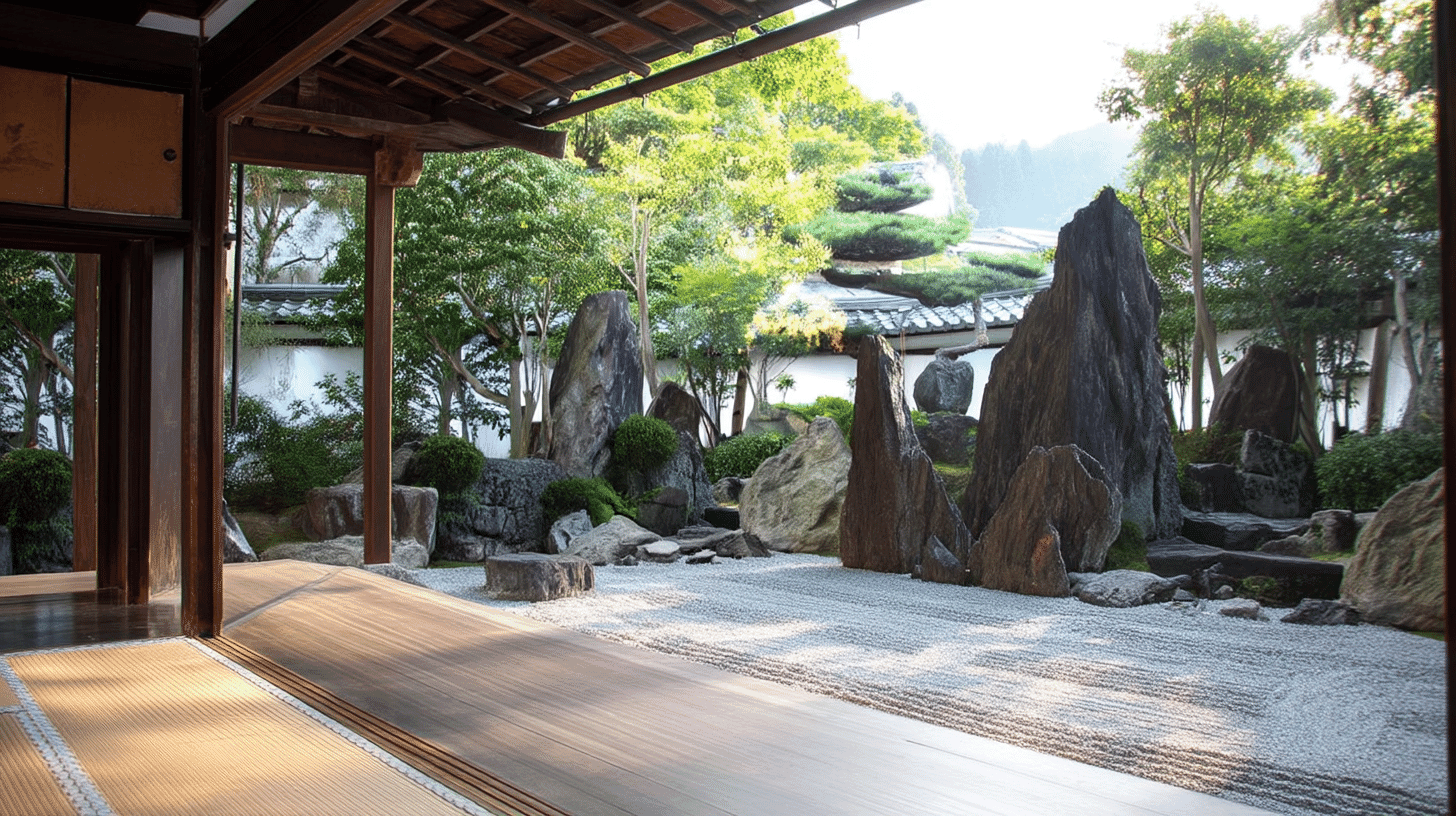
The Ground Around the Study Garden, Designated in 1955
Daisen-in Temple Garden (大仙院庭園, Daisenin Teien) at Murasakino Daitokuji-cho, Kita Ward, Kyoto City, was designated a national Place of Scenic Beauty on 3 February 1955. It falls under monuments, as a Place of Scenic Beauty.
The Agency for Cultural Affairs sets out what the designation covers: the ground on all four sides of the dry landscape garden at the study, together with the garden of the abbot's hall.
Not the dry garden at the study itself, but the ground around it. That garden is treated separately, under its own name, and appears as its own entry among the Agency's related records. What this article covers is what lies around it, and the garden of the abbot's hall.
A Manner Called Extremely Plain
Of the abbot's hall garden, the Agency's account is brief.
The garden of the abbot's hall is a scene in an extremely plain manner, an L-shaped area with nothing more than two tiers of clipped hedge run around it.
Nothing more than and extremely plain are the terms used. No stone grouping, no raked sand, no planting is recorded. What is there is two tiers of clipped hedge.
The ground is L-shaped: not a straight strip but an area that turns partway along, with the hedge running round it.
Two tiers of clipped hedge means hedges of differing height set one behind the other, so the planting steps up from front to back.
The word at the centre of the description is plain. Not lavish, not finely wrought: plainness is what the record puts first.
What It Means to Record Plainness
The commentary contains no word of praise. Finely done, of high value: none of these appears.
What is set down is the extent, the shape and the composition. The record states what is there and stops.
Among gardens covered here, Jukoin was said to retain its design well as a dry garden of its kind, and the precinct at Eihoji to be one of the representative examples. This record carries no such sentence of assessment.
The designation itself, though, marks this ground as something to be kept. A plain garden is recorded plainly.
The Agency's field for the managing body is blank.
Designating the Ground on Four Sides
How the extent was drawn is worth noting: the ground on all four sides of the dry garden at the study falls within the designation.
Not the garden but the area enclosing it. The garden at the centre is treated as its own property, and its surroundings belong here.
Centre and surroundings are designated apart. The structure resembles Yasaka Shrine, where the main hall and the twenty-nine structures of the precinct carry separate designations.
Including the surroundings presumably reflects how much the setting governs the way the central garden is seen, though the Agency records no reason.
The related entries list Jukoin Garden, the Daisen-in study garden and Keishunin Garden. Several gardens of subsidiary temples at Daitokuji are each handled separately.
Visiting
Daisen-in Temple Garden is at Murasakino Daitokuji-cho, Kita Ward, Kyoto City. It belongs to a temple, so whether and how it can be seen follows the temple's practice.
Hours and admission may change, so check before travelling. Conditions may also differ between the study garden and the abbot's hall garden.
What repays attention is the two tiers of clipped hedge. That is the one thing the Agency records of the abbot's hall garden, so the question is how the hedge runs around the L-shaped ground.
The ground on four sides of the study garden also falls within the designation. Along with the stones at the centre, what surrounds them is worth looking at.
Q&A
- When was this garden designated?
- On 3 February 1955, as a national Place of Scenic Beauty under monuments. It lies at Murasakino Daitokuji-cho, Kita Ward, Kyoto City, and the Agency's field for the managing body is blank.
- Is this the famous stone garden?
- No. The Agency defines the extent as the ground on all four sides of the dry landscape garden at the study, together with the garden of the abbot's hall. The dry garden itself is treated separately under its own name.
- What is the abbot's hall garden like?
- The Agency records it as a scene in an extremely plain manner, an L-shaped area with nothing more than two tiers of clipped hedge run around it. No stone grouping, raked sand or planting is recorded.
- Why does the designation include the surrounding ground?
- The Agency includes the ground on all four sides of the study garden but records no reason. The garden at the centre is treated as its own property, so centre and surroundings are designated apart.
- Can it be visited?
- It belongs to a temple, so whether and how it can be seen follows the temple's practice. Hours and admission may change, and conditions may differ between the study garden and the abbot's hall garden.
Basic Information
| Name | Daisen-in Temple Garden (大仙院庭園, Daisenin Teien) |
|---|---|
| Location | Murasakino Daitokuji-cho, Kita Ward, Kyoto City, Kyoto Prefecture |
| Designation | Place of Scenic Beauty (monuments); the study garden at Daisen-in is a separate property |
| Year Designated | 1955 (3 February), Place of Scenic Beauty |
| Quantity | The Agency's quantity field is blank |
| Dimensions | The ground on all four sides of the dry landscape garden at the study, together with the garden of the abbot's hall. That garden is a scene in an extremely plain manner, an L-shaped area with nothing more than 2 tiers of clipped hedge run around it |
| Owner | The Agency's field for the managing body is blank |
| Public Access | A temple garden; whether and how it can be seen follows the temple's practice |
References
- Cultural Heritage Online: Daisen-in Temple Garden
- https://bunka.nii.ac.jp/db/heritages/detail/205763
- Daisen-in official site
- https://daisen-in.net/
- Kyoto City Official Travel Guide: Daisen-in
- https://ja.kyoto.travel/tourism/single01.php?category_id=7&tourism_id=513
- Agency for Cultural Affairs, National Cultural Properties Database
- https://kunishitei.bunka.go.jp/
Last verified: 2026.09.05