
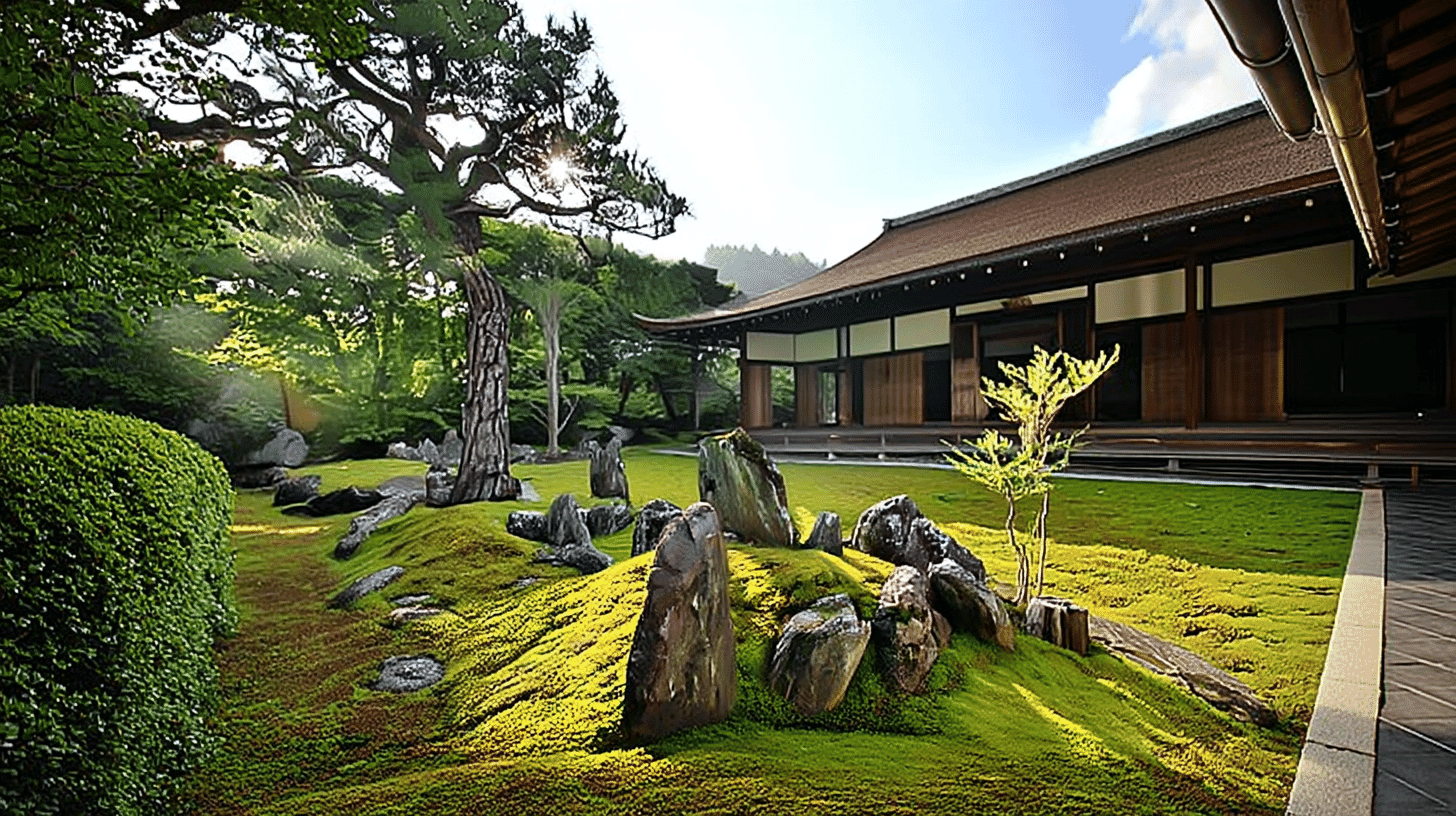
A Flat Garden South of the Abbot's Hall, Designated in 1958
Jukoin Garden (聚光院庭園, Jukoin Teien) at Murasakino Daitokuji-cho, Kita Ward, Kyoto City, was designated a national Place of Scenic Beauty on 12 June 1958. It falls under monuments, as a Place of Scenic Beauty.
The Agency for Cultural Affairs gives its position and size: a flat garden of about fifty tsubo on the south face of the abbot's hall. Fifty tsubo comes to roughly 165 square metres.
A flat garden is one laid without rise or fall. No mound is raised and the ground is kept level. The Agency's field for the managing body is blank.
The Date of Making Is Not Clear
The most important line in the record concerns date.
The date of making is not clear, but as a dry landscape garden of this kind, set south of an abbot's hall, it retains its design well.
Not clear is stated outright. As at Hokaiji, where no settled view of the date exists, the record offers no inference at all here.
Accounts elsewhere say the garden was made by Sen no Rikyu, or is held to be his work. No maker's name appears in the Agency's record. Nor does the garden's popular name.
This article follows the record and notes only that neither date nor maker is set down.
Two Groups of Stones, a Bridge Between
The composition is described precisely.
A hedge closes off the background; along it, stone groupings are set from east to west in two clusters; and a stone bridge is thrown across at the centre between them.
The background is cut off first. The hedge shuts out what lies beyond, the opposite of the borrowed scenery that draws an outside view into a garden, as at Eihoji.
The stones run east to west in two groupings rather than one. Between them, at the centre, lies a bridge of stone.
The two groups are divided and then joined. Separation and connection in one arrangement.
Small Stones, with a Few Set Upright
The treatment of the stones is recorded too.
All the stones are small, but upright stones are set at key points to give variety to the scene.
All small: force is not sought by placing a large stone but by composing with small ones.
Left at that the garden would want variety, so upright stones are set at key points. An upright stone stands rather than lies, and catches the eye against the flat stones around it.
Everything kept small, with a few raised. The north storehouse of the Suga family works the same way, a single black line across white plaster to sharpen the exterior. Hold the whole back, and let one point tell.
The assessment reads: as a dry landscape garden of this kind it retains its design well. Of this kind sets the bounds. The judgment holds within the class of dry gardens laid south of an abbot's hall, not among dry gardens at large.
Visiting
Jukoin Garden is at Murasakino Daitokuji-cho, Kita Ward, Kyoto City. It belongs to a temple, so whether and how it can be seen follows the temple's practice.
It is not necessarily open at all times. Special openings are arranged from time to time, so confirm before travelling.
What repays attention is how the stones are set: among stones all kept small, finding where the upright ones stand. Key points is the Agency's phrase for those positions.
The garden lies on the south face of the abbot's hall, with a hedge closing the background. The two groupings running east to west and the stone bridge between them can also be made out.
Q&A
- When was the garden designated?
- On 12 June 1958, as a national Place of Scenic Beauty under monuments. It lies at Murasakino Daitokuji-cho, Kita Ward, Kyoto City, and the Agency's field for the managing body is blank.
- Did Sen no Rikyu make it?
- The Agency records that the date of making is not clear and gives no maker's name. The garden's popular name does not appear either. This article notes only that neither date nor maker is set down.
- How is the garden composed?
- The Agency records a flat garden of about fifty tsubo on the south face of the abbot's hall, with a hedge closing off the background, stone groupings set from east to west in two clusters along it, and a stone bridge across at the centre.
- What marks the treatment of the stones?
- The Agency records that all the stones are small but that upright stones are set at key points to give variety to the scene. Rather than seeking force from a large stone, the garden composes with small ones and raises a few.
- Can it be visited?
- It belongs to a temple, so whether and how it can be seen follows the temple's practice. It is not necessarily open at all times, and special openings are arranged from time to time, so confirm before travelling.
Basic Information
| Name | Jukoin Garden (聚光院庭園, Jukoin Teien) |
|---|---|
| Location | Murasakino Daitokuji-cho, Kita Ward, Kyoto City, Kyoto Prefecture |
| Designation | Place of Scenic Beauty (monuments) |
| Year Designated | 1958 (12 June), Place of Scenic Beauty |
| Quantity | The Agency's quantity field is blank |
| Dimensions | A flat garden of about 50 tsubo on the south face of the abbot's hall. A hedge closes off the background, with stone groupings set from east to west in 2 clusters along it and a stone bridge across at the centre. All the stones are small, with upright stones at key points to give variety. The date of making is not clear |
| Owner | The Agency's field for the managing body is blank |
| Public Access | A temple garden; whether and how it can be seen follows the temple's practice |
References
- Cultural Heritage Online: Jukoin Garden
- https://bunka.nii.ac.jp/db/heritages/detail/163131
- Kyoto City Official Travel Guide: Jukoin
- https://ja.kyoto.travel/event/single.php?event_id=6900
- Agency for Cultural Affairs, National Cultural Properties Database
- https://kunishitei.bunka.go.jp/
- Agency for Cultural Affairs: introduction to monuments
- https://www.bunka.go.jp/seisaku/bunkazai/shokai/kinenbutsu/
Last verified: 2026.09.05