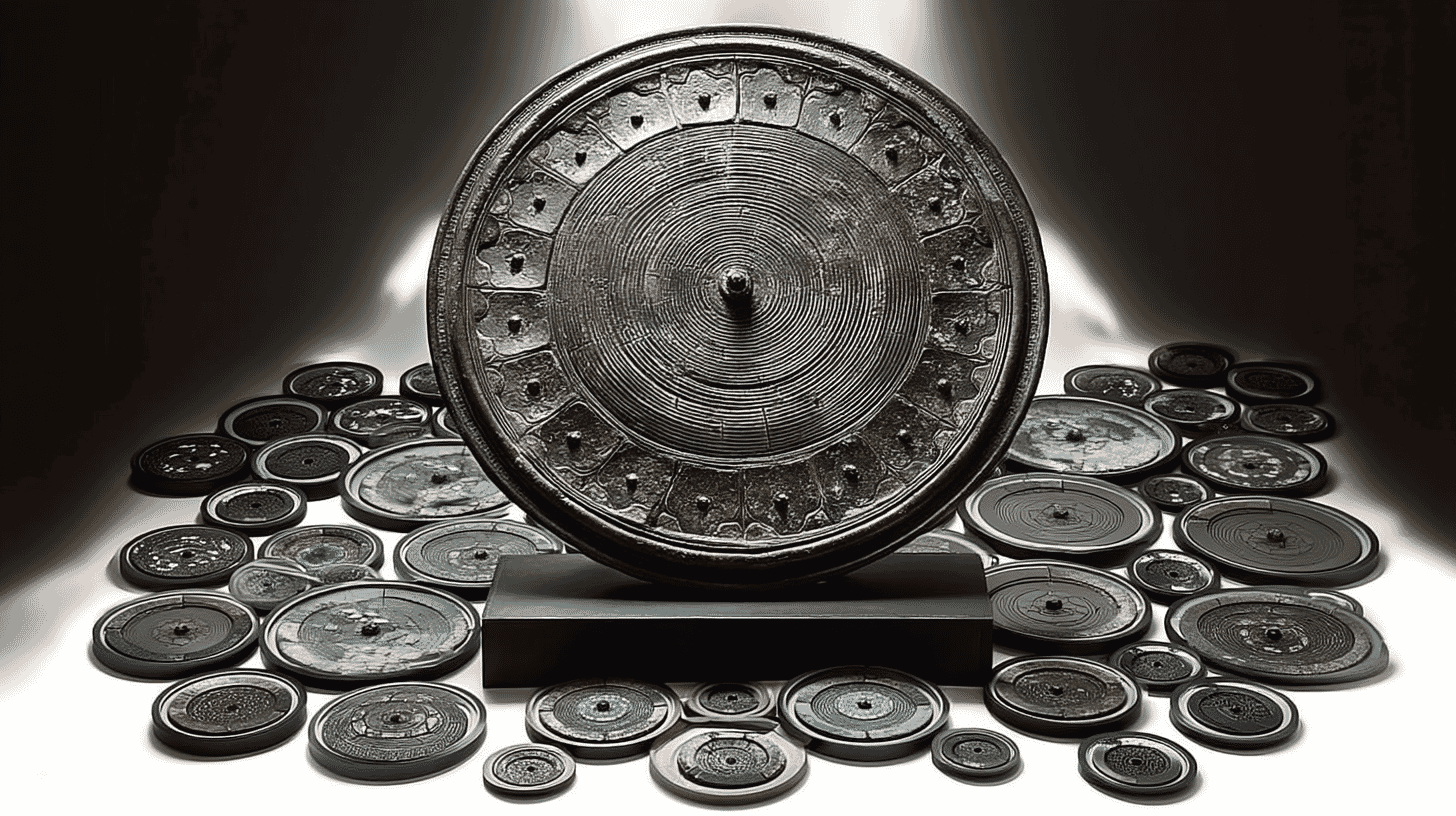
The Hirabaru Royal Tomb Artifacts: Unearthing the Splendor of an Ancient Queen's Burial
Hidden among the tranquil rice paddies and rolling hills of Itoshima City in Fukuoka Prefecture lies one of Japan's most extraordinary archaeological discoveries — the Hirabaru Site. From a single burial mound dating back approximately 1,800 years, archaeologists recovered a breathtaking collection of bronze mirrors, jade ornaments, glass beads, and an iron sword, all designated collectively as a National Treasure of Japan. These artifacts open a remarkable window into the power, artistry, and spiritual beliefs of the ancient kingdom of Ito, one of the polities described in the Chinese chronicle Wei Zhi Wajinden (Record of the People of Wa).
Discovery: A Treasure Hidden Beneath a Mandarin Orange Grove
The story of the Hirabaru Site begins in January 1965, when a local farmer was digging to plant mandarin orange trees and unexpectedly unearthed fragments of broken bronze mirrors. This chance discovery led to a full-scale archaeological excavation led by the renowned researcher Dairoku Harada. What they found was nothing short of astonishing: a rectangular moated tomb (known in Japanese as a hōkei shūkōbo) measuring approximately 14 meters by 12 meters, with a wooden coffin buried at its center.
The tomb, designated as Tomb No. 1, yielded an enormous quantity of burial goods — 40 bronze mirrors, numerous jade and agate beads, glass ornaments, ear pendants, and an iron sword with a plain ring pommel. These artifacts, initially designated as an Important Cultural Property in 1990, were elevated to National Treasure status on June 9, 2006, in recognition of their unparalleled historical and cultural significance.
Why These Artifacts Are a National Treasure
The Hirabaru tomb artifacts hold National Treasure status for several compelling reasons. First and foremost, the sheer number of bronze mirrors — 40 in total — recovered from a single burial is without parallel in the Yayoi period. No other tomb in Japan from this era has produced such a vast quantity of mirrors in one location, underscoring the extraordinary status of the person buried here.
Among the 40 mirrors, five are large-format naikō kamon kyō (mirrors with linked arc petal design) measuring 46.5 centimeters in diameter. These are the largest bronze mirrors ever excavated in Japan, and their immense size and intricate craftsmanship make them objects of both artistic excellence and ritual significance. The remaining mirrors include 32 TLV mirrors (hōkaku kiku kyō) of Chinese Han dynasty manufacture and one four-dragon design mirror (shichi kyō).
Beyond the mirrors, the tomb contained a remarkable array of personal adornments — magatama (curved jade beads), tubular agate beads forming bracelets and necklaces, glass beads, and jade ear pendants — all applied with generous amounts of vermillion (cinnabar), a sacred red pigment associated with ritual purity in ancient East Asia. Taken together, these artifacts provide an invaluable record of Yayoi-period diplomacy, craftsmanship, and spiritual life at the highest levels of society.
The Kingdom of Ito: A Gateway Between Japan and the Continent
The Hirabaru artifacts gain even deeper significance when understood in the context of the ancient kingdom of Ito (Ito-koku). According to the Wei Zhi Wajinden, a Chinese historical record from the 3rd century CE, Ito was one of the key polities in the land of Wa (ancient Japan) and served as a critical diplomatic waypoint for envoys traveling between Japan and the Chinese court. The chronicle notes that Ito had "kings for generations," and the extraordinary wealth of the Hirabaru burial strongly supports the identification of this site as a royal tomb of the Ito kingdom.
What makes this tomb especially intriguing is the strong evidence suggesting that the buried individual was a woman — possibly a queen. Unlike other royal tombs of this period, which typically contain weapons as primary grave goods, the Hirabaru burial is dominated by ornamental jewelry and ear pendants (jitō), accessories traditionally associated with women. The near absence of weapons and the abundance of personal adornments have led many scholars to conclude that this was the tomb of a female ruler, fueling captivating speculation about connections to Queen Himiko or the mythological sun goddess Amaterasu.
Highlights and Must-See Attractions
The Giant Bronze Mirrors
The five large naikō kamon kyō mirrors, each measuring 46.5 cm in diameter and weighing approximately 8.4 kg, are the undisputed stars of the collection. Their backs are adorned with eight petal-shaped arc patterns radiating from a central knob, surrounded by concentric circles and approximately 1,500 finely incised arc lines on the rim. The excavator Dairoku Harada noted their resemblance to the legendary Yata no Kagami (Eight-Span Mirror), one of the three Imperial Regalia of Japan — a tantalizing connection that continues to fascinate researchers and visitors alike.
The Jade and Glass Ornaments
The tomb yielded hundreds of exquisite beads, including magatama (comma-shaped jade beads), cylindrical agate beads, dark blue glass beads, and amber-opal ear ornaments. These demonstrate the sophisticated networks of trade and craftsmanship that connected the Ito kingdom with the Asian continent, particularly China and the Korean Peninsula.
Itokoku Historical Museum
The actual artifacts are displayed at the Itokoku Historical Museum in Itoshima City, where the 3rd-floor permanent exhibition hall recreates the excavation scene with a full-scale model of the tomb, surrounded by the original mirrors, beads, and other grave goods. Four of the five large mirrors are displayed here (the fifth is periodically exhibited at the Kyushu National Museum in Dazaifu). Volunteer guides are available to provide detailed English explanations upon request.
Hirabaru Historical Park
The original tomb site has been preserved and restored as the Hirabaru Historical Park, a peaceful open-air park featuring the reconstructed burial mound, ceramic wall panels depicting the excavated artifacts, and informational signboards explaining the site's history. The park also contains the restored Old Fujise Family Residence, an Edo-period farmhouse built in 1737 — the oldest surviving private dwelling in Kyushu. In October, the surrounding fields burst into bloom with approximately 100,000 cosmos flowers, planted each year by local volunteers to honor the ancient queen.
The Great Pillar and Solar Worship
On the eastern side of Tomb No. 1, archaeologists discovered a posthole approximately 70 cm in diameter, believed to have supported a massive wooden pillar estimated at up to 20 meters tall. This pillar was aligned with the Hinata Pass to the southeast, and around October 20th each year, the sunrise appears directly over this pass when viewed from the tomb — a striking alignment that suggests the ancient people of Ito practiced a form of solar worship. This annual phenomenon draws visitors to the park each autumn.
Surrounding Area: Exploring Itoshima
Itoshima City has become one of Fukuoka Prefecture's most popular destinations, blending ancient history with stunning coastal scenery and a vibrant culinary scene. After visiting the Hirabaru site and museum, consider exploring these nearby attractions:
- Sakurai Futamigaura — The iconic "Wedded Rocks" connected by a sacred shimenawa rope, one of Japan's Top 100 Sunset Views, located about 20 minutes by car from the park.
- Raizan Sennyoji Temple — A historic Buddhist temple nestled in the mountains, famous for its spectacular autumn foliage and a 400-year-old giant maple tree.
- Itoshima Coastal Drive — A scenic route along the peninsula featuring beach cafes, the London Bus Cafe, and the famous Palm Tree Swing, popular with photographers and visitors alike.
- JA Itoshima Ito-Saisai — One of Kyushu's largest farmers' markets, offering the freshest local produce, seafood, and regional specialties just 2 km from the park.
- Oyster Huts (October–March) — Itoshima's famous seaside oyster shacks offer all-you-can-eat grilled oysters during the winter season, a must-try culinary experience.
- 📍 Plan Your Visit to Kyoto
- Find tours, activities & transport passes near Excavated Items from the Hirahara Square Moat Tomb in
- [ Kinkakuji Fushimi Inari & Kimono Rental ]
Q&A
- Where can I see the actual National Treasure artifacts from the Hirabaru tomb?
- The artifacts are displayed at the Itokoku Historical Museum (伊都国歴史博物館) in Itoshima City, Fukuoka Prefecture. The permanent exhibition on the 3rd floor showcases the original bronze mirrors, jade beads, and other grave goods alongside a full-scale reconstruction of the excavation. One of the five large mirrors is periodically displayed at the Kyushu National Museum in Dazaifu. Please note that the museum was temporarily closed for renovation from October 2025 to January 2026; please check the official website for current operating status before your visit.
- Is there an English guide or audio guide available at the museum?
- While the main exhibit labels are primarily in Japanese, the museum's volunteer guide association offers guided tours and can sometimes accommodate English-speaking visitors upon advance request. Contact the museum at 092-322-7083 to inquire about English assistance. Some display panels include brief English descriptions, and informational videos are available in the 4th-floor media space.
- How do I get to the Hirabaru Historical Park and Itokoku Historical Museum from Fukuoka City?
- From central Fukuoka (Tenjin or Hakata), take the JR Chikuhi Line to Chikuzen-Maebaru Station (approximately 40 minutes). From there, take the Itoshima City community bus toward Sone Ground and get off at "Hirabaru Kofun Iriguchi" (about 15 minutes), then walk 2-3 minutes. For the museum, take the community bus from JR Susenji or Hatae Station to the "Itokoku Rekishi Hakubutsukan" stop (about 8-20 minutes). Alternatively, a rental car provides the most flexibility — the sites are approximately 20 km west of central Fukuoka, reachable in about 30 minutes via the Nishi-Kyushu Expressway.
- What is the best season to visit the Hirabaru site?
- The site can be enjoyed year-round, but mid-to-late October is especially recommended. During this period, approximately 100,000 cosmos flowers bloom around the park, and around October 20th, you can witness the sunrise perfectly aligned with the Hinata Pass as seen from the ancient tomb — a phenomenon possibly linked to ancient solar rituals. The annual Hirabaru Royal Tomb Festival is also held in October. Spring (March–April) is another lovely time, when cherry blossoms and mild weather make for pleasant exploration.
- Is there a connection between the Hirabaru tomb and Queen Himiko?
- The connection is debated among scholars. Some researchers have noted that the burial's characteristics — its wealth of mirrors, the predominance of female accessories, and its location in the Ito kingdom mentioned in the Wei Zhi Wajinden — are consistent with a powerful female ruler from the period close to Himiko's era. However, ceramic dating suggests the tomb may slightly predate Himiko's time (late 2nd century rather than mid-3rd century). The excavator Dairoku Harada proposed that the tomb belonged to Tamayori-hime, a figure from Japanese mythology associated with the sun goddess Amaterasu. The debate continues to fuel fascinating scholarly discussion.
Basic Information
| Official Name | Artifacts from the Hirabaru Rectangular Moated Tomb, Fukuoka Prefecture (福岡県平原方形周溝墓出土品) |
|---|---|
| Category | National Treasure (Archaeological Artifacts) |
| Period | Late Yayoi period (approximately late 2nd century CE, around 1,800 years ago) |
| National Treasure Designation | June 9, 2006 |
| Owner | National Government (Agency for Cultural Affairs) |
| Exhibition Location | Itokoku Historical Museum (糸島市立伊都国歴史博物館), 916 Ihara, Itoshima City, Fukuoka Prefecture 819-1582 |
| Museum Hours | 9:00–17:00 (last entry 16:30) |
| Closed | Mondays (or next weekday if Monday is a public holiday), December 29 – January 3 |
| Admission | Adults: 220 yen / High school students: 110 yen / Children, seniors (65+), and disabled visitors: Free |
| Phone | 092-322-7083 |
| Tomb Site | Hirabaru Historical Park (平原歴史公園), Arita, Itoshima City — Free admission, open access |
| Key Artifacts | 40 bronze mirrors (including 5 large mirrors of 46.5 cm diameter — Japan's largest), jade/agate/glass beads, ear ornaments, iron sword |
| Access | JR Chikuhi Line to Chikuzen-Maebaru Station, then community bus (approx. 15–20 min). By car: approx. 30 min from central Fukuoka via Nishi-Kyushu Expressway. |
References
- 福岡県平原方形周溝墓出土品 — Cultural Heritage Online (文化遺産オンライン)
- https://bunka.nii.ac.jp/heritages/detail/188462
- 福岡県文化財データベース — 平原方形周溝墓出土品
- https://www.fukuoka-bunkazai.jp/frmDetail.aspx?db=1&id=46
- 平原遺跡 — Wikipedia (Japanese)
- https://ja.wikipedia.org/wiki/平原遺跡
- 伊都国歴史博物館 — Wikipedia (Japanese)
- https://ja.wikipedia.org/wiki/伊都国歴史博物館
- 平原遺跡(ひらばるいせき) — Itoshima City Official Website
- https://www.city.itoshima.lg.jp/site/bunkazai/hirabaru-iseki.html
- 伊都国歴史博物館 — Itoshima City Tourism Association (つなぐ糸島)
- https://kanko-itoshima.jp/spot/itokokurekishi/
- 平原歴史公園 — Itoshima City Tourism Association (つなぐ糸島)
- https://kanko-itoshima.jp/spot/hirabarurekishikouen/
- 国宝-考古|平原方形周溝墓出土品 — WANDER 国宝
- https://wanderkokuho.com/201-11231/
- Mirror with Linked Arcs — Wikipedia (English)
- https://en.wikipedia.org/wiki/Mirror_with_Linked_Arcs
- 伊都国歴史博物館へのアクセス — Itoshima City Official Website
- https://www.city.itoshima.lg.jp/m043/010/040/060/030/hakubutsukansyuhen.html
Last verified: 2026.02.17
Nearby heritages
- Edo Castle Ruins
- Itoshima City, Oaza Takaso, Oaza Daimon, Oaza Koraiji
- Koso Shrine Main Hall
- Takaso, Itoshima City, Fukuoka Prefecture
- Sone Ruins (Hirahara Ruins/Warezuka Tomb/Zenbinzuka
- Arita and Sone, Maebaru City
- Imajuku Burial Mounds (Marukumayama Burial Mound, Otsuka
- Nishi Ward, Fukuoka City, Oaza Shusenji, Imajukucho, Oaza Imajuku Aoki, Oaza Iiji, Oaza Tokunaga
- Shito Dolmen Group
- Oaza Shito, Maebara City
- Nogata Ruins
- Nogata, Nishi Ward, Fukuoka City
- Mikumo Ibara Ruins
- Itoshima City, Fukuoka Prefecture
- Raizan Kamagoishi
- Maebaru City Oaza Raizan and Oaza Iihara
- Imayama Ruins
- Yokohama, Nishi Ward, Fukuoka City
- Lepidite-Bearing Pegmatite Dikes in Nagatare
- Nagatare, Nishi Ward, Fukuoka City