Wall Paintings of the Five-Story Pagoda at Daigoji Temple – A National Treasure of Heian Buddhist Art in Kyoto

Discover the National Treasure wall paintings inside the Five-Story Pagoda at Daigoji Temple in Kyoto. Dating from 951, these exquisite murals of the Two Realms Mandala and Shingon Patriarchs are among the oldest surviving Buddhist paintings in Japan.

Wall Paintings of the Five-Story Pagoda at Daigoji Temple — A Thousand-Year Masterpiece of Esoteric Buddhist Art

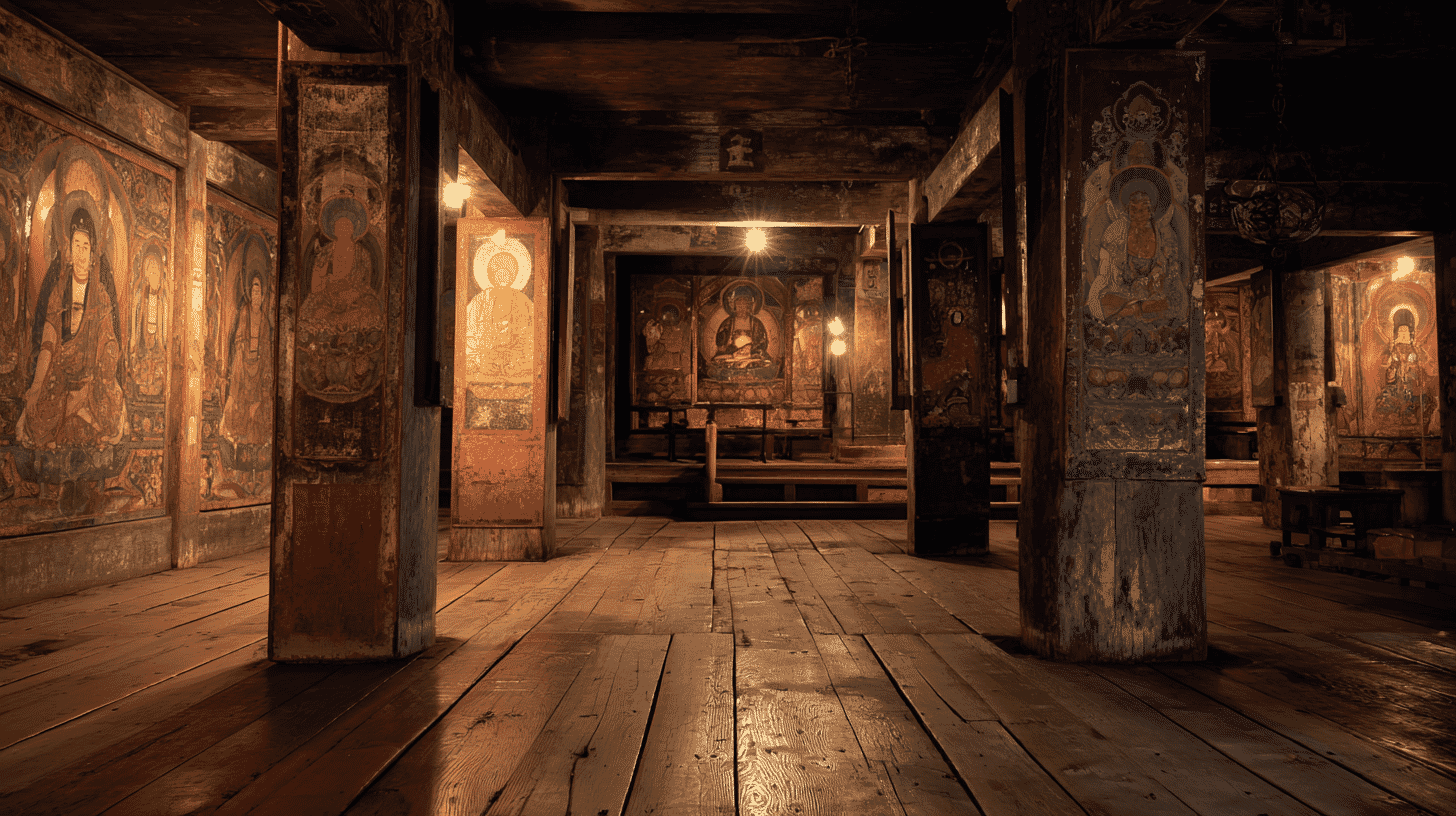
Hidden within Kyoto's oldest wooden structure lies one of Japan's most extraordinary artistic treasures. The wall paintings on the first story of the Five-Story Pagoda at Daigoji Temple — formally designated as the "Gojū-no-tō Shojū Hekiga (Itae Jakushoku)" — are a National Treasure of Japan, painted in 951 during the Heian period. These murals stand alongside the wall paintings of the Phoenix Hall at Byodoin as the most important surviving examples of Heian-era painting, offering a rare glimpse into the spiritual and artistic world of tenth-century Japan.

What makes these paintings truly remarkable is that they mark a pivotal transition in the history of Japanese art — from the bold, powerful tradition of early Heian Esoteric Buddhist painting to the refined elegance of the new Fujiwara style. Among the painted figures, the portrait of Kukai (Kobo Daishi), founder of Shingon Buddhism, is believed to be the oldest surviving painted image of this legendary monk anywhere in Japan.

A Pagoda Built in Imperial Devotion

To understand the wall paintings, one must first know the story of the pagoda that houses them. Daigoji Temple was founded in 874 by the monk Shobo (Rigen Daishi), a spiritual descendant of Kukai. The temple soon became closely connected with the imperial court, particularly Emperor Daigo, who devoted deep faith to the temple — so much so that his posthumous name was taken from it.

When Emperor Daigo passed away in 930, his third son, Prince Yoakira, proposed building a five-story pagoda to pray for the repose of his father's soul. Construction began in 936 under Emperor Suzaku, but delays — including Prince Yoakira's death in 937 — meant the project was not completed until 951, during the reign of Emperor Murakami. The pagoda thus embodies the devotion of two imperial brothers to their father's memory, guided by the prayers of their mother, Empress Onshi.

Standing approximately 38 meters tall, with its distinctive finial (sorin) accounting for about 13 meters — roughly one-third of the total height — the pagoda has a solid, grounded appearance that sets it apart from the slender silhouettes of later Japanese pagodas. It is the oldest surviving wooden building in all of Kyoto Prefecture and the only structure at Daigoji to have survived the devastating Onin War of the fifteenth century.

The Wall Paintings: A Mandala in Three Dimensions

Upon entering the first story of the pagoda, visitors discover a space that was conceived as a three-dimensional mandala — a sacred Buddhist cosmos rendered in paint across every available surface. The 18 panels that constitute this National Treasure are distributed across the interior's central pillar cover boards (shinbashira oiita), four heavenly pillars (shitenchū), lattice window backing boards (renjimado), and wainscot panels (koshi hameita).

The subject matter is divided into two major groups. The first comprises the deities of the Ryōkai Mandala — the Two Realms Mandala that lies at the heart of Shingon Esoteric Buddhism. The Diamond Realm (Kongōkai) mandala, featuring Dainichi Nyorai forming the wisdom-fist mudra, appears on one face of the central pillar, while the Womb Realm (Taizōkai) mandala is depicted across the remaining three faces and the surrounding wall panels. Together, they represent the entirety of the Buddhist cosmos as understood in Shingon doctrine.

The second group portrays the Eight Patriarchs of Shingon Buddhism (Shingon Hasso) — the lineage of masters who transmitted Esoteric Buddhist teachings from India through China to Japan. Seven of the eight are depicted (Subhakarasimha is absent): Nagarjuna, Nagabodhi, Vajrabodhi, Amoghavajra, Yixing, Huiguo, and Kukai himself. These figures are painted on the wainscot panels encircling the interior walls.

Why These Paintings Are a National Treasure

The wall paintings were designated as a National Treasure on June 5, 1976, recognized independently from the pagoda building itself (which holds its own National Treasure designation as architecture). Several factors contribute to their extraordinary cultural significance.

First, they are among the rarest surviving examples of mid-Heian period painting. While many Buddhist paintings from this era have been lost to fire, war, and the passage of time, the Daigoji murals have endured for over a thousand years, making them an invaluable benchmark for understanding tenth-century Japanese art.

Second, they occupy a unique position in art history as a transitional work. The paintings are rooted in the powerful, austere tradition of early Heian Esoteric Buddhist art, yet they show the first signs of the graceful, flowing Fujiwara style that would come to define the following centuries of Japanese aesthetics. This convergence of old and new makes them what art historians call a "benchmark work" (kijun-saku) of the tenth century.

Third, their three-dimensional arrangement within the pagoda interior — with deities and patriarchs placed in careful relationship to one another across pillars, walls, and window panels — represents a remarkably sophisticated spatial composition. Rather than simply decorating flat surfaces, the artists created an immersive sacred environment where the viewer stands at the center of the Buddhist cosmos.

Finally, the portrait of Kukai among the Eight Patriarchs is considered the oldest surviving painted depiction of the great master, adding immense historical value to an already extraordinary artistic achievement.

Artistic Style and Technique

The paintings are executed in polychrome pigments on wooden boards (a technique known as itae jakushoku). This medium, more durable than silk or paper, has helped preserve the works across the centuries, though significant pigment loss has occurred over time — particularly on the patriarch portraits, where figures are now visible primarily as silhouettes.

The artistic execution reveals a fascinating duality. Certain elements — the precise iconographic rendering of the mandala deities, the strong outlines, and the formal symmetry — reflect the established tradition of Esoteric Buddhist painting that had been practiced since Kukai's time. Yet other qualities — a softer, more elegant brushwork, a sense of flowing movement, and a courtly refinement — anticipate the "Fujiwara new style" that would flourish in the later Heian period. Academic research on these wall paintings earned the prestigious Imperial Prize of the Japan Academy in 1960, underscoring their importance to art historical scholarship.

How to See the Wall Paintings

Viewing these National Treasure paintings requires a bit of planning, as the pagoda interior is not open for regular sightseeing. There are several ways to see the murals.

On the 29th of every month (the 28th in February), Daigoji holds the "Gojū Daitō Kaihi Nōkyō Hōyō" — a special memorial service inside the Five-Story Pagoda held on the anniversary of Emperor Daigo's death. Visitors who perform sutra copying (shakyō) and offer a donation of ¥1,000 may view the interior from outside the four open doors during the ceremony. Services are held at 10:30 and 13:30. Regular temple admission is required in addition.

Occasional special openings also take place, such as the autumn special viewing organized by the Kyoto Association for the Preservation of Ancient Culture, which may allow closer access to the interior. In recent years, these events have been held in November.

Fragments of the original paintings — including sections of the lattice window boards that were removed during past restorations — are sometimes displayed at Daigoji's own Reihōkan Museum or at the Kyoto National Museum. These offer the opportunity to view the painting technique up close in a well-lit museum setting.

Daigoji Temple: A World Heritage Site of Extraordinary Depth

Daigoji Temple is the head temple of the Daigo school of Shingon Buddhism, registered as a UNESCO World Heritage Site in 1994 as part of the "Historic Monuments of Ancient Kyoto." The temple complex spans the entirety of Mount Daigo, divided into Shimo-Daigo (Lower Daigo) at the mountain's base and Kami-Daigo (Upper Daigo) near the summit, reached by an approximately one-hour mountain hike.

In the lower precinct, visitors can explore the Kondō (Main Hall, National Treasure), the Five-Story Pagoda, the vermilion Bentendō Hall reflected beautifully in its surrounding pond, and the Reihōkan Museum housing over 150,000 temple treasures. The Sanbōin sub-temple, with its National Treasure reception hall and celebrated garden designed by Toyotomi Hideyoshi, offers a stunning example of Momoyama-period aesthetics.

Daigoji is also one of Kyoto's premier destinations for cherry blossom viewing, owing to the approximately 700 trees planted for Hideyoshi's legendary "Daigo no Hanami" party of 1598. In autumn, the temple grounds transform into a tapestry of crimson and gold, with evening illumination events adding a magical dimension to the experience.

Surrounding Attractions

Daigoji's location in southeastern Kyoto places it conveniently near several other notable destinations. Fushimi Inari Taisha, with its iconic thousands of vermilion torii gates, is accessible by public transportation. The historic town of Uji, home to the National Treasure Byodoin Phoenix Hall and renowned for its premium green tea, lies a short train ride to the south. The Zuishin-in Temple nearby is associated with the Heian-period poet Ono no Komachi.

Within walking distance of Daigoji's main gate, visitors can find Zengan-ji Temple, known for its thousand-year-old Japanese nutmeg tree, and Ichigon-ji Temple, a Daigoji sub-temple where prayers offered with a single wish are said to be granted. Hōkai-ji Temple, about a twenty-minute walk south, is the birthplace of Shinran, founder of Jōdo Shinshū Buddhism, and houses a Heian-era Yakushi Nyorai statue.

📍 Plan Your Visit to Kyoto
Find tours, activities & transport passes near Five Storied Pagoda First Layered Mural (color Board
[ Kinkakuji Fushimi Inari & Kimono Rental ]

Q&A

QCan I see the wall paintings inside the Five-Story Pagoda at any time?
ANo. The pagoda interior is not open for general admission. The primary way to view the paintings is on the 29th of each month (28th in February), when a special memorial service is held. Participants who complete sutra copying and pay a ¥1,000 offering can view the interior from outside the open doors. Occasional special openings also occur, particularly in autumn. Check the Daigoji Temple official website for the latest schedule.
QAre the wall paintings well preserved? What can I actually see inside?
AAfter more than a thousand years, the pigments have naturally deteriorated. The mandala paintings on the central pillar retain more detail and color, allowing you to identify Dainichi Nyorai and surrounding deities. The patriarch portraits on the wall panels have experienced significant pigment loss and appear primarily as silhouettes. Despite this, the overall composition and atmosphere of the sacred space remain deeply impressive. A flashlight or binoculars may help, though photography restrictions should be observed.
QIs there English-language support available at Daigoji Temple?
ADaigoji provides English-language signage at key locations and English pamphlets at the entrance. The official website also has English pages. However, the monthly sutra-copying ceremony and special openings are conducted in Japanese. Having a basic understanding of the Buddhist concepts or traveling with a guide may enhance your experience.
QHow long should I allow for a visit to Daigoji Temple?
AFor Shimo-Daigo (Lower Daigo) alone, including the pagoda, Kondō, Sanbōin, and Reihōkan Museum, plan at least 1.5 to 2 hours. If you wish to hike to Kami-Daigo (Upper Daigo), add approximately 2 to 3 hours for the round trip. On the 29th, the sutra-copying ceremony itself takes about one hour per session.
QWhat is the best season to visit?
AEach season offers a distinct experience. Spring (late March to mid-April) brings spectacular cherry blossoms, though the temple is at its most crowded. Autumn (mid-November to early December) features breathtaking foliage and evening illumination events. If your primary goal is to see the wall paintings, the monthly 29th ceremonies are available year-round, and visiting in quieter periods such as early summer or winter can provide a more contemplative experience.

Basic Information

Official Name Five-Story Pagoda First-Story Wall Paintings (Color on Board) — Gojū-no-tō Shojū Hekiga (Itae Jakushoku)
Designation National Treasure (Painting) — Designated June 5, 1976
Designation Number 00150
Number of Panels 18 panels
Period Heian period, 951 (Tenryaku 5)
Technique Polychrome painting on wooden boards (Itae Jakushoku)
Subject Two Realms Mandala (Ryōkai Mandala) and Eight Patriarchs of Shingon Buddhism (minus Subhakarasimha)
Owner Daigoji Temple (Shingon-shū Daigo-ha Head Temple)
Location 22 Higashioji-cho, Daigo, Fushimi-ku, Kyoto 601-1325, Japan
Temple Hours Summer (Mar 1 – early Dec): 9:00–17:00 / Winter (early Dec – end Feb): 9:00–16:30 (last entry 30 min before closing)
Admission 3-area pass: ¥1,500 (adults) / 2-area: ¥1,000 / 1-area: ¥600 — Spring period rates higher. Monthly 29th ceremony: additional ¥1,000 sutra-copying offering.
Access Approx. 10–13 min walk from Daigo Station on the Kyoto Municipal Subway Tozai Line. Keihan Bus route 301 from Kyoto Station (Hachijo Exit) to Daigoji-mae stop.
Official Website https://www.daigoji.or.jp/

References

Cultural Heritage Online — Five-Story Pagoda First-Story Wall Paintings (Agency for Cultural Affairs)
https://bunka.nii.ac.jp/db/heritages/detail/188696
Daigoji Temple Cultural Assets Archives — Five-Story Pagoda First-Story Wall Paintings
https://www.daigoji.or.jp/archives/cultural_assets/NP006/NP006.html
Daigoji Temple — Gojū Daitō Kaihi Nōkyō Hōyō (Monthly 29th Pagoda Opening)
https://www.daigoji.or.jp/special_news/gojunoto_gokaihi.html
Daigoji Temple — Grounds and Buildings (Garan)
https://www.daigoji.or.jp/grounds/garan.html
Daigoji Temple — Visiting Hours and Admission
https://www.daigoji.or.jp/guide/time.html
Kyoto City Tourism Association — Daigoji Five-Story Pagoda
https://ja.kyoto.travel/tourism/single01.php?category_id=7&tourism_id=2742
WANDER Kokuho — National Treasure Painting: Five-Story Pagoda First-Story Wall Paintings
https://wanderkokuho.com/201-00159/
Nara National Museum — All of Daigoji, National Treasure Exhibition
https://www.narahaku.go.jp/exhibition/special/201407_daigoji/
Wikipedia — Daigo-ji
https://en.wikipedia.org/wiki/Daigoji

Last verified: 2026.02.08