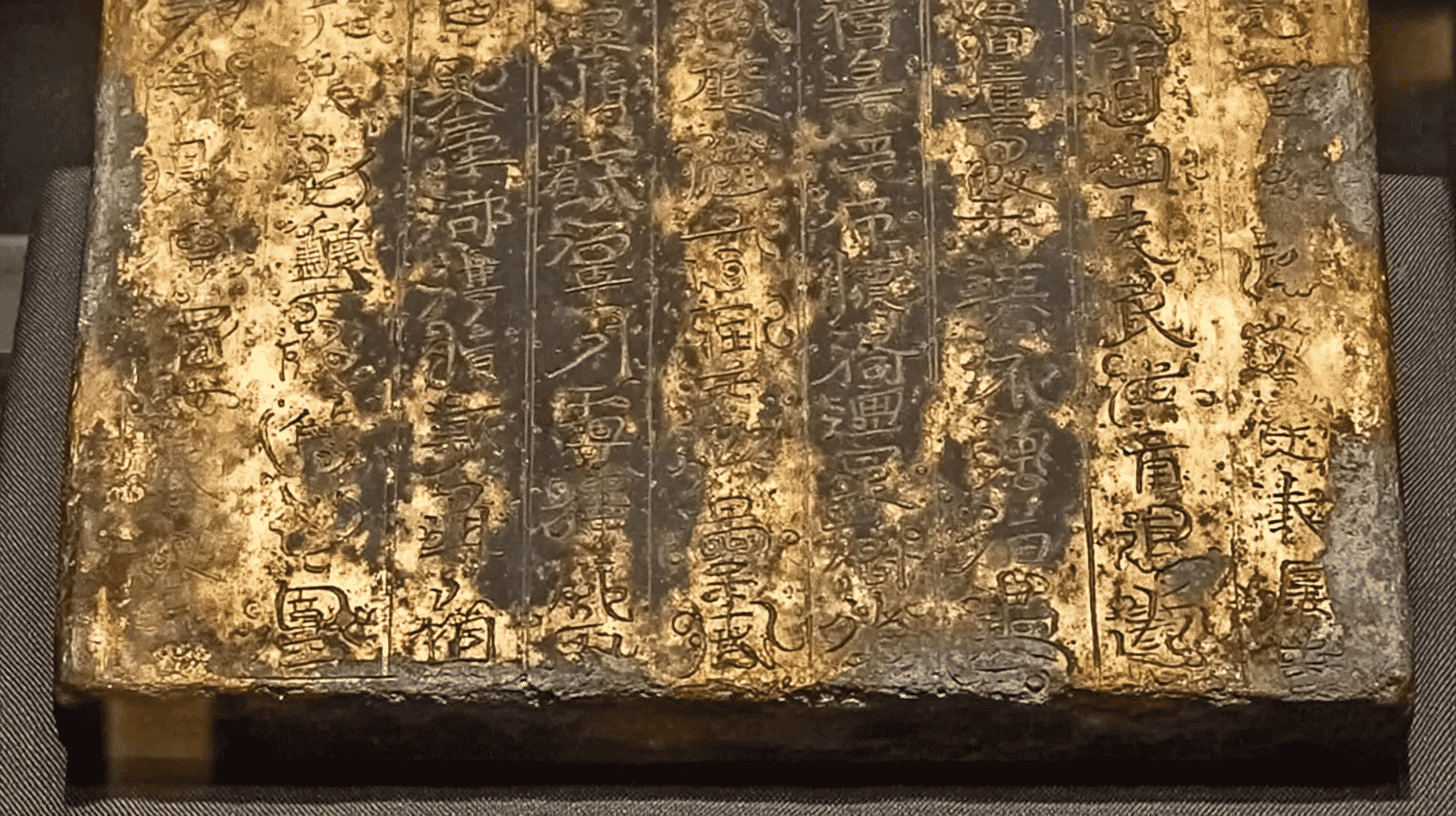
Gilt-Bronze Epitaph of Ishikawa no Toshitari: A National Treasure Linking the Nara Period to the Present
Buried for over a millennium in the hills of what is now Takatsuki City, Osaka, a small gilt-bronze plate quietly preserved the life story of one of the Nara period's most distinguished aristocrats. The Gilt-Bronze Epitaph of Ishikawa no Toshitari (金銅石川年足墓誌, Kondō Ishikawa Toshitari Boshi) is one of only fifteen known epitaphs surviving from 7th- and 8th-century Japan, and it stands as a remarkable bridge between the written chronicles of ancient Japan and the physical evidence that confirms them.
Designated a National Treasure in 1952, this small but exquisitely crafted artifact combines historical documentation with refined artistry, offering a window into the world of Nara period aristocracy, the influence of Tang Chinese culture on Japan, and the evolving funerary customs of an era when Buddhism was transforming Japanese society.
What Is the Epitaph?
The Gilt-Bronze Epitaph of Ishikawa no Toshitari is a rectangular bronze plate measuring approximately 29.6 cm in length, 10.4 cm in width, and just 0.3 cm in thickness. Both sides of the plate are gilded with gold, giving it a lustrous appearance that has endured across the centuries, though time has added a patina of verdigris in places.
On the front surface, a 130-character inscription is engraved in six vertical lines of elegant Tang-style calligraphy, set between finely ruled vertical lines. The text records the genealogy, official positions, death, and burial of Ishikawa no Toshitari, a high-ranking nobleman who served three successive emperors during the Nara period. Surrounding the inscription is an intricately engraved arabesque border pattern, so delicate in its execution that observers have noted the object feels more like a work of decorative art than a simple funerary record.
The epitaph was originally placed inside a wooden chest made of hinoki cypress, together with cremated human remains. This wooden chest, partially preserved and affixed with bronze nails, is also designated alongside the epitaph as an attached cultural property.
Ishikawa no Toshitari: A Nara Period Nobleman
Ishikawa no Toshitari (688–762 CE) was a descendant of one of ancient Japan's most powerful families, the Soga clan. According to the inscription, he was a tenth-generation descendant of the legendary Soga no Ishikawa Sukune, and the eldest son of Ishikawa no Iwatari, who held the Junior Third Rank and served as Left Senior Controller.
Toshitari's career began modestly. His first investiture did not come until the age of 47 — unusually late for an aristocrat of his standing. However, once elevated, he proved himself an exceptional administrator. While serving as governor of Izumo Province, Emperor Shōmu personally praised his benevolent governance and rewarded him with silk, cloth, and rice.
His fortunes rose further as his political ally Fujiwara no Nakamaro gained power. Toshitari eventually attained the Senior Third Rank and the prestigious title of Gyoshi-taifu (equivalent to Chief Councilor of State), while concurrently serving as Head of the Department of Worship (Jingikan Haku). This represented the highest office achieved by any member of the Soga/Ishikawa clan since his grandfather's era.
Beyond politics, Toshitari was a man of letters and faith. He appears in the Man'yōshū, Japan's oldest anthology of poetry, and was a devout Buddhist who commissioned the copying of sutras for the souls of his deceased son and parents. He passed away at the age of 75 at his residence in the capital, and was laid to rest in Sakadare-yama in Settsu Province.
Why Is It Designated a National Treasure?
The Gilt-Bronze Epitaph of Ishikawa no Toshitari holds National Treasure status for several compelling reasons that span historical, archaeological, and artistic significance.
First, it is one of only fifteen known epitaphs surviving from ancient Japan. While the Chinese tradition of burying inscribed tablets with the deceased was widely practiced during the Northern and Southern Dynasties through the Tang period, this custom was adopted in Japan only briefly, from the late 7th to the late 8th century. The scarcity of these objects makes each surviving example extraordinarily valuable.
Second, the epitaph confirms the historical existence and biographical details of a figure recorded in the Shoku Nihongi (the official chronicle of Japan) and the Man'yōshū. This kind of physical corroboration of literary and historical sources is exceptionally rare for the Nara period, providing scholars with invaluable cross-referencing material.
Third, the inscription reveals important details about aristocratic burial customs, genealogical practices, and administrative geography of the Nara period, including the ancient place names of Settsu Province, Shimōkami District, and Shiraga-gō — information that helps historians reconstruct the social landscape of 8th-century Japan.
Finally, the quality of craftsmanship is remarkable. The Tang-style calligraphy is beautifully executed, and the arabesque border demonstrates a level of artistic refinement that elevates this object beyond a mere historical document into the realm of fine metalwork.
Highlights and Points of Interest
If you have the opportunity to view the epitaph during one of its rare public exhibitions, several features are especially worth noting.
The arabesque border pattern is perhaps the most visually striking feature. Delicately engraved with a scrolling vine motif, it frames the inscription with an elegance that evokes the finest decorative arts of the Tang-influenced Nara period. Visitors who have viewed the epitaph in person recommend bringing a magnifying glass or monocular to fully appreciate the intricate detail of this border.
The calligraphy itself is written in a refined Tang Chinese literary style that includes not only genealogical and factual records but also a poetic eulogy at the end. The closing passage — which speaks of a legacy lasting a hundred generations, carriages of a thousand years, and the desolate night terrace where pine and cypress stand wreathed in mist — transforms the epitaph from an administrative record into a poignant memorial.
A replica of the epitaph is kept at the Tokyo National Museum, allowing visitors to study its form even when the original is not on display. The original, owned by a private collector and deposited at the Osaka Museum of History, is exhibited only occasionally — perhaps once every few years — making each public viewing a special event for cultural heritage enthusiasts.
The Story of Its Discovery
The epitaph remained hidden underground for more than a thousand years after Toshitari's burial in 762 CE, until a remarkable chain of events brought it to light in 1820 (Bunsei 3) during the Edo period.
According to local records, the landowner and village headman of Kōtoku village in Shimōkami District dreamed that the earth had collapsed near the Kōjin Pine on the southern slope of Kōjin-yama (also known as Sakadare-yama). Visiting the site the next morning, he discovered that the soil had indeed subsided slightly. Upon excavation, he found a wooden box surrounded by charcoal, and inside it, a gilt-bronze plate and human remains.
In 1849 (Kaei 2), the Tanaka family, who owned the land, erected a stone monument called the Kōjin-zuka to mark the burial site. This monument can still be seen today in the Magami-chō area of Takatsuki City, serving as a tangible connection to the discovery site.
Where to See the Epitaph
The original epitaph is deposited at the Osaka Museum of History, a striking modern building located adjacent to Osaka Castle. While the epitaph is not part of the museum's permanent display due to its private ownership and the need for careful conservation, it is occasionally exhibited during special exhibitions or loaned to other institutions.
The Osaka Museum of History itself is well worth a visit regardless. The museum covers 1,400 years of Osaka's history across four exhibition floors (floors 7 through 10), featuring life-size reconstructions of historical settings, including the magnificent Naniwa Palace throne hall on the top floor. The panoramic views of Osaka Castle from the 10th floor are spectacular.
For those interested in the broader archaeological context, the Tokyo National Museum houses a replica of the epitaph that can be viewed more regularly. Additionally, special exhibitions at institutions such as the Takatsuki Shiroato History Museum have occasionally featured the original.
Nearby Attractions
A visit to the Osaka Museum of History can easily be combined with exploration of the surrounding cultural treasures. Osaka Castle, one of Japan's most iconic landmarks, is located directly across the street and offers both historical exhibits and panoramic city views from its observation deck. The Naniwa Palace ruins, which lie beneath and beside the museum, can be explored through a guided underground tour.
For visitors specifically drawn to the Takatsuki area where the epitaph was discovered, the Imashirozuka Ancient History Museum provides an excellent introduction to the region's rich archaeological heritage, including the Imashirozuka Kofun, believed to be the tomb of Emperor Keitai. The nearby Takatsuki Shiroato History Museum also offers exhibitions related to local history and cultural properties.
Further afield, the Nara National Museum and the Tokyo National Museum both hold related collections of ancient Japanese epitaphs and Nara period artifacts, providing broader context for understanding this National Treasure within the wider arc of Japanese cultural history.
- 📍 Plan Your Visit to Osaka
- Find tours, activities & transport passes near Gilt-Bronze Ishikawa Tonoashi Tombstone
- [ USJ Tickets Osaka Castle & Dotonbori Food Tours ]
Q&A
- Can I see the Gilt-Bronze Epitaph of Ishikawa no Toshitari on a regular basis?
- The original epitaph is privately owned and deposited at the Osaka Museum of History, but it is not on permanent display. It is exhibited only occasionally, perhaps once every few years, during special exhibitions or when loaned to other museums. It is recommended to check the museum's website or exhibition schedule before visiting. A replica can be viewed at the Tokyo National Museum.
- Who was Ishikawa no Toshitari?
- Ishikawa no Toshitari (688–762 CE) was a high-ranking nobleman of the Nara period, descended from the powerful Soga clan. He served three emperors — Shōmu, Kōken, and Junin — and rose to the position of Gyoshi-taifu (equivalent to Chief Councilor of State) with the Senior Third Rank. He was also a poet featured in the Man'yōshū and a devout Buddhist.
- What language is the inscription written in?
- The inscription is written in classical Chinese (kanbun), which was the formal written language used by the Japanese court and elite during the Nara period. The calligraphy follows an elegant Tang Chinese style, and the literary composition demonstrates a high level of sophistication in Chinese poetic conventions.
- Is there anything to see at the actual discovery site in Takatsuki?
- Yes. A stone monument called the Kōjin-zuka, erected in 1849 to mark the burial site, still stands in the Magami-chō area of Takatsuki City. While there is no museum at the site itself, the nearby Imashirozuka Ancient History Museum and Takatsuki Shiroato History Museum offer related archaeological exhibits.
- How does this epitaph compare to other ancient Japanese epitaphs?
- The epitaph of Ishikawa no Toshitari is one of fifteen known ancient epitaphs from the 7th–8th centuries in Japan. Among these, it is distinguished by its refined Tang-style calligraphy, the poetic quality of its literary composition, and its beautifully engraved arabesque border. The Nara National Research Institute for Cultural Properties has noted that it represents one of the finest examples of Chinese-influenced literary style and artistic craftsmanship among surviving Japanese epitaphs.
Basic Information
| Official Name | 金銅石川年足墓誌 (Kondō Ishikawa Toshitari Boshi / Gilt-Bronze Epitaph of Ishikawa no Toshitari) |
|---|---|
| Category | National Treasure (Archaeological Material) |
| Designation Date | March 29, 1952 (originally designated as an Important Cultural Property on April 17, 1911) |
| Period | Nara period, Tenpyō Hōji 6 (762 CE) |
| Material | Gilt bronze (copper plate gilded with gold on both sides) |
| Dimensions | Length: 29.6 cm, Width: 10.4 cm, Thickness: 0.3 cm |
| Inscription | 130 characters in 6 lines (classical Chinese) |
| Excavation Site | Magami-chō, Takatsuki City, Osaka Prefecture (ancient Sakadare-yama, Shiraga-gō, Shimōkami District, Settsu Province) |
| Year of Discovery | 1820 (Bunsei 3, Edo period) |
| Owner | Private collection |
| Deposited At | Osaka Museum of History (大阪歴史博物館) |
| Museum Address | 4-1-32 Otemae, Chuo-ku, Osaka 540-0008 |
| Museum Hours | 9:30–17:00 (last entry 16:30) |
| Closed | Tuesdays (next day if holiday), December 28 – January 4 |
| Museum Admission | Adults: 600 yen / High school & university students: 400 yen / Junior high and younger: Free |
| Access | Osaka Metro Tanimachi Line / Chuo Line, "Tanimachi-Yonchome" Station, Exit 9 (immediately adjacent) |
| Attached Cultural Property | Fragments of wooden chest with bronze nails (木櫃残闕(銅釘付)) |
References
- 国宝-考古|金銅石川年足墓誌[個人蔵] | WANDER 国宝
- https://wanderkokuho.com/201-00835/
- 大阪歴史博物館:常設展:展示更新情報:【国宝】金銅石川年足墓誌
- https://www.osakamushis.jp/news/2006/tenjigae/060401.html
- 模造 石川年足墓誌 – 文化遺産オンライン
- https://bunka.nii.ac.jp/heritages/detail/496761
- 石川年足 – Wikipedia
- https://ja.wikipedia.org/wiki/%E7%9F%B3%E5%B7%9D%E5%B9%B4%E8%B6%B3
- Epitaphs of Ancient Japan – Nara National Research Institute for Cultural Properties
- https://www.nabunken.go.jp/english/e-catalogue/3.html
- ISHIKAWA no Toshitari – Japanese Wiki Corpus
- https://www.japanesewiki.com/person/ISHIKAWA%20no%20Toshitari.html
- 重要文化財|灌頂随願往生経(石川年足願経)|奈良国立博物館
- https://www.narahaku.go.jp/collection/1191-0.html
- List of National Treasures of Japan (archaeological materials) – Wikipedia
- https://en.wikipedia.org/wiki/List_of_National_Treasures_of_Japan_(archaeological_materials)
- 国宝「石川年足墓誌」が発見された「荒神塚」 – 日々是好日 とっつあんの雑記帳
- https://blog.goo.ne.jp/tottuan310920/e/0a65371d291a73544f11f9ef4d12b211
Last verified: 2026.02.08
Nearby heritages
- Battle of Sekigahara, Colored on Gold Paper (eight Panel
- Osaka Museum of History 4-1-32 Otemae, Chuo-ku, Osaka City, Osaka Prefecture
- Tachi Sword (inscribed with Norikuni; the Handle Bears a
- Osaka Museum of History 4-1-32 Otemae, Chuo-ku, Osaka City, Osaka Prefecture
- Paper Version of the Twelve Heavenly Illustrated Images
- Osaka Museum of History 4-1-32 Otemae, Chuo-ku, Osaka City, Osaka Prefecture
- Earthenware Vessel with a Lid and Stand
- Osaka Museum of History 4-1-32 Otemae, Chuo-ku, Osaka City, Osaka Prefecture
- Sword〈Mei Mamoru〉
- Osaka Museum of History 4-1-32 Otemae, Chuo-ku, Osaka City, Osaka Prefecture
- Haniwa Male Kneeling Statue
- Osaka Museum of History 4-1-32 Otemae, Chuo-ku, Osaka City, Osaka Prefecture
- Bronze Cup
- Osaka Museum of History 4-1-32 Otemae, Chuo-ku, Osaka City, Osaka Prefecture
- Haniwa Excavated from the Takamawari Kofun Group in
- 4-1-32 Otemae, Chuo-ku, Osaka
- Collection of Japanese Poems Selected After Emperor
- 4-1-32 Otemae, Chuo-ku, Osaka City, Osaka Prefecture
- Emperor Gokomatsu's Handwritten Yuzu Nembutsu Solicitation
- 4-1-32 Otemae, Chuo-ku, Osaka