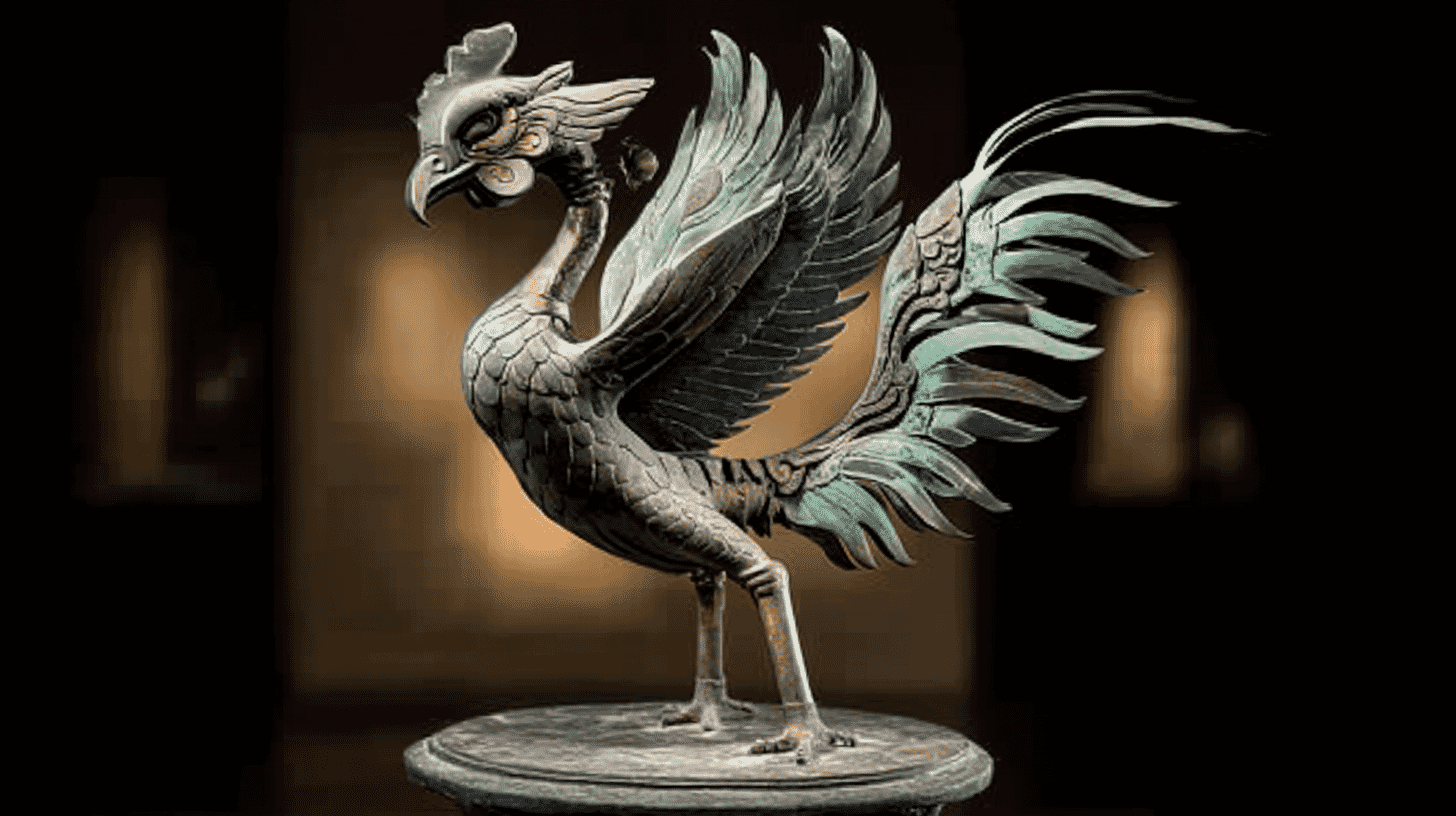
Gilt Bronze Phoenixes of Byodo-in: A National Treasure from Japan's Golden Age
Perched high above the roofline of one of the most beautiful buildings ever created in Japan, a pair of mythical birds once gazed across the waters of a paradise garden. These are the Gilt Bronze Phoenixes — Kondō Hōō (金銅鳳凰) — of Byodo-in Temple in Uji, Kyoto. Created in 1053 during the height of the Heian period, they are among the finest surviving examples of Japanese metalwork and hold the prestigious designation of National Treasure. Today, the original phoenixes rest safely inside the Byodo-in Museum Hoshokan, while faithful replicas stand watch on the temple roof, continuing a tradition that has endured for nearly a thousand years.
A Phoenix Born from the Dream of Paradise
The story of the Gilt Bronze Phoenixes begins with one of the most powerful families in Japanese history. In 1052, Fujiwara no Yorimichi — Regent and chief advisor to three emperors — converted his father Fujiwara no Michinaga's luxurious riverside villa in Uji into a Buddhist temple. The following year, in 1053, the Amida Hall (now universally known as the Phoenix Hall, or Hōō-dō) was completed. It was designed to embody the Pure Land Paradise of Amida Buddha on earth, a place of absolute tranquility and beauty where the faithful would be reborn after death.
To crown this vision of paradise, a pair of gilt bronze phoenix statues was placed at either end of the central hall's great ridge. The phoenix — hōō in Japanese — is a legendary bird of Chinese origin, believed to appear only in times of peace and virtuous rule. As a guardian of the Buddha, it was the perfect symbol for this earthly representation of the Western Paradise. From their elevated vantage point, the two phoenixes surveyed the temple's serene reflection in the Aji-ike pond below, completing a landscape intended to transport the viewer into the realm of the divine.
Masterwork of Heian Metalcraft
The Gilt Bronze Phoenixes are masterpieces of the chūdō tokkin technique — cast bronze with gold plating. Each phoenix was crafted in three separate sections and assembled together, a sophisticated method that demonstrates the advanced metallurgical skills of 11th-century Japanese artisans. The North Phoenix stands at a total height of approximately 235 centimeters (statue height 98.8 cm), while the South Phoenix measures about 228.8 centimeters in total height (statue height 95.0 cm).
The birds stand upon circular pedestal bases, their chests thrust proudly forward and their wings and tails spread wide in a posture of regal authority. The craftsmanship extends to the finest details: each head features a comb, crown feathers, and wattle, while sharp brows frame a powerful beak. Fish-scale patterns (gyorin-mon) ornament the neck and body, and a jeweled collar with a sacred gem encircles each throat. The flight feathers, many of which are later replacements, are fashioned from copper plate and attached with rivets, bearing engraved wave patterns created through the sukibori (chiseling) technique.
Although much of the original gold gilding has been lost to time and the statues are now covered in the green patina of aged bronze, the expressive power and refined craftsmanship remain immediately evident. These phoenixes represent the absolute pinnacle of Heian-period metalwork — a time when few such objects were created, making their survival all the more remarkable.
Why the Phoenixes Are Designated a National Treasure
The Gilt Bronze Phoenixes hold extraordinary value on multiple levels. As stated in the official designation, they are "outstanding masterpieces among the rare surviving craft objects of the Heian period" and "representative works in the history of Japanese metalwork." The cultural significance of these statues can be understood through several key points.
First, the extreme rarity of surviving Heian-period metalwork makes them irreplaceable documents of 11th-century artistic achievement. While Heian culture produced some of Japan's greatest literary and artistic works, very few metal craft objects from this era have survived the centuries of war, fire, and natural disaster that ravaged much of Japan's architectural heritage.
Second, the phoenixes are intimately connected to the Phoenix Hall itself — the only original structure remaining from the vast Byodo-in complex — and to the broader cultural world of the Fujiwara regency, when Japanese court culture reached its zenith. They form an inseparable part of the Phoenix Hall's identity and the UNESCO World Heritage Site of "Historic Monuments of Ancient Kyoto."
Third, the quality of the metalwork is exceptional. The balanced composition, the expressive modeling, and the refined surface decoration all speak to the highest level of craftsmanship available to the Fujiwara court.
The phoenixes were first designated as a National Treasure in 1951 together with the Phoenix Hall building. They were removed from the roof in 1965 for conservation and separately designated as an Important Cultural Property in 1972, before receiving their independent National Treasure designation on June 6, 1973.
An Icon on Japan's Currency
The Gilt Bronze Phoenixes are among the most widely recognized images in Japan, having appeared on the nation's currency. The South Phoenix was featured on the reverse of the 10,000 yen banknote from 2004 to 2024 (Series E), and a phoenix image also adorned an earlier series of the same note (Series C, 1958–1984). Meanwhile, the Phoenix Hall building itself has appeared on the reverse of the 10 yen coin since 1951. This makes Byodo-in the only cultural property in Japan to have been featured on both a coin and a banknote.
In July 2024, Japan introduced newly redesigned banknotes, and the 10,000 yen note's reverse was changed to feature Tokyo Station. However, the previous banknotes bearing the phoenix remain valid currency and continue to circulate. The phoenix's long presence on Japan's highest-denomination note is a testament to the deep cultural resonance of these magnificent statues.
Where to See the Original Phoenixes
The original Gilt Bronze Phoenixes are permanently displayed at the Byodo-in Museum Hoshokan (Hōshōkan), located within the temple grounds. Designed by acclaimed architect Akira Kuryu, the museum opened in 2001 and is largely built underground to preserve harmony with the historic landscape. Inside, natural light and carefully designed illumination create a contemplative atmosphere where visitors can appreciate the phoenixes at close range — something that was never possible when they stood on the rooftop nearly a thousand years ago.
In addition to the phoenixes, the museum houses other National Treasures from Byodo-in, including the original temple bell (bonshō) — one of Japan's "Three Great Bells" — and 26 of the 52 Bodhisattvas on Clouds (Unchū Kuyō Bosatsu) that originally adorned the interior walls of the Phoenix Hall. A computer-generated color reconstruction of the Phoenix Hall's original interior, with its vivid paintings of the Pure Land Paradise, is another highlight of the museum.
Admission to the Hoshokan Museum is included in the general Byodo-in admission fee. Photography is not permitted inside the museum, so take the time to observe the phoenixes closely and appreciate the intricate details of their nearly thousand-year-old craftsmanship.
The Phoenix Hall and Its Treasures
No visit to see the Gilt Bronze Phoenixes is complete without experiencing the Phoenix Hall itself. The hall is considered to have the highest concentration of National Treasures of any single space in Japan. Inside, visitors can see the sole surviving work by the great Heian sculptor Jōchō — the seated Amida Nyorai (Amida Buddha) statue — surrounded by the remaining Bodhisattvas on Clouds and fragments of the original wall paintings depicting scenes of the Pure Land.
From the outside, the Phoenix Hall presents one of Japan's most beloved views: its elegant symmetry reflected in the Aji-ike pond, with replica phoenix statues glinting on the rooftop. The building's design, with its central hall flanked by wing corridors that extend to either side, gives the structure the appearance of a great bird spreading its wings — the very quality that earned it the name "Phoenix Hall." Mornings, when the eastern sun illuminates the hall's facade, are considered the best time for viewing and photography.
Exploring the Surroundings
Byodo-in is situated in Uji, a charming city located between Kyoto and Nara that has been renowned since the Heian period. The area offers numerous attractions that complement a visit to the temple.
Uji is Japan's most celebrated green tea-producing region, and the streets leading to Byodo-in are lined with tea shops offering matcha, gyokuro, and hojicha. Inside the temple grounds, the tea salon Sabo Toka serves authentic Uji teas paired with seasonal Japanese sweets.
Just across the Uji River, Ujigami Shrine — also a UNESCO World Heritage Site — preserves what is believed to be the oldest surviving shrine building in Japan. The Tale of Genji Museum explores the final chapters of Japan's most famous literary masterpiece, which are set in this very area. A leisurely walk along the Uji River provides beautiful scenery, especially during cherry blossom season in spring and the vivid autumn foliage. Nearby Kosho-ji Temple is another hidden gem well worth visiting, particularly for its stunning tree-lined approach path.
Practical Tips for Visitors
Byodo-in is easily accessible from Kyoto. Take the JR Nara Line from Kyoto Station to JR Uji Station (approximately 16 minutes by rapid train), then walk about 10 minutes to the temple. Alternatively, the Keihan Uji Line reaches Keihan Uji Station, from which the temple is about an 8-minute walk.
Guided tours of the Phoenix Hall interior are available every 20 minutes (up to 50 visitors per session), with reception starting at 9:00 AM and tours running from 9:30 AM to 4:10 PM. These tours are conducted in Japanese, but multilingual brochures are available in English, Chinese, and Korean. An additional fee of 300 yen applies for the interior tour (cash only), on top of the general admission.
Allow at least 90 minutes to fully enjoy the temple grounds, museum, and Phoenix Hall interior. If you wish to also visit the tea salon and explore the sub-temples, plan for about two hours.
- 📍 Plan Your Visit to Kyoto
- Find tours, activities & transport passes near Gilt Bronze Phoenix (former Ridge Ornament of the Central
- [ Kinkakuji Fushimi Inari & Kimono Rental ]
Q&A
- Can I see the original Gilt Bronze Phoenixes, or only replicas?
- The original National Treasure phoenixes are on permanent display inside the Byodo-in Museum Hoshokan, which is included in the general admission fee. The statues on the Phoenix Hall rooftop are replicas installed after the originals were removed in 1965 for preservation.
- Are the phoenixes still featured on Japanese money?
- The phoenix appeared on the reverse of the 10,000 yen banknote from 2004 until the note was redesigned in July 2024. The previous notes remain valid and continue to circulate. The Phoenix Hall building still appears on the 10 yen coin.
- Is there English-language support at Byodo-in?
- Multilingual brochures (English, Chinese, Korean) are available at the reception. The museum has some multilingual displays. However, the guided tour of the Phoenix Hall interior is conducted only in Japanese. Audio guides are available on your own smartphone.
- When is the best time to visit Byodo-in?
- Early morning offers the best lighting for photography of the Phoenix Hall (the sun illuminates the east-facing facade). Spring cherry blossoms and autumn foliage are especially beautiful seasons. Weekday mornings tend to be less crowded. The temple's famous wisteria blooms in late April to early May.
- How long does it take to see the Gilt Bronze Phoenixes in the museum?
- The museum can be explored in about 20 to 30 minutes, though you may wish to spend longer with the phoenixes and other National Treasures. Combined with the garden and Phoenix Hall tour, plan for at least 90 minutes to two hours for the full experience.
Basic Information
| Official Name | Gilt Bronze Phoenixes (Former Ridge Ornament of Phoenix Hall Central Hall) — Kondō Hōō (Hōōdō Chūdō Kyū Munekazari) |
|---|---|
| Designation | National Treasure (Craft) — Designated June 6, 1973 |
| Period | Heian Period (1053 CE) |
| Material & Technique | Cast bronze with gold plating (chūdō tokkin); assembled from separately cast sections |
| Dimensions | North Phoenix: Total height 235.0 cm, statue height 98.8 cm; South Phoenix: Total height 228.8 cm, statue height 95.0 cm |
| Quantity | 1 pair (North and South) |
| Owner | Byodo-in Temple |
| Current Location | Byodo-in Museum Hoshokan (permanent display) |
| Address | 116 Ujirenge, Uji, Kyoto 611-0021, Japan |
| Admission | Adults 700 yen (includes garden and museum); Phoenix Hall interior tour: additional 300 yen (cash only) |
| Opening Hours | Garden: 8:45–17:30 (last entry 17:15); Museum: 9:00–17:00 (last entry 16:45); Phoenix Hall interior: 9:30–16:10 (every 20 min) |
| Access | 10-minute walk from JR Uji Station (JR Nara Line) or 8-minute walk from Keihan Uji Station |
| Official Website | https://www.byodoin.or.jp/en/ |
References
- Cultural Heritage Online — Gilt Bronze Phoenixes (Agency for Cultural Affairs)
- https://bunka.nii.ac.jp/db/heritages/detail/125947
- WANDER National Treasures — Gilt Bronze Phoenixes [Byodo-in / Kyoto]
- https://wanderkokuho.com/201-00552/
- Byodo-in Temple Official Website — Guide
- https://www.byodoin.or.jp/en/guide/
- Byodo-in Temple Official Website — Hoshokan Museum
- https://www.byodoin.or.jp/museum/
- Phoenix Hall — Cultural Heritage, Byodo-in Guide
- https://byodoinguide.jp/contents/content01/
- Wikipedia — Byodo-in (Japanese)
- https://ja.wikipedia.org/wiki/平等院
- nippon.com — World Heritage Kyoto "Byodo-in": Experience 360-Degree National Treasures at the Phoenix Hall
- https://www.nippon.com/ja/guide-to-japan/gu900261/
- KYOTO SIDE — Thorough Analysis of Byodo-in Phoenix Hall: Japan's Highest Density of National Treasures
- https://www.kyotoside.jp/entry/20210303/
- Byodo-in Temple FAQ — About General Visit
- https://www.byodoin.or.jp/en/faq/public/
Last verified: 2026.02.08
Nearby heritages
- Artifacts Excavated from Ozuka Tomb, Kaho County, Chikuzen
- Kyoto National Museum, 527 Chayamachi, Higashiyama-ku, Kyoto City, Kyoto Prefecture
- Bronze Statue of Nyoirin Kannon (half Seated) (said to Be
- Kyoto National Museum, 527 Chayamachi, Higashiyama-ku, Kyoto City, Kyoto Prefecture
- Wooden Standing Statue of Jizo Bodhisattva
- Kyoto National Museum, 527 Chayamachi, Higashiyama-ku, Kyoto City, Kyoto Prefecture
- Colored Statue of Ichikawabeian on Silk (written by Watanabe
- Kyoto National Museum, 527 Chayamachi, Higashiyama-ku, Kyoto City, Kyoto Prefecture
- Avatamsaka Sutra (Volume 40)
- Kyoto National Museum, 527 Chayamachi, Higashiyama-ku, Kyoto City, Kyoto Prefecture
- Avatamsaka Sutra, Volume 8
- Kyoto National Museum, 527 Chayamachi, Higashiyama-ku, Kyoto City, Kyoto Prefecture
- The Huayan Kongmu Zhang Fatsouki (Record of Enlightenment)
- Kyoto National Museum, 527 Chayamachi, Higashiyama-ku, Kyoto City, Kyoto Prefecture
- The Seven Chapters of the Avatamsaka Sutra, Volume 3,
- Kyoto National Museum, 527 Chayamachi, Higashiyama-ku, Kyoto City, Kyoto Prefecture
- Kegon Mongi-Ki (Volume 6, Remaining)
- Kyoto National Museum, 527 Chayamachi, Higashiyama-ku, Kyoto City, Kyoto Prefecture
- Silk Light Color Painting of Willow Herons and Flocks of
- Kyoto National Museum, 527 Chayamachi, Higashiyama-ku, Kyoto City, Kyoto Prefecture