Hokaiji Amida Hall: A National Treasure of Pure Land Paradise in Kyoto

Discover the Amida Hall of Hokaiji Temple, a National Treasure in Kyoto's Hino district. Explore its Kamakura-era architecture, celestial wall paintings, and the majestic Amida Buddha statue dating from the Fujiwara period.

Hokaiji Amida Hall — A Vision of Paradise Preserved for 800 Years

Tucked away in the quiet Hino district of Kyoto's Fushimi Ward, far from the bustling tourist corridors, stands a building that has silently safeguarded a vision of the Buddhist Pure Land for over eight centuries. The Amida Hall (阿弥陀堂) of Hokaiji Temple is one of Japan's designated National Treasures — a masterpiece of Kamakura-period sacred architecture that shelters an equally magnificent National Treasure within: a monumental seated Amida Buddha from the Fujiwara era, serene and golden, surrounded by some of the oldest surviving wall paintings in the country.

For visitors seeking an authentic encounter with Japanese spiritual culture beyond the well-known temples of central Kyoto, Hokaiji offers something rare and deeply moving — a place where the aspirations of Heian-era aristocrats for rebirth in the Western Paradise remain tangible in every brushstroke and beam.

The History of Hokaiji Temple

Hokaiji Temple belongs to the Daigo school of Shingon Buddhism and bears the mountain name Tokozan (東光山). The temple's origins date to 1051, when Fujiwara no Sukenari (also known as Hino Sukenari), a former doctor of letters who had entered the priesthood, enshrined a statue of Yakushi Nyorai (the Medicine Buddha) and established a hall on his family's estate in Hino. According to temple tradition, this Yakushi statue contained within it a tiny, approximately 10-centimeter figure of Yakushi Nyorai said to have been carved by Dengyo Daishi Saicho, the founder of the Tendai school, and passed down through the Hino family for generations.

The Hino family was a prominent branch of the Fujiwara Northern House (Fujiwara Hokke), known for their accomplishments in Confucian scholarship and poetry. In its heyday, the temple compound boasted numerous halls including a five-story pagoda, a Kannon hall, and a Godai hall. However, successive conflicts — most devastatingly the Jokyu War of 1221 — reduced the complex to the two structures that survive today: the Yakushi Hall (Main Hall) and the Amida Hall.

The Hino district carries profound significance in Japanese religious history. It was here that Shinran (1173–1263), the founder of Jodo Shinshu (True Pure Land Buddhism), was born as a son of the Hino clan. Tradition holds that young Shinran grew up visiting the Amida Hall and praying before its golden Buddha — an experience that may have planted the seeds of his revolutionary Pure Land teachings. The Hino family also produced Hino Tomiko, the powerful wife of Ashikaga Yoshimasa, the eighth shogun of the Muromachi period. The literary giant Kamo no Chomei, author of the celebrated essay Hojoki (An Account of My Hut), also lived in the Hino area.

Architecture of the Amida Hall

The current Amida Hall is believed to have been rebuilt shortly after the destruction caused by the Jokyu War of 1221, placing its construction in the early Kamakura period. It is one of the finest surviving examples of a Pure Land (Jodo) style Amida hall — a type of sacred architecture that flourished across Japan during the late Heian and early Kamakura periods, when belief in Amida Buddha's Western Paradise and anxiety about the coming age of mappo (the decline of Buddhist law) deeply shaped aristocratic spirituality.

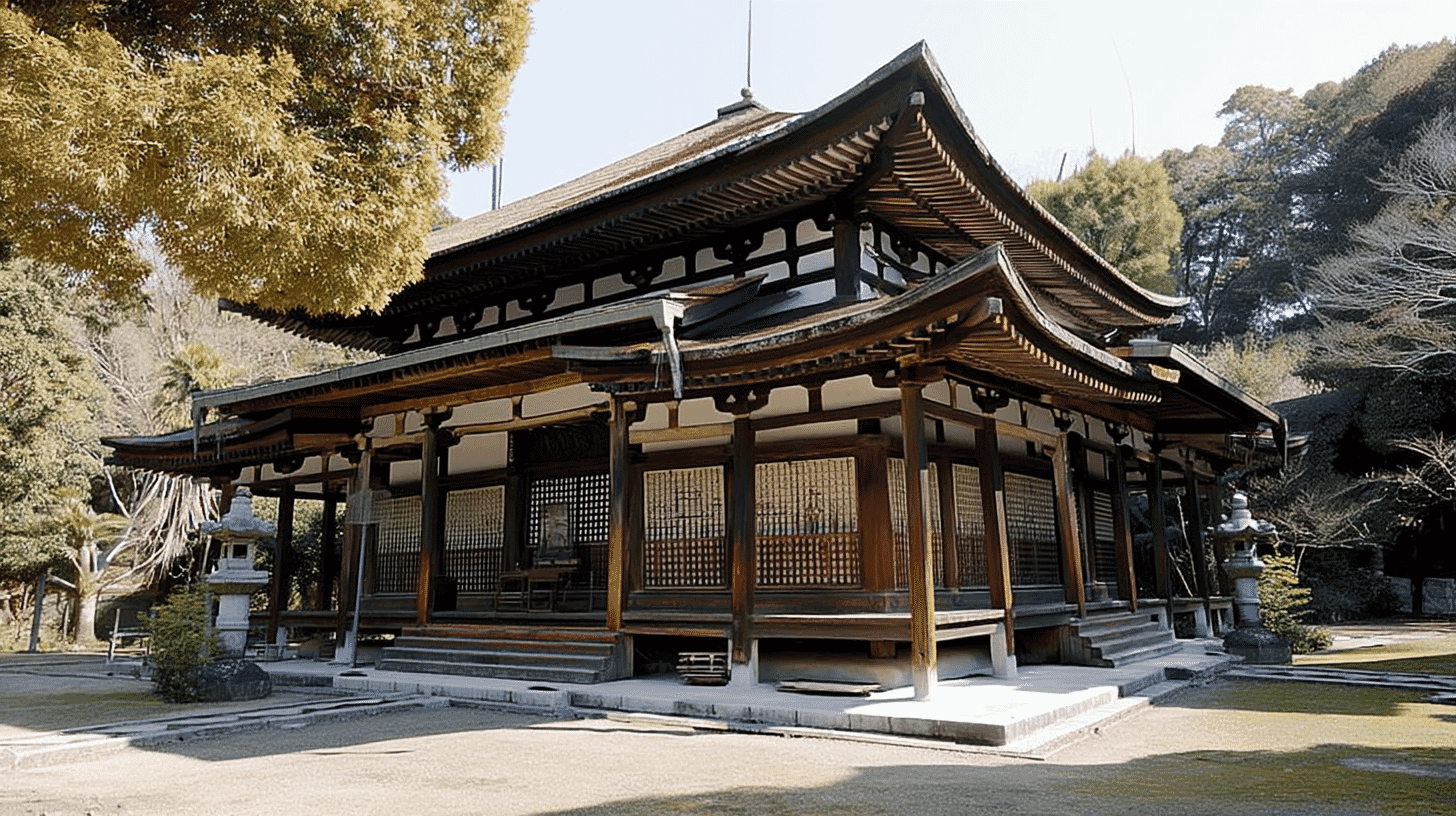
The hall measures five bays by five bays (approximately 13 meters square for the main structure) with a pyramidal hogyo-zukuri roof crowned by a sacred jewel (hoshu). The roof is thatched with Japanese cypress bark (hiwadabuki), its gentle curves lending the structure an air of refined elegance. A lower pent roof, called a mokoshi, wraps around the perimeter, giving the building the appearance of a two-story structure when viewed from outside, though it is in fact a single story.

The front three bays of the mokoshi are raised slightly higher than the rest, creating a subtle emphasis on the main entrance. The mokoshi area is left open, without walls or doors, allowing air and light to flow freely around the building. The main body of the hall features shitomi-do (hinged lattice shutters) across all five bays of its front face — a characteristic element of aristocratic Heian-period architecture.

Inside, there are no partition walls. Instead, four pillars arranged in a square — known as the shiten-chu (Four Heavenly Pillars) — define the inner sanctuary (naijin) around the central altar. The placement of these pillars is deliberately offset from the outer pillars, creating more generous space in the outer sanctuary (gejin) for worshippers to circumambulate the Buddha image. This layout reflects the practice of jogyo-zammai (perpetual walking meditation), in which devotees would walk around the Amida image while chanting the nenbutsu — a practice central to Pure Land devotion.

Why It Was Designated a National Treasure

The Amida Hall was first registered as an Important Cultural Property (then called a "Special Protection Building") on December 28, 1897, and was elevated to National Treasure status on June 9, 1951. Several factors make it an irreplaceable part of Japan's cultural heritage.

First, it is one of the best-preserved examples of the Jodo-style Amida hall — a building type that embodies the spiritual aspirations of Heian and Kamakura aristocracy. While the famous Phoenix Hall (Hoo-do) at Byodoin in Uji represents the most celebrated example of this architectural tradition, the Hokaiji Amida Hall offers a distinctly different character. Official records describe it as possessing an exceptionally "pure" and "magnanimous" quality — more restrained and meditative compared to the ornate grandeur of Byodoin.

Second, the hall is remarkable for preserving both its architectural form and its interior program — the Buddha statue, the wall paintings, and the decorative schemes — as an integrated artistic ensemble from a single historical period. This kind of completeness is exceedingly rare among surviving medieval Japanese temples.

Third, the inner sanctuary retains its original configuration from the time of construction, including the form of the shumidan altar with its railing and ornamental finials, which display characteristic features of the period. This provides invaluable evidence of early Kamakura-period temple interior design.

The Amida Nyorai Seated Statue — A Masterpiece in Gold

Enthroned at the center of the hall is the principal image: a magnificent wooden seated statue of Amida Nyorai (Amitabha Buddha). This figure was created during the late Heian period (late 11th century) and was designated a National Treasure on March 29, 1952.

Standing 2.8 meters tall (a scale known as joroku, indicating it represents one-and-a-half times the height of a standing human), the statue is crafted in the yosegi-zukuri technique — assembled from multiple carved wooden blocks — and finished with gold lacquer (urushi-haku). It sits in meditation upon an octagonal, nine-tiered lotus pedestal, its hands forming the jo-bon josho mudra (the highest grade of the highest rank in Amida's Pure Land), while a delicate halo featuring carved celestial beings (hiten) rises behind it.

Art historians regard this statue as one of the finest and most faithful examples of the Jocho style — the sculptural aesthetic established by the master carver Jocho, whose seated Amida at the Byodoin Phoenix Hall (1053) set the standard for all subsequent Fujiwara-period Buddhist sculpture. The Hokaiji Amida shares the Byodoin figure's plump, gentle cheeks, half-closed eyes gazing downward in infinite compassion, and delicately flowing robes that seem as thin as silk. Together with the Amida figures at Byodoin and Hokongo-in, this statue is sometimes counted among the "Three Amidas of Jocho."

To stand before this figure in the dim, atmospheric interior of the hall — golden and still, radiating quiet benevolence over a millennium — is one of Kyoto's most unforgettable spiritual experiences.

Celestial Wall Paintings — Japan's Living Artistic Heritage

The interior walls and pillars of the Amida Hall preserve an extraordinary program of painted decoration dating from the time of the hall's construction, designated as Important Cultural Properties. These paintings are among the oldest surviving complete wall paintings in Japan — a distinction that became even more significant after the tragic fire that destroyed the celebrated murals of Horyuji's Golden Hall in 1949.

The decorative program comprises 23 panels painted on the plaster walls above the nageshi (horizontal rails) of the inner sanctuary. These include ten panels depicting hiten (celestial beings or apsaras), graceful figures shown scattering flower petals from the sky as offerings to the Buddha; eight panels of seated Amida figures; and five panels depicting ritual implements — flying incense burners (higyo-kasha), flower trays (keban), and musical instruments.

Above these, 24 panels of hosoge (stylized sacred lotus flower) patterns adorn the upper walls, while the coffered ceiling (oriagekumi-tenjo) of the inner sanctuary is painted with further hosoge designs. The Four Heavenly Pillars bear images of deities from the Vajradhatu (Diamond Realm) mandala, the Twelve Heavenly Generals, and the mythical kalavinka birds, though centuries of exposure have caused significant fading and flaking on these surfaces.

What makes these murals particularly rare in Japan is their medium: they are painted on earthen plaster walls (tsuchi-kabe), rather than the wooden panels more commonly used in Japanese temple decoration. The celestial figures are rendered with a free, spontaneous brushwork — gentle-eyed, their robes and scarves billowing in heavenly winds — that captures the elegant, otherworldly aesthetic of the Fujiwara era with remarkable freshness. Together, these paintings transformed the entire interior into a three-dimensional vision of Amida's Pure Land, where art and architecture merge to create a total environment of sacred beauty.

Other Highlights at Hokaiji Temple

While the Amida Hall is undoubtedly the temple's crown jewel, Hokaiji offers several additional points of interest for visitors.

The Yakushi Hall (Main Hall) is itself an Important Cultural Property. The current structure was relocated from Dento-ji Temple in Tatsuta, Ikaruga, Nara Prefecture, in 1904, and dates originally from 1456 (Muromachi period). Inside, it enshrines the temple's principal deity — a standing Yakushi Nyorai figure (Important Cultural Property) from the late Heian period. This statue is popularly known as "Chichi Yakushi" (the Breastfeeding Medicine Buddha), because it is believed to bless expectant and nursing mothers. Visitors will notice the touching sight of many small baby bibs (yodare-kake) hung as votive offerings before the hall — a living testament to centuries of faith.

The lotus pond in front of the Yakushi Hall blooms beautifully from mid-July to early August, adding a seasonal dimension to the visit. Behind the temple, the Hino Family Mausoleum preserves the graves of Shinran's parents, sheltered beneath ancient trees in a serene, contemplative setting.

Each year on January 14, the temple hosts the Hino Hadaka-odori (Hino Naked Festival), a Kyoto City Registered Intangible Folk Cultural Property. During this ritual, men and boys in loincloths purify themselves with cold water and then dance on the veranda of the Amida Hall, clapping their hands above their heads and chanting "Chorai! Chorai!" (a Buddhist invocation meaning "I pay homage"), praying for bountiful harvests and good health. The loincloths used in the ceremony are afterward sought as maternity bands, believed to ensure safe childbirth.

Surrounding Area and Nearby Attractions

Hokaiji is situated in the historic Hino district, a peaceful residential area on the southeastern outskirts of Kyoto near the Uji city boundary. The area retains a rural atmosphere that contrasts beautifully with the urban energy of central Kyoto, making it ideal for visitors who appreciate quiet exploration.

Just a short walk east of the temple stands Hino Tanjo-in, a Jodo Shinshu temple built on the traditional site of Shinran's birth. For anyone interested in the history of Japanese Buddhism, visiting both temples together provides a powerful connection to the origins of one of Japan's most widely practiced faiths.

To the north, the UNESCO World Heritage Site of Daigoji Temple is accessible via subway from Ishida Station to Daigo Station. Daigoji is renowned for its spectacular cherry blossoms — Toyotomi Hideyoshi held his legendary flower-viewing party here in 1598 — and houses a magnificent five-story pagoda, the oldest surviving structure in Kyoto Prefecture (built in 951).

Other notable temples in the broader area include Zuishin-in (associated with the Heian-era poet Ono no Komachi) and Kajuji, both accessible via the Tozai subway line. For those continuing southward, the city of Uji offers the Byodoin Phoenix Hall — another National Treasure Amida hall that makes a fascinating comparison with Hokaiji — as well as Ujigami Shrine, both UNESCO World Heritage Sites.

📍 Plan Your Visit to Kyoto
Find tours, activities & transport passes near Hokaiji Amida Hall
[ Kinkakuji Fushimi Inari & Kimono Rental ]

Q&A

QIs the interior of the Amida Hall open to the public?
AYes, the Amida Hall interior is open for viewing during regular hours (9:00–17:00 from April to September, 9:00–16:00 from October to March). An admission fee applies. When the hall is locked during quiet periods, you can ring the bell or call at the reception, and a staff member will open it and offer a guided explanation in Japanese.
QIs photography allowed inside the Amida Hall?
APhotography policies may vary, so it is best to confirm with the temple staff upon arrival. Generally, photography of National Treasure interiors is restricted at many Japanese temples. The temple does sell beautiful sets of wall painting reproductions and postcards as souvenirs.
QHow do I get to Hokaiji Temple from Kyoto Station?
ATake the Kyoto Municipal Subway Karasuma Line to Karasuma-Oike Station, transfer to the Tozai Line, and ride to Ishida Station. From there, it is approximately a 20-minute walk. Alternatively, take a Keihan Bus from Rokujizo Station (Keihan Uji Line, JR Nara Line, or Subway Tozai Line) on Route 8 to the "Hino Yakushi" bus stop, which is directly in front of the temple.
QHow does Hokaiji Amida Hall compare with the Byodoin Phoenix Hall?
ABoth are outstanding examples of Fujiwara-era Pure Land architecture housing National Treasure Amida statues in the Jocho style. However, while Byodoin is celebrated for its ornate, wing-like exterior, Hokaiji's Amida Hall has a more contemplative, understated beauty. Hokaiji also preserves its original interior painting program and provides an intimate, uncrowded viewing experience. The two make an excellent pair to visit on the same day.
QWhat is the best season to visit?
AHokaiji is beautiful year-round. The lotus pond before the Yakushi Hall is at its finest from mid-July to early August. Autumn foliage provides a lovely backdrop in November. For a unique cultural experience, visit on January 14 for the Hino Naked Festival (Hadaka-odori). Spring cherry blossoms in the surrounding Hino area are also charming.

Basic Information

Name Hokaiji Temple Amida Hall (法界寺阿弥陀堂)
Designation National Treasure (Architecture) — designated June 9, 1951
Period of Construction Early Kamakura period (early 13th century, after 1221)
Architectural Style 5-bay × 5-bay, single story with mokoshi (lower eaves), hogyo-zukuri (pyramidal roof), hiwadabuki (cypress bark thatch)
Principal Image Wooden Seated Amida Nyorai (National Treasure, Fujiwara period, H. 280 cm, yosegi-zukuri, gold lacquer)
Temple Affiliation Tokozan Hokaiji (東光山法界寺), Daigo school of Shingon Buddhism (Bekaku Honzan)
Temple Founder Hino Sukenari (日野資業), 1051
Address 19 Hino Nishi Omichi-cho, Fushimi-ku, Kyoto 601-1417, Japan
Phone 075-571-0024
Hours 9:00–17:00 (April–September) / 9:00–16:00 (October–March)
Admission Adults: ¥500 / High school students: ¥400 / Junior high & elementary students: ¥200
Access Keihan Bus Route 8 to "Hino Yakushi" stop (directly in front); or approx. 20-min walk from Ishida Station (Kyoto Municipal Subway Tozai Line)

References

文化遺産データベース — 法界寺阿弥陀堂
https://bunka.nii.ac.jp/db/heritages/detail/156455
ひのやくし 法界寺 — 阿弥陀堂
https://hino-houkaiji.com/amidado/
ひのやくし 法界寺 — 東光山 法界寺について
https://hino-houkaiji.com/about/
ひのやくし 法界寺 — 参拝のご案内
https://hino-houkaiji.com/sanpai/
法界寺 — Wikipedia
https://ja.wikipedia.org/wiki/%E6%B3%95%E7%95%8C%E5%AF%BA
法界寺 — 京都市観光協会
https://ja.kyoto.travel/tourism/single01.php?category_id=7&tourism_id=456
Hokai-ji Temple — Japanese Wiki Corpus
https://www.japanesewiki.com/shrines/Hokai-ji%20Temple.html
法界寺 — 京都通百科事典
https://www.kyototuu.jp/Temple/HoukaiJi.html
法界寺 — 西国四十九薬師霊場会
https://yakushi49.jp/38hokaiji/
国宝-建築|法界寺 阿弥陀堂 — WANDER 国宝
https://wanderkokuho.com/102-01916/
京都の文化遺産を守り継ぐために「日野薬師 法界寺の歴史と文化財の維持保存」 — 京都市文化観光資源保護財団
https://www.kyobunka.or.jp/learn/learn_art/1971.php

Last verified: 2026.02.08

Nearby heritages
