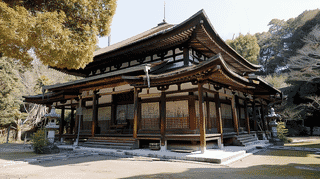
Hokaiji Main Hall (Yakushi-do): A Muromachi-Period Treasure in Kyoto's Hino District
Tucked away in the quiet Hino district of Kyoto's Fushimi Ward, Hokaiji Temple holds a remarkable collection of cultural treasures spanning nearly a millennium. Among them, the Main Hall — known as the Yakushi-do — stands as a designated Important Cultural Property of Japan. Originally built in 1456 during the Muromachi period, this hall was relocated to its current site in 1904 and continues to enshrine the temple's principal deity, a sacred statue of Yakushi Nyorai (the Medicine Buddha). The hall is a testament to the enduring spiritual traditions of the Hino clan, one of Japan's most historically significant aristocratic families.
Historical Background: The Hino Clan and the Founding of Hokaiji
Hokaiji Temple traces its origins to 1051 (Eisho 6), when Hino Sukenari, a scholar-turned-monk of the Fujiwara Northern House, constructed a hall to enshrine a statue of Yakushi Nyorai. Inside this statue, he placed a small three-inch image of Yakushi said to have been carved by Saicho (Dengyo Daishi), the founder of the Tendai school of Buddhism, which had been passed down through generations of the Hino family.
The Hino clan produced several figures of great historical importance. Shinran, the founder of Jodo Shinshu (True Pure Land Buddhism), was born at this very temple in 1173. Hino Tomiko, the wife of the eighth Ashikaga shogun Yoshimasa and a pivotal figure in the Onin War, also hailed from the Hino family. The area is additionally associated with Kamo no Chomei, the celebrated author of Hojoki (An Account of My Hut).
The Main Hall (Yakushi-do): Architecture and Designation
The current Main Hall was not originally built for Hokaiji. It was constructed in 1456 (Kosho 2) as the main hall of Dento-ji, a temple in Tatsuta, Ikaruga Town, Nara Prefecture. Dento-ji had served as the jingu-ji (shrine-temple) of Tatsuda Shrine but eventually fell into disuse. In 1904 (Meiji 37), the hall was carefully disassembled and relocated to Hokaiji, where it was reassembled as the new Main Hall.
The building measures five bays in width (keta-yuki) and four bays in depth (hari-ma), with a single-story hip roof (yosemune-zukuri) covered in hon-kawara (formal tile) roofing. The interior follows the traditional esoteric Buddhist layout, divided by lattice screens into an inner sanctuary (naijin) and an outer worship space (gejin). The naijin features a coffered ceiling (go-tenjo), while the innermost section has an elegant raised coffered ceiling (oriagego-tenjo). A ridge tag (munafuda) discovered during the relocation confirmed the 1456 construction date, making this a valuable surviving example of Muromachi-period Buddhist architecture. The hall was designated an Important Cultural Property on April 5, 1909.
Why Was It Designated a Cultural Property?
The Yakushi-do holds significance for several reasons. First, its confirmed 1456 construction date — verified by the original ridge tag — provides a precisely dated example of mid-Muromachi religious architecture. The building preserves the characteristic esoteric temple interior layout of the period. Second, its relocation history is itself noteworthy: the successful transplantation of an entire temple hall from Nara to Kyoto in the early twentieth century represents an important chapter in Japan's cultural preservation efforts. The hall also provides the setting for an exceptional group of Buddhist sculptures that are themselves designated Important Cultural Properties.
Highlights: The Sacred Treasures Within
The Yakushi-do enshrines the temple's principal image, a standing statue of Yakushi Nyorai (Important Cultural Property) dating from the late Heian period. Standing 88 centimeters tall and carved from cherry wood (sakura) using the yosegi-zukuri (joined woodblock) technique, the statue is unusual for its era in its choice of material. Because the image was long kept as a hidden Buddha (hibutsu), its kirikane (cut gold leaf) decorative patterns on the robes remain remarkably well preserved.
Inside the statue's body rests a small subsidiary image — the three-inch Yakushi said to have been made by Saicho himself. This "womb within a womb" imagery led to the statue's association with pregnancy and childbirth, earning the temple its popular name "Chichi Yakushi" (Milk Yakushi). For centuries, expectant mothers have come to pray here for safe delivery and abundant breast milk. Today, the lattice screens of the Yakushi-do are covered with votive bibs (yodare-kake) sent by mothers from across Japan, so densely layered that the interior of the hall is barely visible from outside.
Flanking the principal image within its shrine cabinet (zushi) are attendant statues of Nikko Bosatsu and Gakko Bosatsu from the Kamakura period. In two additional shrine cabinets to the left and right stand twelve Junishin-sho (Twelve Heavenly Generals), also from the Kamakura period and designated Important Cultural Properties. Each figure, roughly 60 centimeters tall, is crowned with a carved zodiac animal and displays a dynamic, powerful pose. Note that both the principal image and the Twelve Generals are normally closed to public viewing.
The National Treasure Amida-do: A Must-See Neighbor
Standing directly across from the Yakushi-do within the temple precinct is the Amida-do (Amida Hall), designated a National Treasure. This hall, rebuilt in the Kamakura period around 1226, is one of the finest surviving examples of Amida-do architecture from the era of Pure Land Buddhist devotion. Its graceful cypress-bark hip roof and surrounding mokoshi (pent roof) shelter a majestic 2.8-meter seated Amida Nyorai (also a National Treasure) in the jocho style — considered alongside the Amida at Byodo-in and Hokongo-in as one of the three great Amida statues attributed to the master sculptor Jocho's tradition. The interior walls are adorned with celestial maiden murals (Important Cultural Property), among the oldest surviving painted wall decorations in Japan, depicting heavenly beings scattering flower petals in offerings.
Visitor Information
Hokaiji Temple welcomes visitors year-round. The temple grounds offer a serene retreat from the bustle of central Kyoto, with the two historic halls — the National Treasure Amida-do and the Important Cultural Property Yakushi-do — forming the heart of the precinct. The Amida-do interior, with its stunning Amida statue and wall paintings, is open for regular viewing. The Yakushi-do's principal image is normally kept hidden, though rare special viewings do occur — most recently in 2016, when the statue was shown publicly for the first time in 51 years as part of the Kyoto Special Cultural Properties Exhibition.
Every January 14th, the temple hosts the Hokaiji Hadaka Odori (Naked Festival), a registered Intangible Folk Cultural Property of Kyoto City. In this striking ritual, men and boys clad only in loincloths gather on the veranda of the Amida-do, clapping their hands above their heads and chanting "Chorai! Chorai!" while pressing against one another in prayer for good harvests and health. The loincloths worn during the ritual are believed to bring safe childbirth when later used as maternity belts.
Surrounding Attractions
The Hino area offers several points of interest for visitors wishing to explore further. Hino Tanjoin, a Jodo Shinshu temple built in the Edo period to commemorate Shinran's birthplace, is located just a short walk from Hokaiji. Behind the temple grounds, the Hino family mausoleum preserves the graves of Shinran's parents, Hino Arinori and Kikko-nyo, shaded by ancient trees. The UNESCO World Heritage site of Daigoji Temple, one of Kyoto's grandest temple complexes, lies approximately 2 kilometers to the north. The quiet rural atmosphere of Hino itself, set among gentle hills near the border with Uji City, provides a welcome contrast to the more heavily visited areas of Kyoto.
- 📍 Plan Your Visit to Kyoto
- Find tours, activities & transport passes near Hokaiji Temple Main Hall (Yakushido)
- [ Kinkakuji Fushimi Inari & Kimono Rental ]
Q&A
- What is the Yakushi-do (Main Hall) of Hokaiji, and why is it important?
- The Yakushi-do is the Main Hall of Hokaiji Temple, designated an Important Cultural Property of Japan. Originally built in 1456 during the Muromachi period as part of a temple in Nara, it was relocated to Hokaiji in 1904. It preserves a characteristic esoteric Buddhist architectural layout and houses several important Buddhist sculptures including the principal Yakushi Nyorai statue.
- Can I see the principal Yakushi Nyorai statue?
- The Yakushi Nyorai is normally kept as a hidden Buddha (hibutsu) and is not on regular public display. Special viewings are held on rare occasions — the most recent was in 2016, the first public showing in over 50 years. However, you can admire the countless votive bibs covering the hall's lattice screens, a moving testament to centuries of maternal devotion.
- What is the connection between Hokaiji and Shinran?
- Shinran (1173–1263), the founder of Jodo Shinshu Buddhism, was born at Hokaiji Temple. His father, Hino Arinori, was a member of the Hino clan. Shinran spent his early childhood in this area before being ordained at age nine. The nearby Hino Tanjoin was later built to commemorate his birthplace.
- How do I get to Hokaiji Temple?
- Take the Keihan Bus (Route 8) and alight at the Hino Yakushi stop, which is right in front of the temple. Alternatively, from Ishida Station on the Kyoto Municipal Subway Tozai Line, it is approximately a 20-minute walk. From Rokujizo Station (Keihan, JR, or subway), take a Keihan Bus bound for Higashi-mikurayama and get off at Hino Tahokcho, then walk 5 minutes. Free parking is available for visitors arriving by car.
- What are the admission fees and opening hours?
- Admission is 500 yen for adults, 400 yen for high school students, and 200 yen for elementary and junior high school students. The temple is open from 9:00 AM to 5:00 PM (April–September) and 9:00 AM to 4:00 PM (October–March). Group visits require advance reservation.
Basic Information
| Name | Hokaiji Main Hall (Yakushi-do) / 法界寺本堂(薬師堂) |
|---|---|
| Designation | Important Cultural Property (designated April 5, 1909) |
| Construction | 1456 (Kosho 2), Muromachi period |
| Original Location | Dento-ji Temple, Tatsuta, Ikaruga-cho, Nara Prefecture |
| Relocation | 1904 (Meiji 37), moved to Hokaiji Temple |
| Structure | 5 bays × 4 bays, single story, hip roof (yosemune-zukuri), hon-kawara tile roofing |
| Temple | Hokaiji (Shingon-shu Daigo-ha Bekkaku Honzan) |
| Mountain Name | Tokozan (東光山) |
| Address | 19 Hino Nishiomichi-cho, Fushimi-ku, Kyoto 601-1417 |
| Phone | 075-571-0024 |
| Website | https://hino-houkaiji.com/ |
| Hours | 9:00–17:00 (Apr–Sep) / 9:00–16:00 (Oct–Mar) |
| Admission | Adults ¥500, High school ¥400, Elementary/Junior high ¥200 |
| Access | Keihan Bus "Hino Yakushi" stop (immediate); Subway Tozai Line "Ishida" Station (20 min walk) |
References
- 法界寺 - Wikipedia
- https://ja.wikipedia.org/wiki/%E6%B3%95%E7%95%8C%E5%AF%BA
- ひのやくし 法界寺 公式ホームページ
- https://hino-houkaiji.com/
- 法界寺 - 京都観光Navi
- https://ja.kyoto.travel/tourism/single01.php?category_id=7&tourism_id=456
- 法界寺 | 西国四十九薬師霊場会
- https://yakushi49.jp/38hokaiji/
- 法界寺 京都通百科事典
- https://www.kyototuu.jp/Temple/HoukaiJi.html
- 法界寺(日野薬師) | 京都に乾杯
- https://www.kyotonikanpai.com/spot/04_04_yamashina_daigo/hokaiji.php
Last verified: 2026.04.11