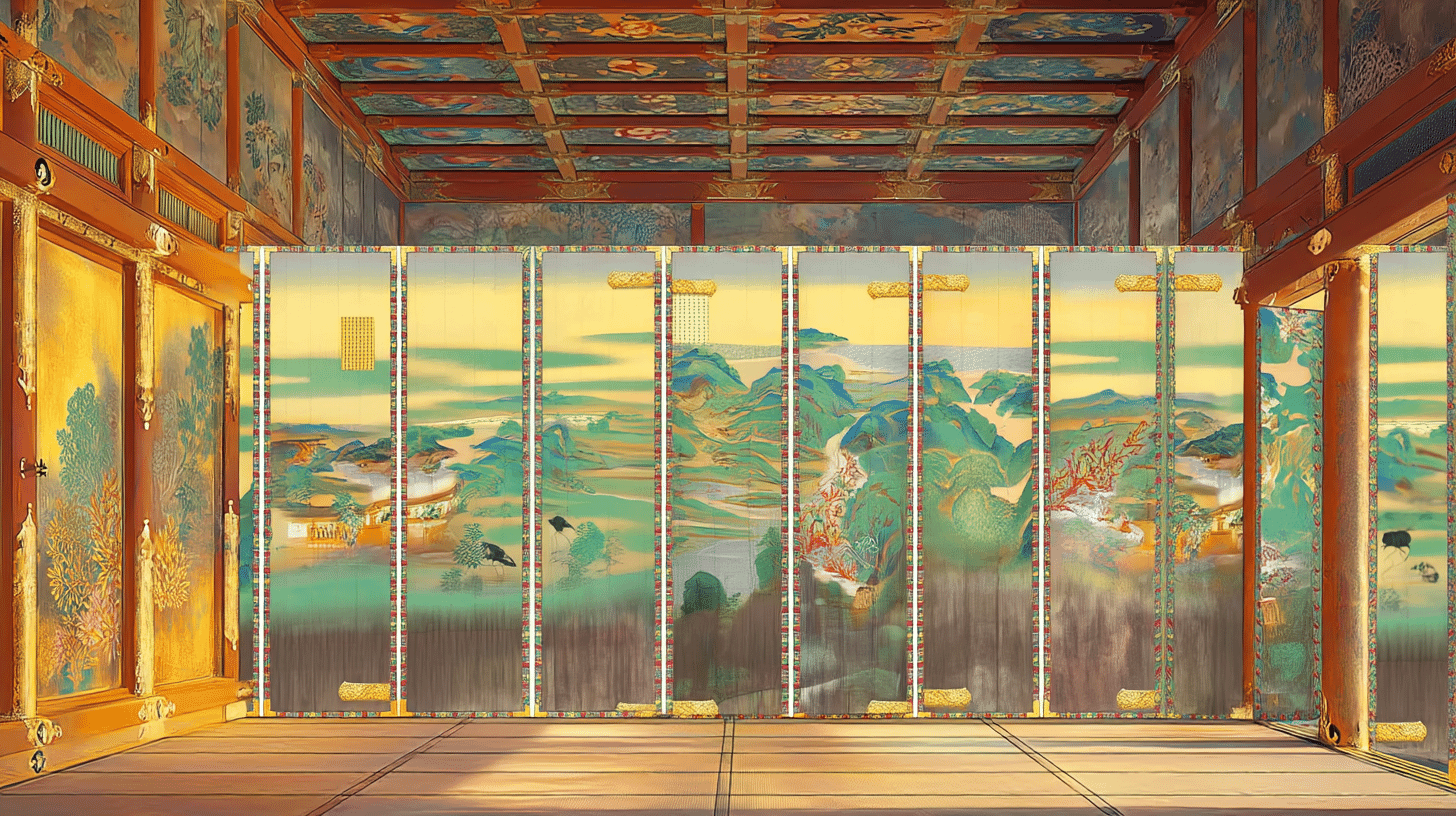
Phoenix Hall Wall & Door Paintings: A Thousand-Year-Old Vision of Paradise
Deep within the iconic Phoenix Hall of Byodo-in Temple in Uji, Kyoto, a set of extraordinary paintings has survived for nearly a millennium. Known formally as the Paintings on the Walls and Doors of Chu-do Hall of Phoenix Hall (鳳凰堂中堂壁扉画), these 14 panels of colored images on wooden boards constitute one of Japan's most precious National Treasures in the painting category. Created in 1053 CE to adorn the interior of the newly completed Amida Hall, they represent Japan's oldest surviving examples of Kuhon Raigo-zu — depictions of the nine grades of rebirth in the Buddhist Pure Land — rendered in the classical Yamato-e painting style.
These paintings were not merely decorative. For the Heian-period aristocrats who commissioned them, they served as tangible windows into the afterlife — vivid portrayals of the moment when Amida Buddha would descend from the Western Paradise to welcome the souls of the faithful. Today, they remain an irreplaceable record of 11th-century Japanese religious art, aesthetics, and the spiritual aspirations of an entire era.
The Historical Context: An Age of Spiritual Anxiety
To truly appreciate these paintings, it is essential to understand the world in which they were created. The year 1052 was of momentous significance in Japanese Buddhism: it was believed to mark the beginning of Mappo, the "Latter Day of the Law" — a degenerate age in which the teachings of the Buddha would decline and enlightenment through traditional practice would become virtually impossible. This belief sent waves of spiritual anxiety through Heian-period society, particularly among the aristocracy.
In response, Pure Land Buddhism surged in popularity. This tradition centered on faith in Amida Buddha (Amitabha) and aspiration for rebirth in his Western Paradise, known as Gokuraku Jodo. The monk Genshin's influential text Ojoyoshu (Essentials of Pure Land Rebirth, 985 CE) provided vivid descriptions of both the horrors of hell and the glories of the Pure Land, further fueling this devotion among the ruling class.
It was against this backdrop that Fujiwara no Yorimichi, one of the most powerful men in Japan and son of the legendary regent Fujiwara no Michinaga, converted his father's country villa on the banks of the Uji River into a Buddhist temple in 1052. The following year, he completed the Amida Hall — what we now call the Phoenix Hall — as a physical manifestation of the Pure Land on earth. The wall and door paintings were an integral part of this grand vision, transforming the interior into a comprehensive depiction of the journey from this world to paradise.
What the Paintings Depict
The 14 panels designated as National Treasures cover three distinct subjects, all rooted in the teachings of the Kanmuryojukyo (Contemplation Sutra). Together, they create a complete visual theology of death, judgment, and rebirth that once surrounded worshippers on every side.
Kuhon Raigo-zu: Nine Grades of Welcoming Descent
The central theme across 11 of the 14 panels is the Kuhon Raigo-zu, which illustrates the nine levels of rebirth in the Pure Land. According to Pure Land doctrine, at the moment of death, the manner in which Amida Buddha descends to welcome the soul varies depending on the person's faith and meritorious deeds during their lifetime. These nine grades range from the highest level (Jobon Josho, "upper grade, upper birth") to the lowest (Gebon Gesho, "lower grade, lower birth").
The original door panels display the grades from Jobon Chusho (upper grade, middle birth) through Gebon Gesho. Two additional door panels showing Jobon Josho (upper grade, upper birth) — the most exalted grade — are classified as supplementary designated items (fusoku). In each scene, Amida Buddha and a retinue of bodhisattvas are depicted descending on clouds to welcome the deceased, set against backgrounds of Japanese landscape in the Yamato-e style — rolling mountains, flowing rivers, and scenes evoking the natural beauty of the Kyoto region across the four seasons.
Nissokan-zu: Meditation on the Setting Sun
Two door panels on the west side of the hall depict the Nissokan-zu, an illustration of the first of the sixteen meditative visualizations described in the Contemplation Sutra. The painting shows a woman observing a magnificent sunset over the ocean — a practice in which the devotee meditates on the setting sun as it sinks into the western horizon, the direction believed to be the location of the Pure Land. These panels hold a position of special significance, as they face the most sacred direction in Pure Land Buddhism.
Butsugo-heki: The Wall Behind the Buddha
The single panel behind the seated Amida Buddha statue depicts architectural structures — a tower and bridge — that bear a striking resemblance to the Phoenix Hall itself. This self-referential imagery reinforces the idea that the Phoenix Hall was conceived as an earthly recreation of the Pure Land palace, blurring the boundary between the physical temple and the heavenly realm it was meant to represent.
Why These Paintings Are a National Treasure
The wall and door paintings of Phoenix Hall were designated as a National Treasure on May 30, 1972, receiving what is known as a "double designation" — the Phoenix Hall building itself had already been designated as a National Treasure in 1951, and the paintings were deemed so important that they warranted separate recognition as artworks in their own right.
Several qualities justify this exceptional status. First, they are the oldest surviving examples of Kuhon Raigo-zu in Japan, making them an irreplaceable primary source for understanding how Heian-period Japanese visualized the passage from life to the afterlife. Second, the paintings are among the finest surviving examples of Yamato-e — the distinctly Japanese painting tradition that emerged from Chinese Tang-dynasty influences — from the 11th century. The landscape backgrounds feature recognizable Japanese terrain and seasonal motifs rather than continental imagery, marking them as milestones in the development of Japan's own artistic identity.
Third, the paintings reveal the remarkable sophistication of Heian-period court culture. The execution is attributed to leading painters of the era (possibly including members of the Takuma school of Buddhist painters), and the quality of composition, color, and detail reflects the highest artistic standards of the time. Finally, the paintings are invaluable as historical documents that illuminate the religious beliefs, aesthetic sensibilities, and cultural practices of the Fujiwara regency — the apex of classical Japanese civilization.
Highlights and What to Look For
When viewing the interior of Phoenix Hall, several elements deserve special attention. Observe how each Raigo scene sets the celestial procession of Amida and the bodhisattvas against distinctly Japanese landscapes. Unlike the continental styles that preceded Yamato-e, these backgrounds depict rolling hills, gentle rivers, and seasonal foliage recognizable as the natural scenery of the Kyoto and Uji region. The interplay between sacred Buddhist imagery and earthly Japanese beauty is one of the paintings' most distinctive and moving qualities.
Notice also the variation between the nine grades. In the higher grades, Amida arrives with a magnificent retinue of celestial attendants, while the lower grades show a more modest reception. This graduated approach was not simply artistic convention — it was a deeply felt theological statement about the consequences of one's actions in life.
The Nissokan-zu panels on the western doors are particularly poignant: the image of the sun setting over the ocean carries multiple layers of meaning, combining the beauty of nature with the promise of paradise and the meditative discipline of visualization. The Butsugo-heki (wall behind the Buddha) offers a fascinating "mirror" effect, depicting structures that echo the very hall in which the viewer stands — a reminder that this space was designed to be paradise itself.
While the original door panels have been replaced with high-quality reproductions for preservation purposes, the wall paintings remain in their original positions. Visitors can also view original panels and CG reconstructions of the full-color interior at the Hoshokan Museum on the temple grounds, which provides an immersive sense of how splendid the hall must have appeared when it was newly completed in 1053.
Visiting Information: How to See the Paintings
The wall and door paintings can be viewed during the interior tour of Phoenix Hall at Byodo-in Temple. This is a separate experience from general admission to the temple grounds and requires an additional fee.
The interior tour operates every 20 minutes, with a maximum of 50 visitors per session. Tours begin at 9:30 AM, and the last session starts at 4:10 PM. Reception opens at 9:10 AM, and tickets are distributed on a first-come, first-served basis at the interior tour reception desk within the garden. During peak seasons such as cherry blossom time in spring and autumn foliage, waiting times can be substantial, so arriving early in the morning is strongly recommended.
The guided explanation inside the hall is conducted in Japanese, but written guides are available in English, Traditional Chinese, Simplified Chinese, and Korean. Photography is not permitted inside the hall. Each interior tour lasts approximately 15 minutes.
For a deeper understanding before or after the interior tour, the Hoshokan Museum within the temple grounds is highly recommended. The museum displays original artifacts from the Phoenix Hall, CG reconstructions of the colorful interior as it appeared in the 11th century, and multilingual explanatory materials. Museum admission is included in the general temple admission fee.
Surrounding Area: Exploring Uji
Byodo-in is located in Uji, a historic city approximately 15 kilometers southeast of central Kyoto. Uji offers a wealth of additional cultural experiences that pair beautifully with a visit to the temple.
Just across the Uji River stands Ujigami Shrine, another UNESCO World Heritage Site and one of the oldest surviving shrine buildings in Japan. The shrine's elegant simplicity provides an interesting contrast to the ornate splendor of Phoenix Hall. Walking between the two sites takes only about 10 minutes along pleasant riverside paths.
Uji is one of Japan's most celebrated tea-producing regions, with a history of tea cultivation dating back to the 13th century. The approach road to Byodo-in, known as Byodo-in Omotesando, is lined with traditional tea shops where visitors can sample high-quality matcha and gyokuro. The temple's own tea salon, Toka, offers authentic Uji green tea in a tranquil setting overlooking the garden.
Other notable attractions in Uji include Koshoji Temple with its beautiful seasonal approach, the Tale of Genji Museum (the classic novel is set partly in Uji), and the scenic Uji River itself, where cormorant fishing takes place during summer evenings. The Sawarabi-no-Michi walking path connects many of these sites through a leafy, atmospheric route.
- 📍 Plan Your Visit to Kyoto
- Find tours, activities & transport passes near Hououdo Chudo Wall Door Painting (color Board Painting)
- [ Kinkakuji Fushimi Inari & Kimono Rental ]
Q&A
- Can I see the original paintings inside Phoenix Hall?
- The original wall paintings remain in place inside the hall. However, the removable door panels have been replaced with reproductions for conservation purposes. The original door panels and detailed CG reconstructions can be viewed at the Hoshokan Museum on the temple grounds, included in general admission.
- Is the interior tour available in English?
- The guided explanation is in Japanese only. However, written commentary sheets are available in English, Traditional Chinese, Simplified Chinese, and Korean. You can request one at the interior tour reception desk. Visiting the Hoshokan Museum first is also recommended, as it provides multilingual context that enhances the interior tour experience.
- How early should I arrive to secure a spot on the interior tour?
- Arrival by the time the temple garden opens (8:45 AM) is recommended, especially on weekends, holidays, and during peak seasons (cherry blossom season in late March–April and autumn foliage season in November). Reception for interior tours opens at 9:10 AM, and time slots are assigned on a first-come, first-served basis. On busy days, all slots can fill before midday.
- What is the difference between the paintings and the other National Treasures inside Phoenix Hall?
- Phoenix Hall contains multiple National Treasures: the building itself (designated 1951), the Amida Nyorai seated statue by the master sculptor Jocho, 52 Bodhisattva on Clouds statues, the canopy, and the wall and door paintings (designated 1972). The paintings received a rare "double designation" separate from the building, recognizing their exceptional standalone value as masterpieces of Heian-period art.
- Is photography permitted inside Phoenix Hall?
- No, photography is not permitted inside the Phoenix Hall during the interior tour. However, you are welcome to photograph the exterior of the hall and the surrounding gardens. The Hoshokan Museum also has some areas where photography is restricted.
Basic Information
| Official Name | Paintings on the Walls and Doors of Chu-do Hall of Phoenix Hall (鳳凰堂中堂壁扉画(板絵著色)) |
|---|---|
| Category | National Treasure (Painting) |
| Number of Panels | 14 panels (plus 2 supplementary designated panels) |
| Date of Creation | 1053 CE (Heian period) |
| Technique | Color on wooden board (板絵著色) |
| Subjects | Kuhon Raigo-zu (Nine Grades of Rebirth), Nissokan-zu (Sunset Meditation), Butsugo-heki (Wall Behind Buddha) |
| National Treasure Designation Date | May 30, 1972 |
| Owner / Location | Byodo-in Temple, Uji, Kyoto Prefecture |
| Address | 116 Uji Renge, Uji City, Kyoto 611-0021, Japan |
| Temple Hours | Garden: 8:45 AM – 5:30 PM; Hoshokan Museum: 9:00 AM – 5:00 PM; Interior Tour: 9:30 AM – 4:10 PM (every 20 min, max 50 per session) |
| Admission | Garden + Museum: Adults ¥700, Junior/Senior High ¥400, Elementary ¥300; Interior Tour: additional ¥300 |
| Access | 10-minute walk from JR Uji Station (JR Nara Line) or Keihan Uji Station (Keihan Uji Line). From Kyoto Station, approx. 20 min by JR Miyakoji Rapid. |
| World Heritage Status | Part of "Historic Monuments of Ancient Kyoto" (UNESCO, 1994) |
| Official Website | https://www.byodoin.or.jp/en/ |
References
- Cultural Heritage Online — 鳳凰堂中堂壁扉画(板絵著色)
- https://bunka.nii.ac.jp/db/heritages/detail/177782
- WANDER 国宝 — 国宝-絵画|鳳凰堂中堂 壁扉画[平等院/京都]
- https://wanderkokuho.com/201-00155/
- World Heritage Byodoin — The Paintings
- https://www.byodoin.or.jp/en/learn/picture/
- World Heritage Byodoin — Guide
- https://www.byodoin.or.jp/en/guide/
- Wikipedia — Byōdō-in
- https://en.wikipedia.org/wiki/By%C5%8Dd%C5%8D-in
- Japan Tourism Agency — Nine Forms of Welcoming the Dead to the Pure Land (Kuhon Raiko-zu)
- https://www.mlit.go.jp/tagengo-db/en/R1-00387.html
- Wikipedia — Raigō
- https://en.wikipedia.org/wiki/Raig%C5%8D
- Japanese Wiki Corpus — Yamato-e painting
- https://www.japanesewiki.com/culture/Yamato-e%20painting.html
- World Heritage Byodoin — Internal View Guide
- https://www.byodoin.or.jp/guide/internal-view/
Last verified: 2026.02.08