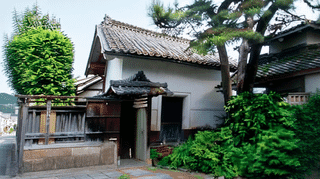
The Imabayashi Family Residence
The Imabayashi Family Residence (今林家住宅, Imabayashi-ke Jūtaku) in Yorozumachi, Miyazu City, Kyoto Prefecture, is the town house of a silk-thread wholesaling family; its main house, former shop and five earth-walled storehouses, built between the late Edo period and the Meiji era, were entered on the national register as Registered Tangible Cultural Property in two stages, in 2002 and 2009.
Three buildings meet the street: the main house, the former shop to its west and the rice storehouse to its east. The other four stand deeper in the plot. The family still lives here, which shapes almost everything about how the Imabayashi Family Residence can be seen.
The house is also one of the component properties of the Japan Heritage story "Tango Chirimen Corridor," which traces three centuries of silk weaving in northern Kyoto Prefecture.
Thread Merchants in a Silk Economy
Tango chirimen, a crinkled silk crepe woven around Miyazu and the Tango Peninsula, reached the rest of Edo-period Japan through Kyoto. A guild of Kyoto wholesalers controlled the trade, setting prices and buyers, and even the raw silk the weavers needed came through merchants in the Nishijin district, most of it from northern Honshu.
A few Miyazu merchants began buying raw silk directly from across the country, cutting Kyoto out. Nakazo Imabayashi, fifth head of the family, was one of them. Born in 1777, he was apprenticed at fifteen to a merchant house in Iwataki, and in 1816, at forty-one, he opened his own thread wholesaling business.
Trading under the shop name Kanaya, the family added chirimen production and coastal shipping on the Kitamaebune routes. A local preservation group, Tenkyo Sakujigumi, lists warehousing, rice and sugar, sake brewing and soy sauce as well, and notes that the family served as town elders and purveyors to the Miyazu domain.
The business closed in 1914. Later heads of the family helped found a Japan-Korea trading company and served as deputy mayor of Miyazu and president of the Miyazu Bank. A relative, Hikotaro Imabayashi, worked as chief of design at the Obayashi construction firm on Osaka's old city hall and Nakanoshima Public Hall.
The Plot on Yorozumachi
Yorozumachi runs east to west just south of the old castle town's main street. On a castle-town map of 1845, the eastern half of the street carries the name Yorozumachi and the western half is marked as the blacksmiths' quarter.
The Imabayashi plot lies on the north side of the street. The main house presents its long, eave-side frontage under a gabled roof; the former shop stands to its west behind a tall wall, also facing south; the rice storehouse sits on the street to the east. Behind them, the silk thread storehouse adjoins the main house in the northwest, the former raw silk storehouse stands behind the shop, the tool storehouse holds the north edge and the miso storehouse the northeast corner.
Footprints range widely. The main house covers 261 square metres and the former shop 80 square metres; among the storehouses, the silk thread store takes 44 square metres, the tool store 39 square metres, the rice store 25 square metres, the former raw silk store 22 square metres and the miso store just 17 square metres.
The former raw silk storehouse is dated to the fifth year of Ansei, which is 1858, although the Agency for Cultural Affairs database gives 1857 in its Western-calendar field. The former shop is late Edo, the main house dates from 1892, and the four storehouses are Meiji.
Registration
Five buildings were registered on 21 August 2002: the main house and the silk thread, rice, tool and miso storehouses. The former shop and the former raw silk storehouse followed on 8 January 2009, so the two oldest structures were the last to be added.
Registration criteria differ by building. The main house, former shop and former raw silk storehouse contribute to the historic townscape; the rice, tool and miso storehouses are judged hard to reproduce; the silk thread storehouse alone is listed as a model of design.
The storehouses share one unusual detail. The Agency notes that four of them set their rafters in a fan at the eave corners, a method found here and there among Miyazu storehouses, and the owners' association for registered properties in Kyoto Prefecture reads it as the signature of carpenters working across Tango.
Visiting and Getting There
The Imabayashi Family Residence is a private home. The Kyoto association of registered property owners lists it as open by inquiry only, and names the former shop and the former raw silk storehouse as the buildings that can be shown (checked 25 September 2026). Tenkyo Sakujigumi's guide, however, describes the interiors as closed. No opening days or fees are published, so contact the association's listed number before planning a visit inside.
From the street you can see the fronts of three buildings: the two town houses with their lattices and firewalls, and the tile-panelled rice storehouse beside them. Stand on the opposite side of Yorozumachi to take in the whole run. The other four buildings are hidden inside the plot. Please keep photography to the public road and stay off the doorstep.
The nearest station is Miyazu on the Kyoto Tango Railway, roughly a 15-minute walk away. There is no published visitor parking.
References
- Database of National Cultural Properties: Imabayashi Family Residence Main House (Agency for Cultural Affairs)
- https://kunishitei.bunka.go.jp/bsys/maindetails/101/00002945
- Database of National Cultural Properties: Imabayashi Family Residence Former Shop (Agency for Cultural Affairs)
- https://kunishitei.bunka.go.jp/bsys/maindetails/101/00007510
- Database of National Cultural Properties: Imabayashi Family Residence Silk Thread Storehouse (Agency for Cultural Affairs)
- https://kunishitei.bunka.go.jp/bsys/maindetails/101/00002947
- Database of National Cultural Properties: Imabayashi Family Residence Former Raw Silk Storehouse (Agency for Cultural Affairs)
- https://kunishitei.bunka.go.jp/bsys/maindetails/101/00007511
- Database of National Cultural Properties: Imabayashi Family Residence Rice Storehouse (Agency for Cultural Affairs)
- https://kunishitei.bunka.go.jp/bsys/maindetails/101/00002946
- Database of National Cultural Properties: Imabayashi Family Residence Tool Storehouse (Agency for Cultural Affairs)
- https://kunishitei.bunka.go.jp/bsys/maindetails/101/00002948
- Database of National Cultural Properties: Imabayashi Family Residence Miso Storehouse (Agency for Cultural Affairs)
- https://kunishitei.bunka.go.jp/bsys/maindetails/101/00002949
- Imabayashi Family and the Thread Trade, Miyazu History Series No. 103 (Miyazu City)
- https://www.city.miyazu.kyoto.jp/site/citypro/5164.html
- Imabayashi Residence (Kyoto Association of Registered Cultural Property Owners)
- https://www.kyoto-tobunkai.org/catalogue/51.html
- Miyazu Machiya Guide: Imabayashi Family (Tenkyo Sakujigumi NPO)
- https://www.tenkyo-sakuji.jp/imabayashi.html
- Tango Chirimen Corridor: Component Properties (Japan Heritage Portal)
- https://japan-heritage.bunka.go.jp/ja/stories/story043/culturalproperties/
- Imabayashi Family Residence (Kyoto by the Sea)
- https://uminokyoto.jp/spot/detail.php?sid=254
- Yorozumachi, Miyazu castle town (Kotobank, Nihon Rekishi Chimei Taikei)
- https://kotobank.jp/word/%E4%B8%87%E7%94%BA-3027019
Last verified: 2026.09.25
Basic Information
| Name | Imabayashi Family Residence |
|---|---|
| Location | 604-1 Yorozumachi, Miyazu City, Kyoto Prefecture |
| Designation | Registered Tangible Cultural Properties (7) |
| Coordinates | 35.53613, 135.19196 |