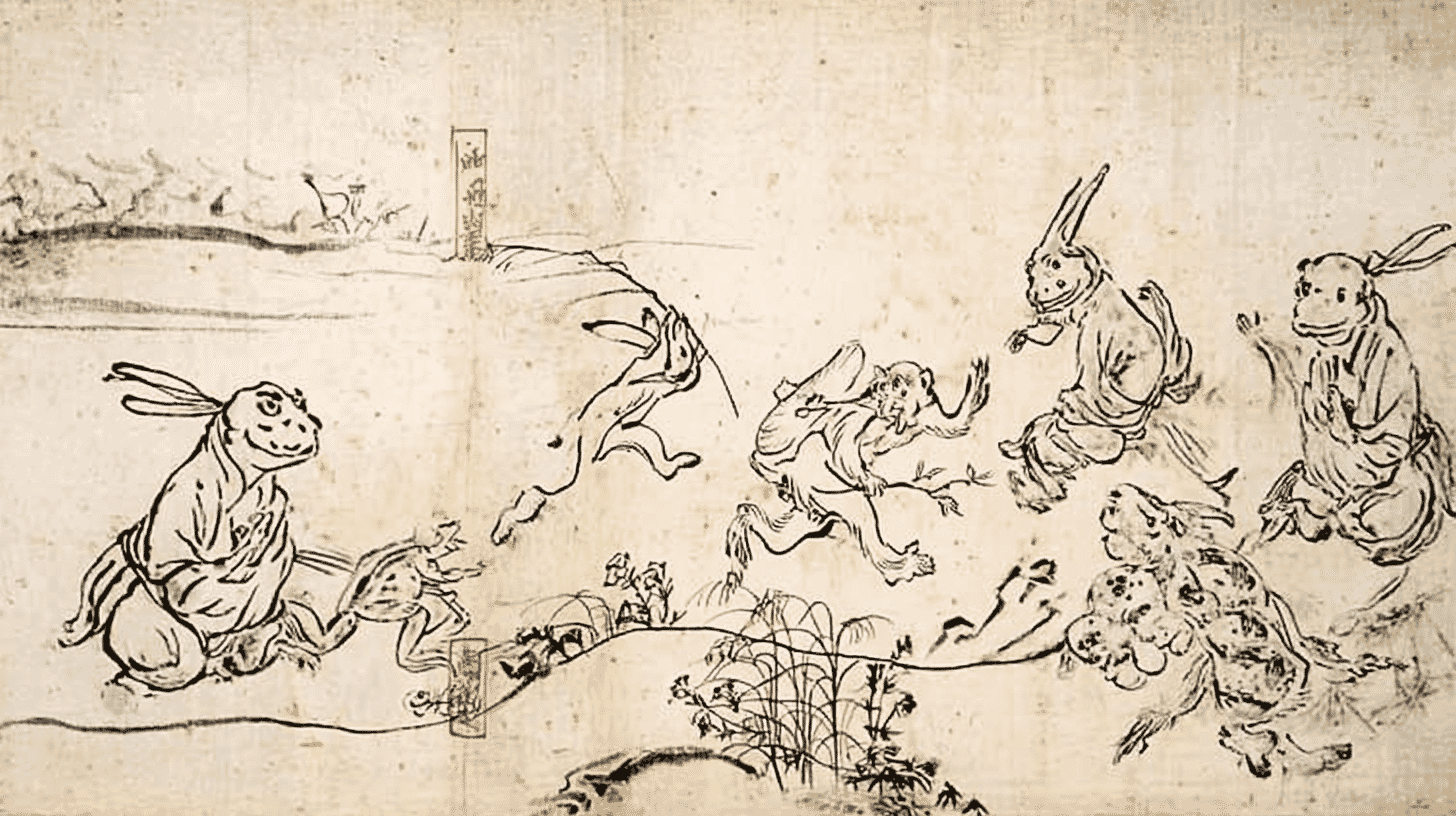
Chōjū-jinbutsu-giga: Japan's Oldest Manga and a Timeless National Treasure
Hidden among the ancient cedar forests of Kyoto's Takao mountains lies a work of art that forever changed the course of visual storytelling in Japan. The Chōjū-jinbutsu-giga (鳥獣人物戯画), commonly known as the "Scrolls of Frolicking Animals and Humans," is a set of four ink-on-paper picture scrolls that have captivated audiences for over 800 years. Designated as a National Treasure of Japan, these scrolls are widely celebrated as the earliest precursor to modern manga and anime — a remarkable achievement of artistic imagination drawn with nothing more than black ink and a brush.
The scrolls are the prized possession of Kōzan-ji Temple, a UNESCO World Heritage site nestled in the northwestern hills of Kyoto. With their lively depictions of anthropomorphic rabbits, frogs, and monkeys engaged in unmistakably human pursuits, the Chōjū-jinbutsu-giga stand as testimony to the timeless power of humor, satire, and masterful brushwork in Japanese art.
What Is Chōjū-jinbutsu-giga?
Chōjū-jinbutsu-giga, literally meaning "Animal-Person Caricatures," is a collection of four handscroll paintings (emakimono) rendered entirely in ink on paper (紙本墨画). Created during the late Heian to early Kamakura periods (12th–13th centuries), the scrolls measure approximately 30 centimeters in height and span a combined length of over 44 meters. Each scroll, designated as Kō (甲), Otsu (乙), Hei (丙), and Tei (丁), features distinct content and artistic styles, suggesting they were produced by multiple anonymous artists across different eras.
The scrolls contain no accompanying text or captions, leaving their narrative open to interpretation — a quality that has only deepened their mystique and appeal over the centuries. They are believed to have originated from the "oko-e" tradition, a type of improvisational caricature drawing practiced among Tendai Buddhist monks, and represent the pinnacle of this artistic lineage.
A Closer Look at Each Scroll
Scroll One (Kō / 甲巻) — The Masterpiece
The most celebrated of all four scrolls, Kō measures 30.4 cm in height and 1,148.4 cm in length. It features anthropomorphized animals — primarily rabbits, frogs, monkeys, and foxes — engaging in distinctly human activities. Scenes include animals bathing in a river, competing in archery contests using lotus-leaf targets, wrestling in sumo matches, and attending Buddhist ceremonies where a frog poses as the Buddha. The scroll is remarkable for its dynamic, flowing brushwork that conveys vivid movement and emotion without a single drop of color. This scroll dates from the late Heian period (12th century) and is universally regarded as the finest of the four.
Scroll Two (Otsu / 乙巻) — The Animal Encyclopedia
The second scroll, measuring 30.6 cm by 1,189.0 cm, takes a dramatically different approach. Rather than depicting personified animals, it presents a naturalistic catalog of both real and imaginary creatures. Horses, cattle, hawks, and dogs appear alongside exotic animals such as elephants, leopards, and tigers, as well as mythical beasts including dragons, unicorns (kirin), and tapir-like creatures (baku). The scroll reads like a medieval bestiary and may have originally served as a reference for artists. It also dates to the late Heian period.
Scroll Three (Hei / 丙巻) — Humans and Animals
At 30.9 cm by 933.3 cm, the third scroll is divided into two distinct halves. The first features human figures engaged in games such as go and backgammon, as well as physical competitions like ear-pulling and neck-pulling contests. The second half returns to anthropomorphized animals in the style of the first scroll. Recent conservation work at the Kyoto National Museum revealed a fascinating discovery: the human and animal sections were originally painted on opposite sides of the same sheets of paper. During the Edo period, the sheets were carefully split apart and reassembled into a single continuous scroll for easier viewing. This scroll dates from the Kamakura period (13th century).
Scroll Four (Tei / 丁巻) — The Human Comedy
The fourth scroll (31.2 cm by 1,130.3 cm) features exclusively human subjects. It opens with acrobatic performances by dwarfs, followed by scenes of monks competing in tests of spiritual power, hooded priests, and other satirical depictions of court and religious life. The brushwork is notably quick and free, with a spirited, sketch-like quality that sets it apart from the other scrolls. Like Hei, this scroll dates to the Kamakura period.
Why Was It Designated a National Treasure?
The Chōjū-jinbutsu-giga was designated as a National Treasure (国宝) of Japan, the highest cultural property classification in the country, in recognition of its extraordinary historical, artistic, and cultural significance. Several key factors underpinned this prestigious designation.
First, the scrolls represent an unparalleled achievement in Japanese ink painting. The artists employed the "hakubyō" technique — fine, modulated brush lines without color — to create compositions of astonishing vitality and narrative power. The ability to convey personality, humor, and movement using nothing but ink demonstrates a level of mastery that transcends time periods.
Second, the scrolls occupy a unique position in art history as the earliest known Japanese works to employ narrative visual techniques that anticipate modern comics and animation, including implied movement, sequential storytelling, and even precursors to speech bubbles and speed lines. This connection to today's globally influential manga and anime traditions gives the scrolls immense cultural significance.
Third, the Chōjū-jinbutsu-giga offers invaluable insight into the social customs, religious practices, and satirical wit of medieval Japan. The anthropomorphic animals are widely interpreted as gentle commentary on the foibles of the aristocratic and religious establishment, making the scrolls an important document of their era's sensibilities.
Finally, the scrolls have survived over 800 years of fires, wars, and the passage of time, making their preservation itself a remarkable achievement. A major four-year conservation project completed in 2013 not only stabilized the scrolls but also revealed new discoveries about their original construction and history.
The Mystery of the Anonymous Artists
One of the most intriguing aspects of the Chōjū-jinbutsu-giga is that the artist — or artists — remain unknown. For centuries, the scrolls were attributed to Toba Sōjō Kakuyū (1053–1140), a high-ranking Buddhist priest renowned for his talent in caricature drawing. However, no historical evidence confirms this attribution. Other names that have been suggested include the Buddhist painter Jōchi and the priest Gishin, but none can be verified.
Modern scholarship, based on the distinct differences in brushwork and artistic style between the scrolls, concludes that multiple artists working at different times were responsible for their creation. The scrolls were likely produced independently and only later came to be collected together at Kōzan-ji Temple, where they acquired their collective identity as the Chōjū-jinbutsu-giga.
Highlights and Must-See Features
The Chōjū-jinbutsu-giga offers numerous scenes that have become iconic in Japanese art and popular culture. Among the most celebrated moments are the sumo wrestling match between a rabbit and a frog, where the frog bites the rabbit's ear and employs leg techniques to flip its opponent — a scene that perfectly captures the scrolls' blend of comedy and dynamism. Another beloved scene shows a rabbit pinching its nose before leaping off a cliff into a river, while a second rabbit rides gleefully on the back of a deer as a mischievous monkey splashes water.
The Buddhist ceremony scene, where animals gather to worship a frog seated as the Buddha, is one of the most satirically charged images in all of Japanese art. Rabbits and monkeys dressed as monks offer prayers and gifts, creating a gentle but unmistakable parody of religious hierarchy.
Visitors to Kōzan-ji Temple can view high-quality reproductions of the scrolls in the Sekisui-in hall. The original scrolls, being extremely fragile National Treasures, are preserved at the Tokyo National Museum (Scrolls Kō and Hei) and the Kyoto National Museum (Scrolls Otsu and Tei). The originals are occasionally displayed during special exhibitions — events that consistently attract enormous crowds.
Kōzan-ji Temple: The Home of the Scrolls
Kōzan-ji Temple (高山寺), formally known as Toganoo-san Kōzan-ji, is a venerable Buddhist temple located in the Takao district of northwestern Kyoto. Founded in 774 during the Nara period and revitalized in 1206 by the revered monk Myōe Shōnin under the patronage of Emperor Go-Toba, the temple was registered as a UNESCO World Heritage Site in 1994 as part of the "Historic Monuments of Ancient Kyoto."
The temple grounds are a treasure trove of cultural properties, housing eight National Treasures and over 10,000 Important Cultural Properties. The Sekisui-in hall, the only surviving structure from Myōe's era, is itself a National Treasure and offers a serene setting to appreciate reproductions of the famous scrolls alongside views of the surrounding forests and valley.
Kōzan-ji is also celebrated as the birthplace of Japanese tea culture. Myōe Shōnin planted tea seeds brought from China by the Zen monk Eisai, and this tea garden — believed to be the oldest in Japan — still exists within the temple grounds. The tea cultivation here eventually spread to Uji, giving rise to Japan's renowned tea traditions.
Surrounding Area and Nearby Attractions
Kōzan-ji Temple is situated in the scenic Takao area, known for its pristine mountain scenery and three historic temples collectively referred to as the "Sanbi" (Three Tails). The area offers an ideal day trip for visitors seeking a more tranquil, nature-immersed Kyoto experience away from the central city's crowds.
Jingo-ji Temple, a short walk south from Kōzan-ji, is the largest and most visited of the three Takao temples. This Shingon Buddhist temple houses sixteen National Treasures and is famous for the activity of throwing ceramic plates off a cliff to ward off misfortune (kawarake-nage). The steep stone staircase approach is surrounded by magnificent maple trees that create a breathtaking canopy of color in autumn.
Saimyō-ji Temple, located between Kōzan-ji and Jingo-ji, is the smallest of the trio but offers a charming vermilion bridge (Shigetsukyo Bridge) over the Kiyotaki River. The temple is particularly beautiful in spring when azaleas bloom on the surrounding mountainsides and in autumn when the maples turn brilliant red and orange.
The Kiyotaki River valley itself makes for a lovely walking route connecting all three temples, offering mountain scenery, traditional restaurants, and a genuine sense of old Kyoto. The autumn foliage season (mid-November) transforms the entire area into one of Kyoto's premier leaf-viewing destinations.
Where to See the Original Scrolls
While Kōzan-ji Temple displays faithful reproductions, visitors who wish to see the original National Treasure scrolls can seek out special exhibitions at Japan's national museums. The first and third scrolls (Kō and Hei) are entrusted to the Tokyo National Museum in Ueno, Tokyo, while the second and fourth scrolls (Otsu and Tei) are kept at the Kyoto National Museum in Higashiyama, Kyoto. Both museums occasionally feature the scrolls in their permanent collection rotations or special exhibitions. Fragments (dankan) of the scrolls are also held at other institutions, including the MIHO Museum in Shiga Prefecture and the Honolulu Museum of Art in Hawaii.
A landmark exhibition in 2021, "National Treasure: Frolicking Animals — The Complete Scrolls," at the Tokyo National Museum brought together all four scrolls and five fragments for the first time, attracting record crowds. Keep an eye on museum schedules for future display opportunities.
Tips for International Visitors
Kōzan-ji is located about 55 minutes from JR Kyoto Station by JR Bus (Takao/Keihoku line) — take the bus bound for "Toganoo" or "Shūzan" and alight at "Toganoo" (栂ノ尾), the final stop, which is right at the temple entrance. Alternatively, Kyoto City Bus No. 8 runs from Shijō Station to the Takao bus stop, though this requires an additional uphill walk. The journey through the winding mountain roads is itself a scenic experience.
The temple grounds are free to enter most of the year, with an additional entrance fee of ¥500 during the autumn foliage season (typically October to early December). Admission to the Sekisui-in hall, where the scroll reproductions are displayed, costs ¥1,000 for adults. The temple is open from 8:30 AM to 5:00 PM year-round.
For a more in-depth experience, Kōzan-ji offers special guided tours led by temple staff, which include access to normally restricted areas such as the Ikō-an tea room, a matcha tea experience, and exclusive souvenirs. These tours require advance reservation and are available on selected dates.
The best seasons to visit are spring for fresh greenery and a peaceful atmosphere, and late autumn (mid to late November) for the spectacular maple foliage. Summer visitors can enjoy the cool mountain air and lush forests, while winter offers quiet solitude and occasional snow-dusted scenery.
- 📍 Plan Your Visit to Kyoto
- Find tours, activities & transport passes near Ink Painting on Paper: Choju Jinbutsu Giga
- [ Kinkakuji Fushimi Inari & Kimono Rental ]
Q&A
- Can I see the original Chōjū-jinbutsu-giga scrolls at Kōzan-ji Temple?
- The original scrolls are too fragile to remain on permanent public display. Kōzan-ji houses high-quality reproductions in the Sekisui-in hall. The originals are preserved at the Tokyo National Museum (Scrolls Kō and Hei) and the Kyoto National Museum (Scrolls Otsu and Tei), where they are occasionally exhibited during special events. Check the museums' schedules for upcoming display opportunities.
- Why are the Chōjū-jinbutsu-giga scrolls called "Japan's oldest manga"?
- The scrolls employ several visual storytelling techniques that are strikingly similar to those used in modern manga and anime, including sequential narrative, implied motion through brush strokes, expressive anthropomorphic characters, and even elements resembling speech bubbles and speed lines. While some scholars debate whether the scrolls should truly be classified as "manga," their influence on the development of Japanese visual narrative traditions is widely acknowledged.
- Is Kōzan-ji Temple accessible for international visitors who don't speak Japanese?
- While the temple is primarily geared toward Japanese-speaking visitors, the scroll reproductions and temple architecture speak a universal visual language. The Sekisui-in hall displays include some English signage. We recommend researching the scrolls beforehand to enhance your appreciation. The JR Bus from Kyoto Station provides straightforward access, with clear announcements for the Toganoo stop.
- How long should I plan for a visit to Kōzan-ji and the Takao area?
- Allow approximately one hour for Kōzan-ji Temple itself. If you plan to visit all three Takao temples (Kōzan-ji, Jingo-ji, and Saimyō-ji), budget a full half-day or more, as the temples are connected by scenic walking paths with some steep sections. Comfortable walking shoes are strongly recommended.
- Is photography allowed at Kōzan-ji Temple?
- Photography policies may vary by area within the temple. The outdoor grounds and garden views are generally open to photography, but restrictions may apply inside the Sekisui-in hall and near the scroll reproductions. Please observe any posted signs and follow the guidance of temple staff during your visit.
Basic Information
| Official Name | Shihon Bokuga Chōjū-jinbutsu-giga (紙本墨画鳥獣人物戯画) |
|---|---|
| Common Name | Chōjū-giga / Scrolls of Frolicking Animals and Humans |
| Cultural Designation | National Treasure of Japan (国宝) |
| Format | Four handscrolls (emakimono), ink on paper (紙本墨画) |
| Period | Late Heian to early Kamakura period (12th–13th century) |
| Author | Unknown (traditionally attributed to Toba Sōjō Kakuyū, 1053–1140) |
| Dimensions | Kō: 30.4 cm × 1,148.4 cm / Otsu: 30.6 cm × 1,189.0 cm / Hei: 30.9 cm × 933.3 cm / Tei: 31.2 cm × 1,130.3 cm |
| Owner | Kōzan-ji Temple, Kyoto |
| Current Preservation | Tokyo National Museum (Kō and Hei scrolls) / Kyoto National Museum (Otsu and Tei scrolls) |
| Kōzan-ji Temple Address | 8 Toganoo-chō, Umegahata, Ukyō-ku, Kyoto 616-8295, Japan |
| Visiting Hours | 8:30 AM – 5:00 PM (year-round) |
| Admission | Sekisui-in Hall: ¥1,000 (adults), ¥500 (elementary school students) / Autumn season: additional ¥500 entrance fee |
| Access | JR Bus from Kyoto Station to "Toganoo" stop (approx. 55 min) / City Bus No. 8 to "Takao" stop + walk |
| UNESCO Status | Kōzan-ji Temple registered as World Heritage Site (1994) as part of "Historic Monuments of Ancient Kyoto" |
References
- 鳥獣人物戯画 ─ 世界遺産 栂尾山 高山寺 公式ホームページ
- https://kosanji.com/chojujinbutsugiga/
- 鳥獣人物戯画 ─ Wikipedia(日本語版)
- https://ja.wikipedia.org/wiki/鳥獣人物戯画
- Chōjū-jinbutsu-giga ─ Wikipedia (English)
- https://en.wikipedia.org/wiki/Chōjū-jinbutsu-giga
- Masterpieces of Kosan-ji Temple: the complete scrolls of Choju Giga ─ Tokyo National Museum
- https://www.tnm.jp/modules/r_free_page/index.php?id=1707&lang=en
- 国宝 鳥獣戯画と高山寺 ─ 京都国立博物館
- https://www.kyohaku.go.jp/old/jp/special/koremade/exhibition20141007.html
- 高山寺<右京区栂尾>─ 京都市公式 京都観光Navi
- https://ja.kyoto.travel/tourism/single01.php?category_id=7&tourism_id=432
- Takao ─ Discover Kyoto
- https://www.discoverkyoto.com/places-go/takao/
- Choju-jinbutsu-giga ─ Facsimile Edition
- https://www.facsimilefinder.com/facsimiles/choju-jinbutsu-giga-facsimile
- Fragment of Choju jinbutsu giga ─ MIHO MUSEUM
- https://www.miho.jp/booth/html/artcon/00000010e.htm
Last verified: 2026.02.17