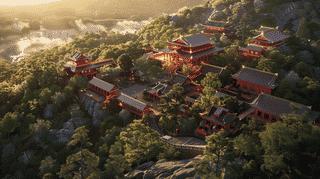
Iwashimizu Hachimangu Shrine
Iwashimizu Hachimangu Shrine (石清水八幡宮) stands on Mount Otokoyama in Yawata, Yawata City, Kyoto Prefecture, and its main shrine buildings on the summit were rebuilt by the Tokugawa shogunate in 1634 (Agency for Cultural Affairs). According to the Agency, it has been revered by the court nobility, the warrior class and many others since its foundation in 860. The mountain stands where the Katsura, Uji and Kizu rivers meet. The shrine's official site traces its origin to 859, when the monk Gyokyo of Daianji in Nara received an oracle from Hachiman at Usa Hachimangu and enshrined the deity on the peak of Otokoyama.
The precinct consists of the upper precinct on the summit, with the main shrine enclosed by corridors; the lower precinct at the northern foot of the mountain, centred on the Tongu hall; and the Toganoo branch shrine in a detached precinct to the west (Agency for Cultural Affairs).
Three Designated Properties
The ten buildings of the main shrine on the summit, including the main hall, its fence, the offering and dance halls, the tower gate, the east and west gates and three corridors, were designated a National Treasure on February 9, 2016 (Agency for Cultural Affairs). The main hall, with an inner and an outer sanctuary set one behind the other, is the oldest and largest surviving hall in the hachiman style.
The eight buildings made up of four branch-shrine halls and three outer gates around the main shrine and the Toganoo branch shrine hall were designated an Important Cultural Property on December 2, 2008, and the late Kamakura stone pagoda at the foot of the mountain on February 19, 1957 (Agency for Cultural Affairs). Each property is described on its own page.
History of the Buildings
According to the Agency's commentary, the buildings were lost several times, as in a fire of 1140, and rebuilt each time. Oda Nobunaga repaired them in 1580, and Toyotomi Hideyori restored the precinct from 1598. The main shrine buildings of the upper precinct were then rebuilt by the Tokugawa shogunate in 1634, and the branch shrines and other buildings were put in order through the Edo period.
The Toganoo branch shrine hall in the detached precinct, built in 1601, is the oldest surviving shrine building in the precinct (Agency for Cultural Affairs).
Visiting
According to Yawata City, the gates open from 6:00 to 18:00, with different hours over the New Year.
Take the Keihan Main Line to Iwashimizu-hachimangu Station, ride the approach cable car from Hachimangu-guchi to Hachimangu-sanjo, and walk 5 minutes from the top station (Iwashimizu Hachimangu Shrine). The car park takes about 60 cars, at up to 500 yen between 9:00 and 16:00, with different charges over the New Year period (January 1 to February 3) and the cherry blossom season. The cable car is closed on some days for maintenance, so check the shrine's notices before visiting.
References
- Iwashimizu Hachimangu Main Shrine, Main Hall (Database of National Cultural Properties, Agency for Cultural Affairs)
- https://kunishitei.bunka.go.jp/heritage/detail/102/1990
- Iwashimizu Hachimangu Shrine, Wakamiyaden Branch Shrine Main Hall (Database of National Cultural Properties, Agency for Cultural Affairs)
- https://kunishitei.bunka.go.jp/heritage/detail/102/00004318
- Iwashimizu Hachimangu Gorinto Pagoda (Database of National Cultural Properties, Agency for Cultural Affairs)
- https://kunishitei.bunka.go.jp/heritage/detail/102/1998
- About the shrine (Iwashimizu Hachimangu official site, Japanese)
- https://iwashimizu.or.jp/about/
- Access (Iwashimizu Hachimangu official site, Japanese)
- https://iwashimizu.or.jp/access/
- Iwashimizu Hachimangu (Yawata City, Japanese)
- https://www.city.yawata.kyoto.jp/0000000457.html
Last verified: 2026.10.19
Basic Information
| Name | Iwashimizu Hachimangu Shrine |
|---|---|
| Location | Yawata, Yawata City, Kyoto Prefecture |
| Owner | Iwashimizu Hachimangu Shrine |
| Designation | National Treasure (1) · Important Cultural Property (2) |
| Coordinates | 34.88064, 135.70027 |