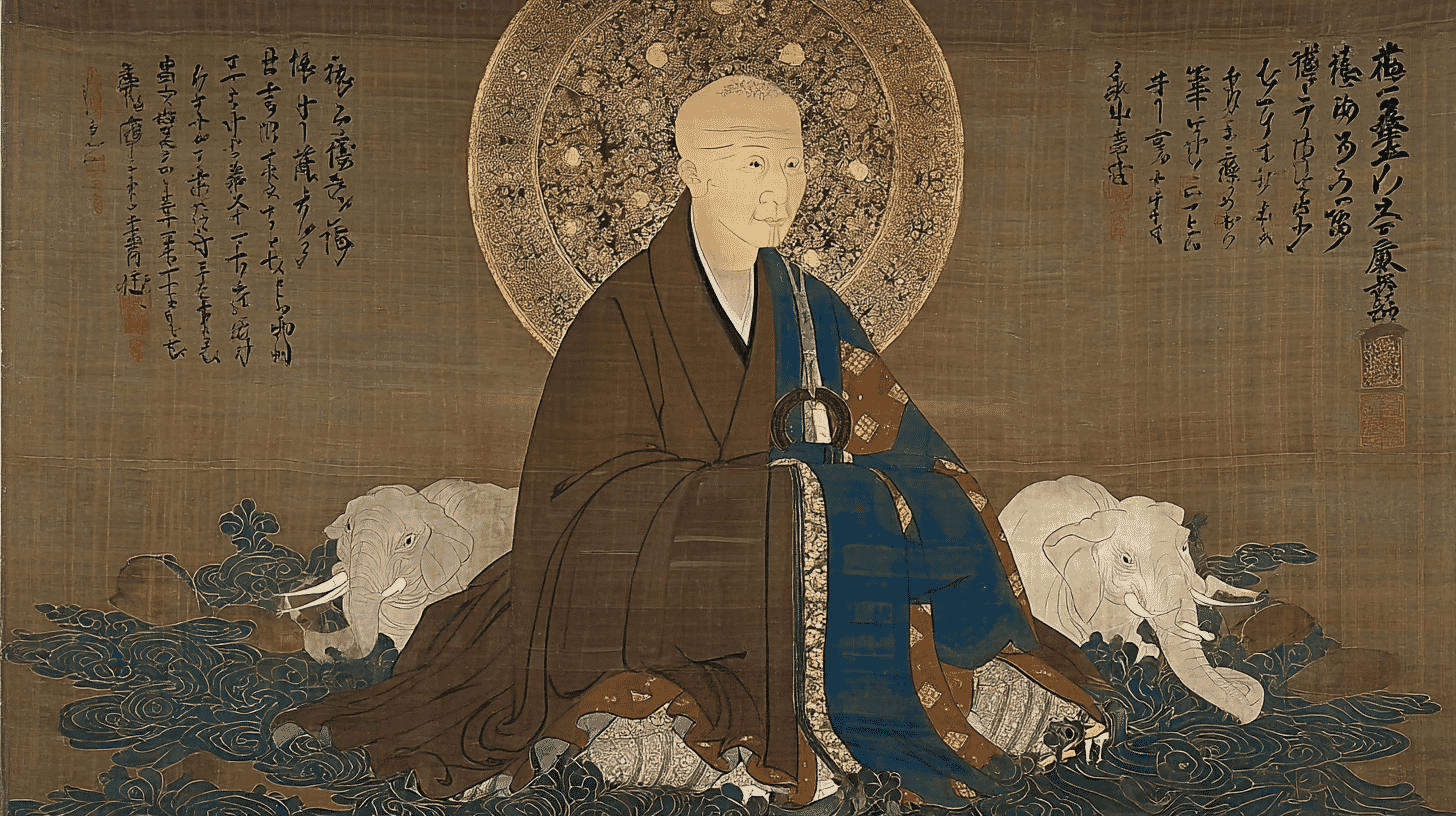
Portrait of Wuzhun Shifan at Tofuku-ji: A Zen Masterpiece Spanning Centuries
Nestled within the vast temple complex of Tofuku-ji in Kyoto lies one of Japan's most remarkable National Treasures — the "Portrait of Wuzhun Shifan" (絹本著色無準師範像, Kenpon Chakushoku Bujun Shiban-zō). Painted on silk in vivid color in the year 1238 during the Southern Song Dynasty of China, this portrait captures the likeness of one of the most influential Zen Buddhist masters in history. Far more than a mere painting, this work stands as a living testament to the profound spiritual exchange between China and Japan that shaped the course of Zen Buddhism.
Who Was Wuzhun Shifan?
Wuzhun Shifan (無準師範, 1178–1249) was a towering figure in the world of Chinese Chan (Zen) Buddhism during the Southern Song Dynasty. Born in Zitong, Sichuan Province, he rose to become the abbot of the prestigious Temple of Mount Jingshan (径山万寿寺), the foremost of the "Five Mountains" of Chinese Zen monasteries.
His renown was so great that Emperor Lizong of Song summoned him to the imperial court in 1233 to discuss the Dharma. For his wisdom, Wuzhun was bestowed the honorific title "Fojian Yuanzhao Chanshi" (Mirror of the Buddha, Zen Teacher) along with a magnificent gold-embroidered kasaya (monastic robe) — the very robe he wears in this portrait. Wuzhun's influence extended far beyond China. Numerous Japanese monks made the perilous journey across the sea to study under him, and his lineage would go on to profoundly shape the development of Rinzai Zen Buddhism in Japan.
The Story Behind the Portrait: Master and Disciple
The story of this National Treasure is inseparable from the bond between master and disciple. Among Wuzhun Shifan's many students was Enni Ben'en (円爾弁円, 1202–1280), a Japanese monk who traveled to Song Dynasty China in 1235 to seek the deepest teachings of Zen. For six years, Enni studied diligently under Wuzhun at Mount Jingshan.
When Enni had completed his training and was preparing to return to Japan in 1241, Wuzhun bestowed upon him a set of precious gifts as proof of dharma transmission — the formal acknowledgment that the disciple had truly received and internalized the master's teaching. Among these gifts were an "inka" (certificate of enlightenment), calligraphic works, and this magnificent portrait bearing Wuzhun's own inscription (自賛, jisan), written in the year 1238.
Enni carried these treasures back to Japan, and upon his return, he was invited by the regent Kujo Michiie to serve as the founding abbot of Tofuku-ji Temple, which was being constructed as the greatest Zen monastery in Kyoto. The portrait has remained at Tofuku-ji ever since — a continuous custodial history of nearly 800 years.
The Chinso Tradition: Portraits with a Sacred Purpose
This painting belongs to a unique genre of Buddhist art known as "chinso" (頂相) — formal portraits of Zen masters created for ritual and commemorative purposes. In the Zen tradition, a chinso served as far more than a decorative image. It was a spiritual object of transmission, a means by which disciples could maintain a visual and emotional connection with their teacher even after parting or after the master's death.
In the standard chinso format, the Zen master is depicted seated cross-legged in a ceremonial chair, dressed in full monastic robes, with his shoes placed on a footstool below. The master typically holds a whisk (hossu) or a staff in his right hand. What distinguishes this particular portrait is the extraordinary skill of its execution: the delicate rendering of facial features, the subtle shading of skin, and the careful depiction of the textures of the robes all suggest that the painter may have been a highly accomplished court artist of the Southern Song period.
Why Was It Designated a National Treasure?
The Portrait of Wuzhun Shifan was designated a National Treasure of Japan on March 29, 1952. Its significance rests on several pillars of cultural and historical importance.
First, it is recognized as a supreme masterpiece of Southern Song Dynasty portrait painting. The artistic technique is exceptional — the lifelike depiction of Wuzhun's features, from the texture of his skin to the fine details of his hair and eyebrows, places this work among the finest surviving examples of 13th-century Chinese portraiture.
Second, the painting carries Wuzhun Shifan's own handwritten inscription (自賛), dated to the second year of the Jiaxi era (嘉熙二年, 1238). This autograph inscription provides irrefutable authentication and makes the work an invaluable document for the study of both art history and calligraphy.
Third, the portrait serves as a physical embodiment of the dharma transmission from Wuzhun to Enni — a pivotal event in the history of Japanese Zen Buddhism. Without this transmission, the establishment of Tofuku-ji and the broader development of Rinzai Zen in Japan might have taken a very different course.
Finally, the painting's unbroken provenance at Tofuku-ji since the 13th century adds immeasurably to its cultural significance. At the temple, it was traditionally preserved alongside a second portrait of Wuzhun (a half-length depiction, now designated an Important Cultural Property) within the same wooden box, testifying to the care with which these sacred images have been safeguarded across the centuries.
Highlights and What to Look For
While the portrait is not on permanent public display — it is housed in the Komyo Hoden (光明宝殿), Tofuku-ji's treasure hall, and is shown only during special exhibitions — visitors fortunate enough to see it should pay close attention to the following details.
The inscription above the portrait, written in Wuzhun's own hand, is a masterwork of calligraphy in its own right. The bold, vigorous brushstrokes reflect the same powerful spirit that characterizes Wuzhun's other surviving calligraphic works, several of which are themselves National Treasures held at other institutions across Japan.
The gold-embroidered kasaya robe depicted in the portrait is the very garment bestowed by Emperor Lizong. Its detailed rendering provides a rare visual record of the luxurious textiles of the Southern Song imperial court.
The overall composition embodies the classic chinso format with such refinement that art historians have long regarded it as one of the defining examples of the genre — a benchmark against which other Zen master portraits are measured.
Where to See the Portrait: Exhibition History
Because of the extreme fragility of silk paintings nearly 800 years old, the Portrait of Wuzhun Shifan is exhibited only on rare occasions, typically at major museum exhibitions. Recent and upcoming opportunities have included the following:
- 2025 (Oct 21 – Nov 16): Kyoto National Museum, "Song and Yuan Buddhist Paintings" exhibition
- 2023 (Oct 7 – Nov 5): Kyoto National Museum, "Tofuku-ji" special exhibition
- 2023 (Mar 7 – Apr 2): Tokyo National Museum, "Tofuku-ji" special exhibition
- 2017 (Nov 14 – Nov 26): Kyoto National Museum, "National Treasures" exhibition
- 2014 (Oct 28 – Nov 9): Tokyo National Museum, "National Treasures of Japan" exhibition
It is advisable to check the websites of the Kyoto National Museum and Tokyo National Museum for the latest exhibition schedules, as these special viewings are the primary opportunity to see this masterpiece in person.
Exploring Tofuku-ji Temple
Even when the portrait itself is not on display, Tofuku-ji Temple offers an extraordinary wealth of cultural experiences for visitors. Founded in 1236 by the regent Kujo Michiie and completed in 1255, Tofuku-ji was built to rival the great temples of Nara — its very name is derived from combining characters from Todai-ji (東大寺) and Kofuku-ji (興福寺). As one of the Kyoto Gozan (Five Great Zen Temples of Kyoto), it has been a center of Zen practice for nearly 800 years.
The Sanmon Gate (National Treasure)
Reconstructed in 1425, this is the oldest surviving Zen main gate in Japan. Standing 22 meters tall, it houses Buddhist statues from the Heian period and ceiling paintings by the renowned monk-painter Mincho. Special public openings of the upper floor are held during the autumn season.
Hojo Gardens (National Scenic Site)
Designed in 1939 by the legendary landscape architect Mirei Shigemori, the four gardens surrounding the Abbot's Quarters represent a bold fusion of Zen tradition and modernist aesthetics. The iconic checkerboard moss garden on the north side has become one of the most recognized images of Japanese garden design worldwide.
Tsutenkyo Bridge and Autumn Foliage
Tofuku-ji is one of Kyoto's most celebrated destinations for autumn foliage. The view from the Tsutenkyo Bridge, overlooking a ravine filled with a sea of crimson and gold Japanese maple trees, is an unforgettable spectacle that draws visitors from across the globe each November.
Ryogin-an (National Treasure)
The Hojo (abbot's quarters) of this sub-temple is the oldest surviving example of its type in Japan, designated as a National Treasure. It is opened to the public during special seasonal exhibitions.
Nearby Attractions
Tofuku-ji's location in southeastern Kyoto places it in close proximity to several other notable destinations. The Fushimi Inari Taisha shrine, famous for its thousands of vermilion torii gates, is just one train stop away on the JR Nara Line. The Sennyuji Temple complex, the imperial family's temple, lies within walking distance and houses an even larger Nirvana painting. For those interested in further exploring Zen culture, the Kennin-ji Temple, Kyoto's oldest Zen temple, is accessible via a short bus or taxi ride.
- 📍 Plan Your Visit to Kyoto
- Find tours, activities & transport passes near Portrait of Shiromu Jun Shihan on Silk Book
- [ Kinkakuji Fushimi Inari & Kimono Rental ]
Q&A
- Can I see the Portrait of Wuzhun Shifan when I visit Tofuku-ji?
- The portrait is not on permanent display. It is housed in the Komyo Hoden treasure hall and is shown only during special exhibitions, typically at the Kyoto National Museum or Tokyo National Museum. Check museum websites for the latest exhibition schedules before planning your visit.
- What is the best season to visit Tofuku-ji Temple?
- Tofuku-ji is magnificent year-round, but the most popular time is mid-November to early December for the autumn foliage. The fresh green maples in spring and early summer are also beautiful and far less crowded. Special events such as the opening of the Sanmon Gate and Ryogin-an are typically held in autumn.
- What is a chinso, and why is it important in Zen Buddhism?
- A chinso (頂相) is a formal portrait of a Zen master. In Zen tradition, these portraits served as symbols of dharma transmission from master to disciple — proof that the disciple had received the master's teaching. They were also used in memorial rituals to represent the master after death. The Portrait of Wuzhun Shifan is considered one of the finest surviving examples of the chinso tradition.
- Is English signage or audio guide available at Tofuku-ji?
- Tofuku-ji provides some English signage at major points of interest within the temple grounds. For a richer experience, consider using a guidebook or a smartphone translation app. Major exhibitions at the Kyoto National Museum and Tokyo National Museum typically offer English-language audio guides and printed materials.
- Are there other National Treasures related to Wuzhun Shifan in Japan?
- Yes. Several of Wuzhun Shifan's calligraphic works are also designated National Treasures. These include the "Inka Certificate for Enni" (also at Tofuku-ji), the "Itawatashi no Bokuseki" letter (at Tokyo National Museum), and the "Sanmon-so" (at Goto Museum in Tokyo). Together with the portrait, these works form an extraordinary collection documenting the cultural exchange between Song China and Kamakura-era Japan.
Basic Information
| Official Name | 絹本著色無準師範像 (Kenpon Chakushoku Bujun Shiban-zō / Portrait of Wuzhun Shifan on Silk) |
|---|---|
| Designation | National Treasure (Paintings) |
| Date of Designation | March 29, 1952 |
| Origin | China, Southern Song Dynasty |
| Date of Creation | 1238 (Jiaxi 2nd year), with autograph inscription by Wuzhun Shifan |
| Medium | Ink and color on silk, mounted as a hanging scroll |
| Format | 1 scroll |
| Owner | Tofuku-ji Temple (東福寺) |
| Location | 15-778 Honmachi, Higashiyama-ku, Kyoto 605-0981, Japan |
| Access | 10-minute walk from JR/Keihan "Tofukuji" Station; approx. 15 min from Kyoto Station via JR Nara Line |
| Visiting Hours (Tofuku-ji) | Apr–Oct: 9:00–16:00; Nov–early Dec: 8:30–16:00; Dec–Mar: 9:00–15:30 |
| Admission (Tofuku-ji) | Temple grounds: Free; Tsutenkyo Bridge & Kaizando: ¥600 (¥1,000 during autumn); Hojo Garden: ¥500; Combined ticket: ¥1,000 |
| Website | https://tofukuji.jp/ |
References
- 国宝-絵画|無準師範像[東福寺/京都] — WANDER 国宝
- https://wanderkokuho.com/201-00049/
- 絹本著色無準師範像 — 文化遺産オンライン
- https://bunka.nii.ac.jp/heritages/detail/444443
- Wuzhun Shifan — Wikipedia (English)
- https://en.wikipedia.org/wiki/Wuzhun_Shifan
- Tōfuku-ji — Wikipedia (English)
- https://en.wikipedia.org/wiki/Tofukuji
- 東福寺 — Wikipedia (Japanese)
- https://ja.wikipedia.org/wiki/東福寺
- 無準師範 — Wikipedia (Japanese)
- https://ja.wikipedia.org/wiki/無準師範
- 拝観案内 — 臨済宗大本山 東福寺
- https://tofukuji.jp/guide/
- 頂相 Dingxiang, Chinzō (Ritual portraits of Zen masters)
- https://terebess.hu/zen/szoto/chinzo.html
- 東福寺 — 京都市観光情報
- https://ja.kyoto.travel/tourism/single01.php?category_id=7&tourism_id=484
- 大本山 東福寺 — 京都ミュージアム探訪
- https://www.kyoto-museums.jp/museum/east/764/
Last verified: 2026.02.08