
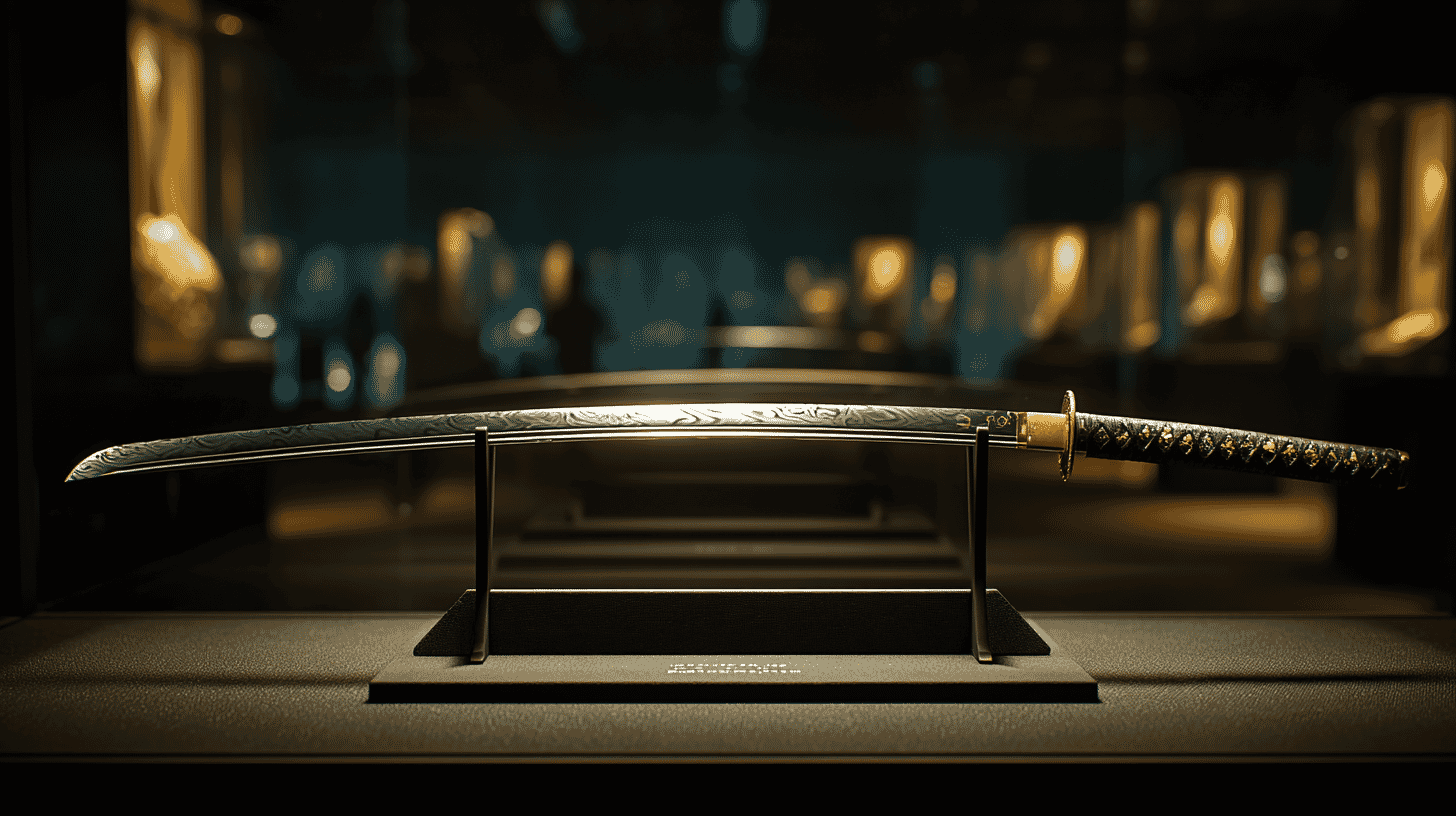
One Sword, National Treasure since 1957
Katana Sword (gold-inlaid attribution to Masamune with the monogram of Hon'ami; owned by Honda Nakatsukasa; known as Nakatsukasa Masamune) (刀, Katana) is a Kamakura-period craft object at the Tokyo National Museum, 13-9 Ueno Park, Taito Ward, Tokyo, made an Important Cultural Property on 3 July 1941 and designated a National Treasure on 19 February 1957. The quantity is one sword, the designation number 00215, and the owner the state through the Agency for Cultural Affairs.
The maker is recorded as Masamune. The blade is 67.0 centimetres long with a curvature of 1.7 centimetres, 2.9 centimetres wide at the base and 2.1 at the point, and the tang is 15.5 centimetres.
3 July 1941 is the date on which the imperial genealogy also became an Important Cultural Property. This is the fourth property here owned by the state.
The Signature Was Not Put There by the Smith
The words gold-inlaid signature in the title show what kind of sword this is.
The Agency records the inscriptions: on one face, owned by Honda Nakatsukasa; on the other, Masamune, with the Hon'ami monogram, both inlaid in gold. Inlay means metal set into a cut groove. Here the metal is gold.
Not cut, but set in. And not by the smith. The commentary states that Hon'ami Koutoku judged the blade to be by Masamune.
With the sword signed by Moromitsu of Osafune, a signature cut by the smith himself fixed the maker. This is otherwise. The original signature was lost, and the name of Masamune was later set in gold by the man who judged it.
On the reverse the maker's name stands beside the appraiser's monogram. The name of the man who made it and the mark of the man who said so share one face.
The Tang Was Shortened, and the Signature Went with It
Why a signature had to be added later is answered in the field for form and condition.
The tang is greatly shortened. The tang is the part that sits inside the hilt, and greatly shortened means it was cut back by a large amount.
A smith's signature is cut into the tang. Shorten the tang and the signature goes too.
Against a blade of 67.0 centimetres, the tang measures 15.5. What the sword looked like before the cutting cannot be known.
The inscription on the front face reads that Honda Nakatsukasa owned it. The owner's name was inlaid as well. Maker and owner alike were added afterwards.
Two Lengths Recorded
The dimensions field carries a second figure besides the blade.
The mounting, of dark blue brocade with a rising-wave pattern, brings the total length to 93.5 centimetres. A mounting is the fitted housing in which a sword is kept.
67.0 centimetres is the blade; 93.5 is the whole with its mounting. The field for provenance and related matters lists that mounting as an accompanying piece.
With the Konjaku Monogatarishu, a repair added new covers and two sets of dimensions were recorded. Here too, contents and housing each have a measurement.
The temper line is described closely: an undulating pattern with irregular clove-like waves and smaller ones mixed in, with deep boundaries, bright lines and streaks of sand. The carving is recorded as a straight groove running through on both faces.
Seeing It
The sword is at the Tokyo National Museum, owned by the state. It is a museum holding, not kept on permanent display.
Its descent is recorded: owned by Honda Tadakatsu, who bore the title of Nakatsukasa, then passing to Tokugawa Ieyasu, the Mito branch of the Tokugawa, and the shogunal house.
The inscription naming Honda Nakatsukasa comes from that owner, and so does the by-name Nakatsukasa Masamune. The word rendered here as a famed piece marks an object of established repute.
Exhibition plans can change, so check the museum's information before travelling.
Q&A
- When was the sword designated?
- It became an Important Cultural Property on 3 July 1941 and a National Treasure on 19 February 1957. The quantity is one sword, the designation number 00215, the location the Tokyo National Museum, and the owner the state.
- Who put the signature there?
- Not the smith. The Agency records that Hon'ami Koutoku judged the blade to be by Masamune, and that name was then inlaid in gold. On the reverse the maker's name stands beside the appraiser's monogram.
- Why is the original signature missing?
- The field for form and condition records that the tang is greatly shortened. A smith's signature is cut into the tang, which sits inside the hilt, so cutting it back removed the signature as well.
- Why are two lengths given?
- 67.0 centimetres is the blade alone; 93.5 centimetres is the whole with its brocade-covered mounting, which is recorded as an accompanying piece.
- Where does the name Nakatsukasa come from?
- From Honda Tadakatsu, who bore the title of Nakatsukasa and owned the sword. His name is inlaid on the front face, and the sword later passed to Tokugawa Ieyasu, the Mito Tokugawa and the shogunal house.
Basic Information
| Name | Katana Sword, gold-inlaid attribution to Masamune with the monogram of Hon'ami, owned by Honda Nakatsukasa, known as Nakatsukasa Masamune (刀, Katana) |
|---|---|
| Location | Tokyo National Museum, 13-9 Ueno Park, Taito Ward, Tokyo |
| Designation | National Treasure (craft), designation no. 00215 |
| Year Designated | 1941 (3 July), Important Cultural Property; 1957 (19 February), National Treasure |
| Quantity | 1 sword |
| Dimensions | Blade 67.0 centimetres, curvature 1.7 centimetres, 2.9 centimetres wide at the base, 2.1 centimetres at the point, tang 15.5 centimetres. With its brocade-covered mounting the total length is 93.5 centimetres. Ridged construction with a peaked back, the tang greatly shortened. The maker is Masamune and the period Kamakura |
| Owner | The state, through the Agency for Cultural Affairs |
| Public Access | A museum holding, not on permanent display |
References
- Cultural Heritage Online: the katana with gold-inlaid attribution to Masamune
- https://bunka.nii.ac.jp/heritages/detail/189046
- Agency for Cultural Affairs, National Cultural Properties Database: the same sword
- https://kunishitei.bunka.go.jp/bsys/maindetails/201/511
- Tokyo National Museum official site
- https://www.tnm.jp/
- Agency for Cultural Affairs, National Cultural Properties Database
- https://kunishitei.bunka.go.jp/
Last verified: 2026.09.05