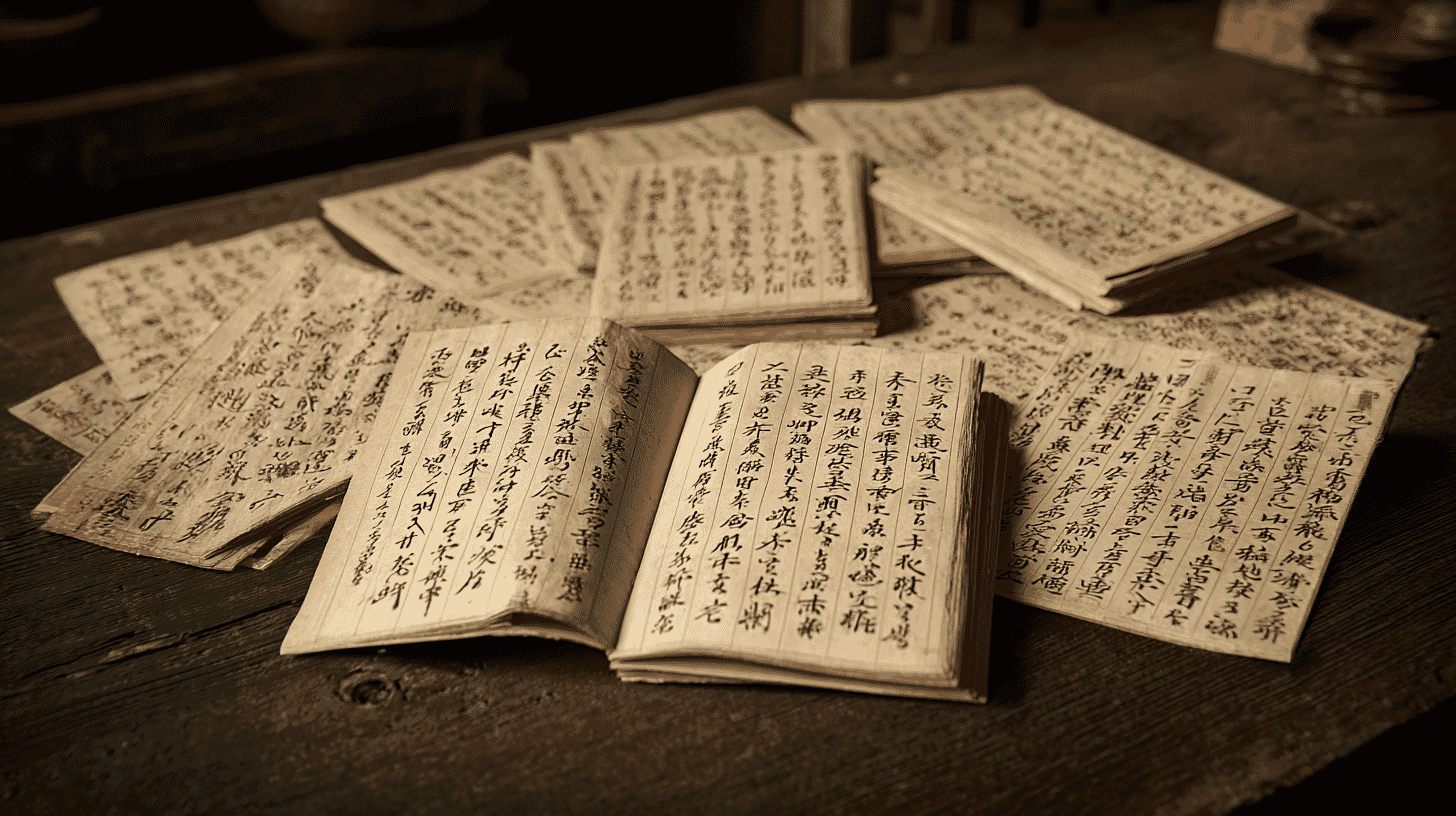
Sanjūjō Sasshi: Kūkai's Thirty Fascicle Booklets – A National Treasure at Ninnaji Temple, Kyoto

Discover Sanjūjō Sasshi, the National Treasure booklets hand-copied by Kūkai in Tang China. Housed at Ninnaji Temple in Kyoto, these 1,200-year-old esoteric Buddhist manuscripts are among Japan's most sacred cultural treasures.

Sanjūjō Sasshi: The Thirty Fascicle Booklets Hand-Copied by Kūkai in Tang China

In the early 9th century, a Japanese monk named Kūkai (空海, 774–835) — later revered as Kōbō Daishi — crossed the perilous seas to Tang Dynasty China in pursuit of the deepest teachings of Esoteric Buddhism. During his stay in the imperial capital of Chang'an, he feverishly transcribed sacred sutras and mantras into small, portable booklets. These precious manuscripts, known as the Sanjūjō Sasshi (三十帖冊子, "Thirty Fascicle Booklets"), survive to this day as one of Japan's most treasured National Treasures, housed at the World Heritage site of Ninnaji Temple in Kyoto.

More than mere copies of scripture, the Sanjūjō Sasshi represent a pivotal moment in the transmission of Buddhist knowledge from China to Japan. They are direct, tangible links to one of the most influential figures in Japanese religious and cultural history — and to the very origins of Shingon Buddhism.

What Is the Sanjūjō Sasshi?

The Sanjūjō Sasshi is a collection of thirty small booklets, each measuring roughly 15 centimeters square — about the size of a modern pocket notebook. They contain hand-copied Buddhist sutras, dharani (ritual incantations), and esoteric ritual texts. The booklets were produced during Kūkai's stay in Chang'an, the capital of Tang Dynasty China, between approximately 805 and 806 CE.

Rather than using the traditional scroll format (kansu-sō) that was standard at the time, Kūkai deliberately chose a compact booklet format known as detchōsō (粘葉装, "butterfly binding"). This innovative decision was purely practical: scrolls were bulky and difficult to transport across the sea, whereas small bound booklets could be packed efficiently for the dangerous voyage home. Today, the Sanjūjō Sasshi is recognized as the oldest surviving example of detchōsō bookbinding in Japan — making it significant not only for its religious content but also for the history of bookmaking.

Although the booklets are collectively attributed to Kūkai, the writing was not his alone. Research has identified more than twenty different hands in the collection, including Chinese scribes hired in Chang'an as well as the renowned calligrapher Tachibana no Hayanari (橘逸勢), who accompanied Kūkai as a fellow member of the Japanese embassy to China. Kūkai's own brushwork appears in several of the booklets, written in a flowing, semi-cursive style that conveys the urgency of a scholar racing against time.

Historical records indicate that the original collection comprised thirty-eight booklets. Over the centuries, eight were lost, leaving the thirty that give the collection its current name.

The Story Behind the Booklets: Kūkai's Mission to China

In 804 CE, Kūkai set sail from Japan as a government-sponsored student monk aboard one of the ships of the eighteenth Japanese embassy to Tang China. The voyage was fraught with danger — storms battered the fleet, and Kūkai's vessel drifted for over thirty days before making landfall on the coast of Fujian Province. Through his exceptional command of classical Chinese, Kūkai helped the embassy gain entry into China and eventually made his way to the capital, Chang'an.

There, at the great Qinglong Temple (青龍寺), he encountered Huiguo (恵果, 746–805), the foremost master of Esoteric Buddhism in China and the seventh patriarch of the lineage tracing back to the historical Buddha. Huiguo immediately recognized Kūkai's extraordinary potential and, in an unprecedented act, transmitted to him the complete teachings of both the Womb Realm (Taizōkai) and Diamond Realm (Kongōkai) mandalas within just a few months. Kūkai was consecrated as the eighth patriarch of the lineage.

Huiguo passed away in December 805, leaving Kūkai with the instruction to return to Japan and spread the teachings. Although originally assigned to study abroad for twenty years, Kūkai cut his stay short to just two years and began preparing for his return. During his final months in China, he worked tirelessly — enlisting local scribes and writing himself — to copy as many essential texts as possible into the compact booklets that would become the Sanjūjō Sasshi. These were his personal study notes, his portable library of the most important esoteric knowledge he had received.

Notably, unlike the official items listed in Kūkai's formal catalog of imported texts (the Shōrai Mokuroku submitted to the Japanese court upon his return in 806), the Sanjūjō Sasshi was kept privately. It was Kūkai's personal treasure, a reference he consulted throughout his life.

Why It Was Designated a National Treasure

The Sanjūjō Sasshi was designated a National Treasure of Japan on June 9, 1951, together with its exquisite lacquer storage box. The designation recognizes the collection's extraordinary significance across multiple dimensions.

First, the booklets are direct physical evidence of the transmission of Esoteric Buddhism from China to Japan. They document what Kūkai studied, what he considered essential, and how he organized his knowledge — providing an irreplaceable window into the intellectual formation of one of Japan's most important religious figures.

Second, as the oldest surviving example of detchōsō (butterfly binding) bookmaking in Japan, the Sanjūjō Sasshi holds foundational importance for the history of the Japanese book. The bookbinding technique itself would not become widespread until centuries later.

Third, the calligraphic content is of exceptional value. Kūkai is celebrated as one of the "Three Great Brushes" (Sanpitsu) of Japan, alongside Emperor Saga and Tachibana no Hayanari. The presence of all three calligraphic traditions within this single collection makes it a peerless resource for the study of early Heian-period calligraphy.

Fourth, the accompanying storage box — the Hōsōge Karyōbinga Maki-e Soku Sasshi-bako (宝相華迦陵頻伽蒔絵冊子箱) — is itself a masterpiece of early Heian lacquerwork. Commissioned by Emperor Daigo in 919 CE to protect the booklets, it is the oldest maki-e lacquer work in Japan with a confirmed date of production. Its lid is inscribed with the purpose of the box and adorned with gold and silver togidashi maki-e designs featuring kalavinka (mythical birds with human heads) and hōsōge (stylized floral arabesque) patterns.

The Dramatic Journey of the Booklets Through History

The history of the Sanjūjō Sasshi after Kūkai's death in 835 reads like a dramatic tale of rival temples, imperial intrigue, and quiet determination.

Following Kūkai's passing, the booklets were entrusted to Tō-ji (東寺), the great Shingon temple in Kyoto that Kūkai himself had been granted by Emperor Saga. However, Kōyasan (高野山), the mountain monastery Kūkai had founded as a retreat, also laid claim to the precious manuscripts. The resulting conflict between the two institutions lasted for decades and had far-reaching consequences for the development of Japanese Buddhism.

Kangen (観賢), a powerful monk and administrator of Tō-ji in the early 10th century, successfully petitioned the court to have the booklets returned to Tō-ji. His efforts contributed to a period of turmoil at Kōyasan that lasted nearly a century. Meanwhile, at Tō-ji, Emperor Daigo commissioned the magnificent lacquer box to house the booklets in 919 CE, confirming their status as objects of the highest national importance.

The final transfer came in the late Heian period, when Prince-Monk Shukaku (守覚法親王, 1150–1202), the sixth head abbot of Ninnaji Temple, borrowed the Sanjūjō Sasshi from Tō-ji for study — and never returned them. As a member of the imperial family and head of a powerful monzeki (imperial cloister) temple, Shukaku was in a position to resist Tō-ji's repeated demands for return. The booklets have remained at Ninnaji ever since, where they are treasured as one of the temple's most sacred possessions.

Highlights and What to See

Viewing the Sanjūjō Sasshi is a rare and moving experience. The booklets are displayed at Ninnaji Temple's Reihokan (霊宝館, Treasure Hall), which opens for special exhibitions in spring and autumn. Because the manuscripts are extremely fragile — they are, after all, over 1,200 years old — only a few booklets are shown at a time, usually displayed open to reveal the dense, meticulous calligraphy within.

When you stand before one of these booklets, you are looking at text written under extraordinary circumstances: a young monk, far from home, copying the most sacred teachings of Esoteric Buddhism by lamplight in the imperial capital of one of the greatest civilizations in world history. The characters are tiny — Kūkai wrote in miniature to maximize the amount of text he could carry home on the ship — yet remarkably legible and beautiful.

Some booklets show Kūkai's distinctive semi-cursive calligraphy, while others display the precise, formal script of Chinese professional scribes. Annotations and notes in the margins reveal how Kūkai used the booklets as working references, adding his own commentary and cross-references over the years.

The lacquer storage box, when exhibited, is equally breathtaking. Despite being over 1,100 years old, its maki-e decoration of kalavinka birds and arabesque flowers remains remarkably preserved, its gold and silver inlay still catching the light. The inscription on the lid clearly identifies the box's purpose and connects it directly to Kūkai's legacy.

A major restoration project spanning six years was completed before the landmark exhibition at the Tokyo National Museum in 2018, during which all thirty booklets were displayed together for the first time in history — an event that drew enormous attention from scholars and the public alike.

Visiting Ninnaji Temple

Ninnaji Temple (仁和寺), where the Sanjūjō Sasshi is housed, is itself a UNESCO World Heritage Site and one of Kyoto's most magnificent temple complexes. Founded in 888 CE by Emperor Uda, it served for centuries as an imperial cloister where members of the imperial family presided as head priests. Today it is the head temple of the Omuro School of Shingon Buddhism.

The temple grounds are expansive and richly rewarding to explore. The Kondō (Golden Hall), a National Treasure, was originally part of the Kyoto Imperial Palace and was relocated to Ninnaji in the early Edo period. The soaring five-story pagoda, the stately Niōmon gate, and the elegant Goten palace complex with its traditional Japanese gardens are all highlights.

Ninnaji is also famous for its Omuro Sakura (御室桜) cherry trees, which bloom about two weeks later than most cherry trees in Kyoto — typically in mid-April. These trees are unusually short, standing only two to three meters tall, allowing visitors to view the blossoms at eye level. Combined with the five-story pagoda in the background, they create one of Kyoto's most iconic spring scenes.

Nearby, within easy walking distance, you can visit Ryōanji Temple (龍安寺), renowned for its enigmatic rock garden, and Kinkakuji (金閣寺), the Golden Pavilion — making Ninnaji an ideal anchor for a full day exploring Kyoto's northwestern cultural treasures.

📍 Plan Your Visit to Kyoto
Find tours, activities & transport passes near Thirty-Cho Booklet
[ Kinkakuji Fushimi Inari & Kimono Rental ]

Q&A

QCan I see the Sanjūjō Sasshi at any time of year?
ANo. The Sanjūjō Sasshi is displayed only during special exhibitions at Ninnaji's Reihokan (Treasure Hall), which is typically open in spring (around April–May) and autumn (around October–November). Because of the manuscripts' extreme fragility, only selected booklets are shown at a time. Check the official Ninnaji Temple website before your visit for current exhibition schedules.
QIs there English-language information available at the Reihokan?
ANinnaji Temple provides some English-language signage and pamphlets. However, detailed explanations of individual artifacts in the Reihokan may be primarily in Japanese. Consider downloading a translation app or bringing a guidebook for deeper understanding. Audio guides may be available during major exhibitions.
QIs photography allowed inside the Reihokan?
APhotography is generally not permitted inside the Reihokan or near the exhibited National Treasures. Please respect these rules to help preserve these irreplaceable cultural properties. You can take photographs freely in most outdoor areas of the temple grounds.
QWhat is the connection between Kūkai and Ninnaji Temple?
ANinnaji was founded in 888 CE, more than fifty years after Kūkai's death. However, as the head temple of the Omuro School of Shingon Buddhism — the sect Kūkai founded — Ninnaji has deep spiritual ties to Kūkai. The Sanjūjō Sasshi came to Ninnaji in the late Heian period through Prince-Monk Shukaku, who borrowed the manuscripts from Tō-ji and never returned them.
QHow do I get to Ninnaji Temple from central Kyoto?
AThe most convenient route is to take the Keifuku Kitano Line (Randen tramway) to Omuro-Ninnaji Station, which is a 2–3 minute walk from the temple gate. Alternatively, from JR Kyoto Station, you can take the JR Bus (route 26) directly to the Omuro-Ninnaji bus stop, a journey of approximately 30–40 minutes.

Basic Information

Official Name Sanjūjō Sasshi (三十帖冊子)
Designation National Treasure (designated June 9, 1951)
Category Calligraphy and Books (書跡・典籍)
Period Early Heian period (c. 805–806 CE)
Quantity 30 booklets, plus 1 lacquer storage box (also designated National Treasure)
Dimensions Each booklet approximately 15 cm × 15 cm; box: 37.0 cm × 24.4 cm × 8.3 cm
Author Kūkai (空海 / Kōbō Daishi), Tachibana no Hayanari, Chinese scribes, and others (20+ hands identified)
Owner / Location Ninnaji Temple (仁和寺), 33 Omuro Ouchi, Ukyo-ku, Kyoto 616-8092, Japan
Viewing Reihokan Treasure Hall at Ninnaji (open spring and autumn only; 500 yen admission)
Temple Hours 9:00 AM – 5:00 PM (March–November); 9:00 AM – 4:30 PM (December–February)
Access 2–3 min walk from Omuro-Ninnaji Station (Keifuku Kitano Line / Randen); JR Bus route 26 from Kyoto Station
Related Designation Ninnaji Temple is a UNESCO World Heritage Site (Historic Monuments of Ancient Kyoto, inscribed 1994)

References

国宝-書跡典籍|三十帖冊子・冊子箱[仁和寺/京都] | WANDER 国宝
https://wanderkokuho.com/201-00584/
仁和寺の書跡 | 世界遺産 真言宗御室派総本山 仁和寺
https://ninnaji.jp/about_culturalassets/calligraphy/
Treasures from Ninnaji Temple and Omuro | Tokyo National Museum
https://www.tnm.jp/modules/r_free_page/index.php?id=1868&lang=en
仁和寺 - Wikipedia
https://ja.wikipedia.org/wiki/仁和寺
宝相華迦陵頻伽蒔絵𡑮冊子箱 - 名品紹介 - 京都国立博物館
https://www.kyohaku.go.jp/jp/collection/meihin/urusi/item05/
空海の息吹を伝える三十帖冊子|お遍路オンライン
https://ohenro-online.com/kouyasan/sannjuujou_sasshi/
国宝「三十帖冊子」 修理から見えてきたもの | 株式会社勉誠社
https://bensei.jp/index.php?main_page=product_book_info&products_id=103695
Ninnaji Temple | Ninna-ji Official Website
https://ninnaji.jp/en/
Ninnaji Temple - Kyoto Travel (japan-guide.com)
https://www.japan-guide.com/e/e3929.html
特別展「仁和寺と御室派のみほとけ」レポート | SPICE
https://spice.eplus.jp/articles/167949

Last verified: 2026.02.08