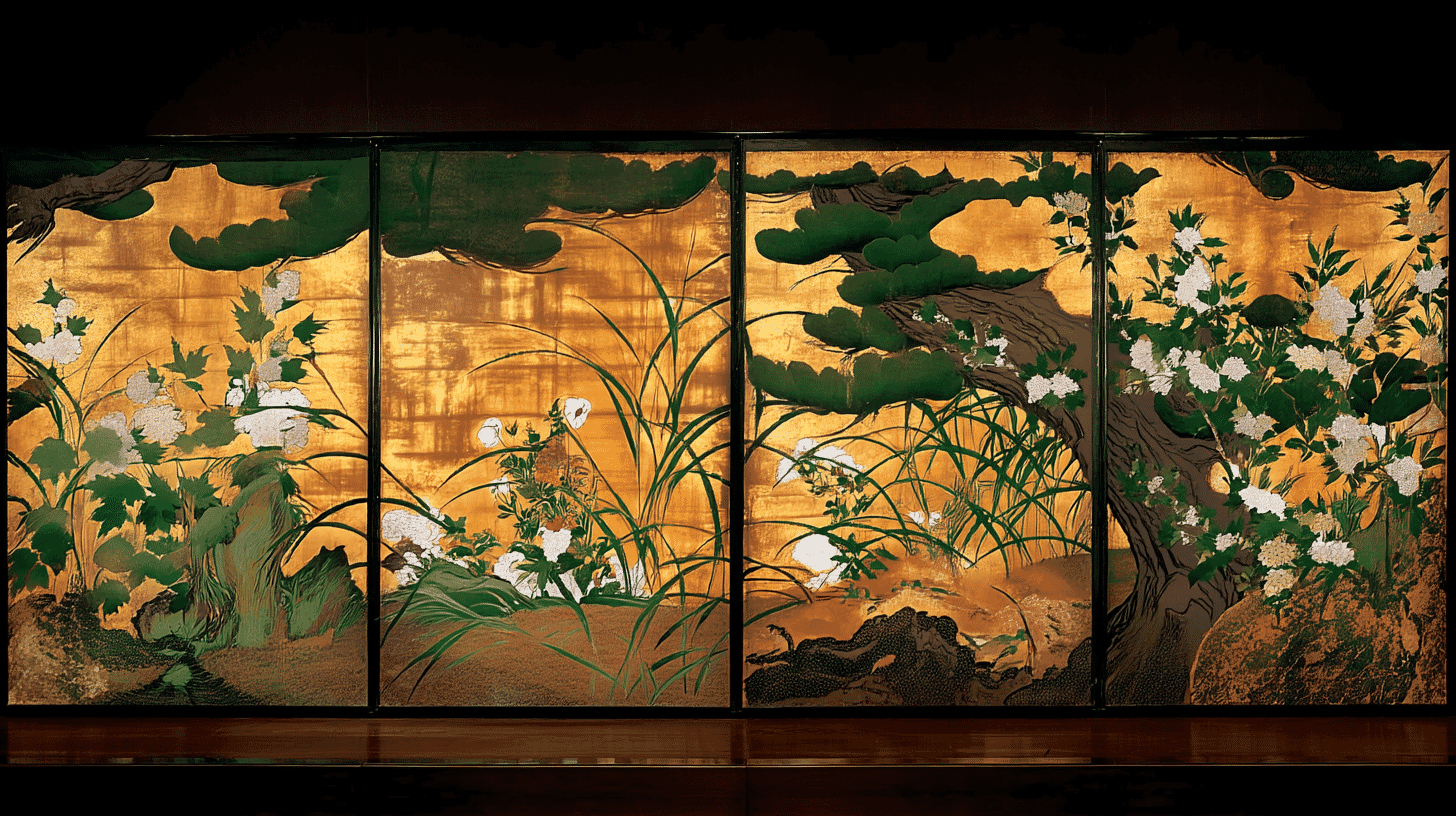
Pine and Flowers on Gold Ground: A National Treasure at Chishakuin Temple, Kyoto

Discover the National Treasure "Pine and Flowers on Gold Ground" two-panel folding screen by the Hasegawa Tohaku school at Chishakuin Temple in Kyoto. A masterpiece of Momoyama-period gold-leaf painting.

Pine and Flowers on Gold Ground: A Dazzling National Treasure at Kyoto's Chishakuin Temple

Tucked within the serene precincts of Chishakuin Temple in Kyoto's Higashiyama district, a pair of magnificent two-panel folding screens radiates with centuries-old gold. Known formally as Shihon Kinji Chakushoku Matsu ni Kusabana-zu (紙本金地著色松に草花図〈二曲屏風〉), or "Pine and Flowers on Gold Ground," this National Treasure stands as one of the finest surviving examples of Momoyama-period painting—an art form defined by its lavish use of gold leaf, vivid mineral pigments, and monumental scale. Created in the late sixteenth century by the renowned Hasegawa school of painters, this pair of folding screens invites visitors into a golden world where stately pine trees preside over delicate wildflowers, capturing the grandeur and poetic sensitivity that defined one of Japan's most creatively exuberant eras.

A Masterpiece Born from Tragedy and Power

The story behind this artwork is inseparable from the turbulent history of Japan's warlord era. In 1591, the military ruler Toyotomi Hideyoshi commissioned a memorial temple called Shounzen-ji on the eastern hills of Kyoto to honor his beloved son Tsurumatsu, who had died at just three years of age. For the interior decoration of this grand temple, Hideyoshi turned to Hasegawa Tohaku (1539–1610), one of the most gifted painters of the age, and his talented workshop. Together, they produced a breathtaking cycle of gold-ground polychrome wall and door paintings—known as kinpeki shōhekiga—depicting cherry blossoms, maple trees, pine groves, autumn grasses, and other natural subjects rendered in brilliant mineral pigments against shimmering backgrounds of gold leaf.

Among these works, the "Pine and Flowers on Gold Ground" screens were originally conceived as part of the larger interior decoration program. Scholars believe that these panels once adorned the walls or alcove areas of the temple's guest hall. After Hideyoshi's death and the fall of the Toyotomi clan, the Tokugawa shogunate granted the Shounzen-ji site and its treasures to Chishakuin Temple in 1615, where they have been carefully safeguarded ever since.

Rescued from the Flames

Chishakuin Temple has endured multiple devastating fires throughout its history, yet these irreplaceable paintings have survived thanks to the extraordinary dedication of the temple's monks. During each conflagration, the monks reportedly rushed to cut the paintings from the walls and carry them to safety. This explains why the works now display uneven edges and seam lines where rescued fragments were later pieced together. The "Pine and Flowers on Gold Ground" panels were eventually remounted in the format of a pair of two-panel folding screens (nikyoku byōbu issō), the form in which visitors can admire them today. Though the original architectural context has been lost, the beauty and power of the paintings remain undiminished.

Why This Work Is Designated a National Treasure

The "Pine and Flowers on Gold Ground" screens were designated a National Treasure by the Japanese government on March 29, 1952, alongside the other surviving masterpieces of the Shounzen-ji painting cycle. Several qualities earned them this highest cultural distinction.

First, the screens represent the pinnacle of kinpeki shōhekiga, a uniquely Japanese painting tradition that reached its artistic zenith during the Momoyama period (1573–1615). The technique of applying lavish gold leaf to create luminous backgrounds, combined with richly saturated mineral pigments for the botanical subjects, resulted in works of unparalleled decorative splendor.

Second, the paintings exemplify the artistic achievement of Hasegawa Tohaku and his workshop, who rivaled the dominant Kano school for the most prestigious commissions of the era. The bold, dynamic depiction of the pine trees contrasts beautifully with the delicate rendering of seasonal wildflowers at their base, demonstrating the Hasegawa school's mastery of both monumental composition and intimate naturalistic detail.

Third, as part of the Shounzen-ji painting cycle, these screens carry profound historical significance as works commissioned by Toyotomi Hideyoshi himself—one of the three great unifiers of Japan—to memorialize his deceased son. They embody the cultural ambition and aesthetic sensibility of the Momoyama ruling class at its peak.

Artistic Highlights and What to Look For

When you stand before these screens in Chishakuin's Treasure Hall, several artistic features deserve special attention.

The gold-leaf ground is not merely a background but an active compositional element. It evokes golden clouds, suffusing the scene with an otherworldly radiance that shifts subtly with changing light and viewing angles. The Momoyama-era artists understood that gold could function as atmosphere itself—simultaneously suggesting sunlight, mist, and the passage of the seasons.

The pine trees serve as the structural backbone of the composition. Their thick, sinuous trunks and spreading branches convey a sense of age, endurance, and vitality. Pine has been a symbol of longevity and steadfastness in Japanese culture since antiquity, and its prominence in these memorial paintings carries a poignant message about the wish for eternal life in the face of loss.

At the feet of the pines, a tapestry of seasonal wildflowers unfolds with remarkable delicacy. Unlike the bold geometry of the trees, the flowers are rendered with a sensitive, almost tender brushwork that invites close inspection. These botanical details showcase the painters' acute observation of nature and their ability to convey both grandeur and intimacy within a single composition.

The interplay between strength and gentleness—massive pines above and fragile blossoms below—is a hallmark of Hasegawa Tohaku's aesthetic philosophy, visible also in his celebrated "Maple Tree" and "Pine with Autumn Grasses" paintings in the same collection.

The Chishakuin Treasure Hall: A Modern Setting for Timeless Art

Since April 2023, Chishakuin Temple has housed its National Treasure paintings in a newly constructed Treasure Hall (Hōmotsukan), built as part of a commemorative project marking the 1,250th anniversary of the birth of Kōbō Daishi Kūkai, the founder of Shingon Buddhism. The state-of-the-art facility features climate-controlled environments, anti-reflective glass cases, and carefully calibrated lighting designed to showcase the gold-leaf surfaces and vivid pigments to their full effect.

The Treasure Hall's National Treasure Exhibition Room displays the full suite of surviving Hasegawa-school wall paintings together, creating an immersive experience surrounded by golden screens on every side. Adjacent to the National Treasure gallery, a special exhibition room presents rotating selections from Chishakuin's collection of approximately 80,000 cultural artifacts.

In the nearby Ōjoin Study Hall, full-size reproductions of the wall paintings have been installed in the positions where the originals once hung, allowing visitors to imagine how these works would have appeared in their original architectural setting—a rare and moving experience that bridges four centuries of history.

Beyond the Paintings: Chishakuin's Famous Garden and Temple Complex

A visit to Chishakuin offers far more than its celebrated paintings. The temple's Scenic Garden (Meishō Teien), designated a Place of Scenic Beauty by the national government, is a Momoyama-period pond-viewing garden said to have been favored by the legendary tea master Sen no Rikyū. Designed to evoke China's Mount Lu, the garden features a long, narrow pond, carefully shaped azalea hedges, natural stones, and a small waterfall, all visible from the broad veranda of the Study Hall. The azaleas burst into spectacular bloom from late April through June, and the garden is equally captivating during autumn foliage season.

The temple grounds themselves are open to visitors free of charge and include the Main Hall (Kondō), the Myōō-den (Fudō Hall), and a hydrangea garden behind the main hall that offers lovely displays in June. Chishakuin also serves as the head temple of the Chisan school of Shingon Buddhism, overseeing some 3,000 affiliated temples throughout Japan, including such famous sites as Naritasan Shinshō-ji in Chiba and Kawasaki Daishi in Kanagawa.

Surrounding Area: A Treasure Trove of Kyoto Culture

Chishakuin enjoys one of the most culturally rich neighborhoods in all of Kyoto. Immediately adjacent to the temple is the Kyoto National Museum, one of Japan's premier art institutions. Just a short walk away stands Sanjūsangen-dō, the extraordinary temple hall housing 1,001 golden statues of the Thousand-Armed Kannon. Also nearby are Yōgen-in, known for its "blood ceiling" and Sōtatsu Tawaraya door paintings, and the Hōkoku Shrine dedicated to Toyotomi Hideyoshi—a fitting companion to the Shounzen-ji story. The area is easily walkable, making it possible to experience several of Kyoto's most significant cultural sites in a single afternoon.

Seasonal Tips for Visitors

While the National Treasure paintings can be viewed year-round inside the climate-controlled Treasure Hall, the overall Chishakuin experience varies beautifully with the seasons. In late April and May, the garden's azaleas create a tapestry of pink and white. June brings the hydrangea garden into full bloom behind the main hall—a lesser-known but enchanting spectacle. Autumn paints the temple grounds in brilliant reds and golds, with maple trees around the bell tower and Main Hall providing some of Higashiyama's finest foliage. Each year on June 15, the Aoba Festival celebrates the birthday of Kōbō Daishi, and on this day the garden and paintings can be viewed free of charge. Morning devotees may also join the temple's daily morning prayers, held at 6:00 AM from March through November and 6:30 AM from December through February.

📍 Plan Your Visit to Kyoto
Find tours, activities & transport passes near Two Panel Folding Screen, Painted Gold on Paper with a
[ Kinkakuji Fushimi Inari & Kimono Rental ]

Q&A

QCan I see the "Pine and Flowers on Gold Ground" screens at any time of year?
AYes. The National Treasure paintings, including these screens, are on permanent display in the Chishakuin Treasure Hall, which is open year-round during regular visiting hours (generally 9:00–16:00). However, temporary closures may occur during special exhibitions or maintenance, so it is advisable to check the temple's official website before visiting.
QIs photography allowed inside the Treasure Hall?
APhotography policies may vary. Historically, photography of the original National Treasure paintings has been restricted to protect the works. Please confirm current rules at the reception desk upon arrival.
QHow do I get to Chishakuin Temple from Kyoto Station?
AFrom Kyoto Station, take City Bus No. 206 or No. 208 and alight at the "Higashiyama Nanajo" stop. The temple is about a five-minute walk from the bus stop. Alternatively, from Keihan Shichijo Station, it is approximately a ten-minute walk east. The journey by bus from Kyoto Station takes roughly ten minutes.
QIs there English-language support available at the temple?
AThe Treasure Hall includes some English signage and informational materials. The temple also offers an audio guide within the exhibition space. However, the guided morning prayer experience is conducted in Japanese. English information about the temple and its treasures is available on the official Chishakuin website.
QWho painted these screens? Are they by Hasegawa Tohaku himself?
AThe screens are attributed to the Hasegawa Tohaku school. While the entire cycle of gold-ground paintings at Chishakuin was produced as a collaborative effort by Tohaku and his workshop, specific attributions for individual panels within the series remain a subject of scholarly discussion. The overall artistic direction and key compositions are credited to Tohaku, with contributions from his son Kyūzō and other disciples.

Basic Information

Official Name 紙本金地著色松に草花図〈二曲屏風〉 (Pine and Flowers on Gold Ground, Two-Panel Folding Screen)
Designation National Treasure (Painting)
Date of Designation March 29, 1952
Period Momoyama period (late 16th century)
Format One pair (issō) of two-panel folding screens
Technique Color on gold-leaf paper (kinpeki shōhekiga)
Artist Attributed to the Hasegawa Tohaku school
Owner Chishakuin Temple (智積院)
Location 964 Higashikawaramachi, Higashiyama-ku, Kyoto 605-0951, Japan
Treasure Hall Admission Adults: 500 yen / Jr. & Sr. High School: 300 yen / Elementary: 200 yen
Scenic Garden Admission Adults: 500 yen / Jr. & Sr. High School: 300 yen / Elementary: 200 yen
Visiting Hours 9:00–16:00 (last entry)
Access City Bus No. 206/208 to "Higashiyama Nanajo" (approx. 10 min from Kyoto Station); or 10-min walk from Keihan Shichijo Station
Official Website https://chisan.or.jp/en/worship/

References

文化遺産データベース — 紙本金地著色松に草花図〈/二曲屏風〉
https://bunka.nii.ac.jp/db/heritages/detail/198816
国指定文化財等データベース — 紙本金地著色松に草花図〈/二曲屏風〉
https://kunishitei.bunka.go.jp/heritage/detail/201/10382
真言宗智山派 総本山智積院 — 宝物館(宝物紹介)
https://chisan.or.jp/worship/artifact/
真言宗智山派 総本山智積院 — 参拝
https://chisan.or.jp/worship/
WANDER 国宝 — 国宝-絵画|障壁画 桜楓図(長谷川等伯・久蔵筆)[智積院/京都]
https://wanderkokuho.com/201-00044/
Highlighting Japan — Masterpieces of Kinpeki Shouhekiga at Chishakuin Temple
https://www.gov-online.go.jp/eng/publicity/book/hlj/html/202210/202210_07_en.html
Suntory Museum of Art — Treasures from the Chishakuin Temple in Kyoto
https://www.suntory.com/sma/exhibition/2022_5/index.html
Wikipedia — 智積院
https://ja.wikipedia.org/wiki/智積院
Wikipedia — 長谷川等伯
https://ja.wikipedia.org/wiki/長谷川等伯
京都で遊ぼうART — 智積院宝物館と長谷川一門の傑作障壁画
https://www.kyotodeasobo.com/art/static/houmotsukan/chisyakuin-temple/02-chisyakuin-tohaku.html
京都観光Navi — 智積院 早朝特別拝観
https://ja.kyoto.travel/event/single.php?event_id=9902

Last verified: 2026.02.17