Kongōjō Darani-kyō: Japan's Oldest Surviving Sutra Manuscript
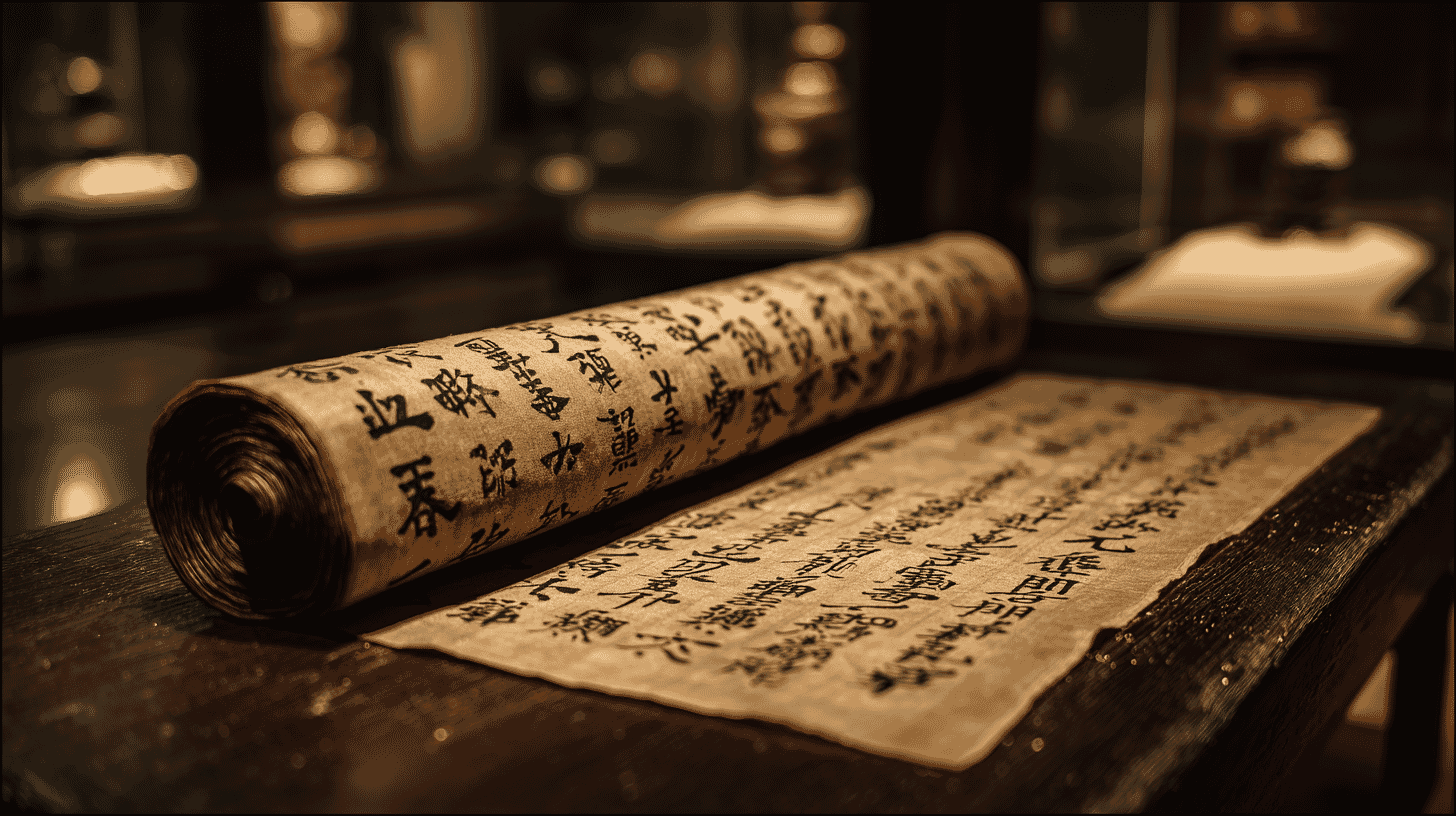
Deep within the archives of Japan's Agency for Cultural Affairs lies a remarkable scroll — a slender ribbon of hemp paper stretching over seven meters long, inscribed with graceful Chinese characters in black ink. This is the Kongōjō Darani-kyō (金剛場陀羅尼経), the oldest surviving handwritten sutra copied in Japan, and a designated National Treasure. Dating to 686 CE, this extraordinary manuscript offers an intimate window into the earliest days of Japanese Buddhist culture, calligraphy, and writing itself.
What Is the Kongōjō Darani-kyō?
The Kongōjō Darani-kyō, also known as the Vajra Mandala Dharani Sutra, is a Buddhist dharani scripture that was originally translated from Sanskrit into Chinese by the Indian-born monk Jñānagupta (闍那崛多) during the Sui Dynasty in the late 6th century. Jñānagupta began his translation work in the Chinese capital of Chang'an around 560 CE during the Northern Zhou period, and continued until his death around 600 CE under the Sui Dynasty.
The National Treasure itself is not the original Chinese translation, but rather a Japanese handwritten copy — a shakyō (写経) — produced in Japan during the Asuka period. It is a single scroll written on hemp paper (mashi), measuring 26.1 centimeters in height and approximately 7.12 meters in total length. The scroll is composed of fifteen individual sheets of hemp paper, each roughly 46 centimeters long, joined together to form a continuous roll. The text is written with light ink guidelines, with 17 characters per line and approximately 27 lines per sheet.
The Oldest Sutra Manuscript in Japan
What makes the Kongōjō Darani-kyō truly extraordinary is its colophon — a dedication note written at the end of the scroll in the same hand as the main text. The colophon reads:
"In the fifth month of the year Hinoe-inu, the Buddhist faithful (chishiki) within Shiki District, Kawachi Province, reverently produced one copy of the Kongōjō Darani Sutra for the sake of seven generations of parents and all sentient beings, that through this virtuous deed they may be reborn in the Pure Land and ultimately attain perfect enlightenment. Teaching monk: Hōrin."
The key to dating this manuscript lies in the word "hyō" (評), used to denote the administrative district. This term was employed in Japan only before the enactment of the Taihō Code in 701 CE, after which the character "gun" (郡) replaced it. Since the only year of Hinoe-inu before 701 is 686 CE (the first year of Emperor Tenmu's Shuchō era), scholars have conclusively dated this scroll to May of that year. This makes it the oldest surviving sutra manuscript copied in Japan, and one of the oldest paper documents in the country — second only to the Sangyō Gisho commentaries attributed to Prince Shōtoku.
Why Was It Designated a National Treasure?
The Kongōjō Darani-kyō was designated as a National Treasure of Japan on June 9, 1951, for several compelling reasons.
First, it is the earliest surviving example of sutra copying (shakyō) in Japan, providing direct physical evidence of Buddhist devotional practices in the late 7th century. The colophon is an invaluable historical document, confirming the existence of organized lay Buddhist communities (chishiki) in the provinces and their role in commissioning religious texts for the spiritual benefit of their ancestors.
Second, the scroll serves as a critical piece of evidence for the study of Japan's early administrative system. The use of "hyō" (評) rather than "gun" (郡) for the district unit confirms that the Asuka Kiyomihara Code, which preceded the Taihō Code, employed a different system of local governance. This has proven instrumental in understanding how Japan transitioned from its early governmental structures to the Chinese-influenced ritsuryō system.
Third, the calligraphy itself is of remarkable artistic and historical significance. The script retains the calligraphic style of the Chinese Six Dynasties period while also incorporating early Tang Dynasty influences, particularly that of the renowned calligrapher Ouyang Xun (557–641) and his son Ouyang Tong. This blending of styles provides a rare example of how continental calligraphic traditions were received and practiced in 7th-century Japan.
Highlights and Points of Fascination
For visitors and enthusiasts of Japanese cultural heritage, the Kongōjō Darani-kyō offers several fascinating points of interest.
The calligraphic style is notable for its upright, refined characters with a slightly high center of gravity. Scholar Uozumi Kazuaki has analyzed the letterforms and concluded that the script is not in a typical sutra-copying style (shakyō-tai) but rather closely resembles the calligraphy of Ouyang Xun, one of the "Three Great Masters of Early Tang." Similarities have also been noted between this sutra and the inscription on the bronze plate at Hase-dera Temple (the Dōban Hokke Sessō-zu), suggesting a shared artistic milieu.
The provenance of the scroll tells a compelling story across centuries. It bears the black seal of the "Hōryū-ji Issai-kyō" (Hōryū-ji Complete Buddhist Scriptures), indicating that it was once part of the great library at Hōryū-ji, one of Japan's most ancient and revered temples. It is believed that the original Chinese text may have been brought to Japan by the monk Dōshō, who studied under the legendary Xuanzang — the great Chinese pilgrim who traveled to India to bring Buddhist scriptures back to China. Over time, however, the scroll left Hōryū-ji and passed into private hands. In 2005, the Agency for Cultural Affairs acquired it from a private collector in Kyoto, ensuring its preservation for future generations.
Uozumi Kazuaki has also proposed that the scribe may have been of Korean heritage. He notes that the use of "hyō" (評) as an administrative term reflects Korean usage, suggesting that Korean immigrants, who played a vital role in the cultural and intellectual life of ancient Japan, may have been involved in the production of this sutra.
Where Can You See It?
As a cultural property owned by the Agency for Cultural Affairs, the Kongōjō Darani-kyō is not on permanent public display. Due to the extreme fragility of paper manuscripts from the 7th century, the scroll is carefully preserved and only exhibited on special occasions at national museums. It has been displayed at the Tokyo National Museum, the Nara National Museum, and the Kyoto National Museum during special exhibitions. Notably, it was featured in the acclaimed "Yan Zhenqing: Beyond Wang Xizhi" calligraphy exhibition at the Tokyo National Museum in early 2019.
Visitors interested in seeing this National Treasure should check the exhibition schedules of Japan's national museums, particularly the Tokyo National Museum and the Nara National Museum, which frequently host exhibitions of calligraphy and Buddhist manuscripts. The e-Kokuho digital database maintained by the National Institutes for Cultural Heritage also provides high-resolution images of select National Treasures.
Surrounding Attractions
While the Kongōjō Darani-kyō itself travels between museums, visitors inspired by this manuscript can explore the rich historical landscape connected to its story.
The Hōryū-ji Temple in Ikaruga, Nara Prefecture, is where the scroll was once preserved. Founded in 607 CE by Prince Shōtoku, Hōryū-ji is home to the world's oldest surviving wooden structures and is a UNESCO World Heritage Site. Its treasure hall offers an extraordinary collection of Buddhist art from the Asuka and Nara periods.
In Yao City, Osaka Prefecture, visitors can explore the area that was once Shiki District (志貴評) of Kawachi Province — the very community that commissioned this sutra in 686 CE. The neighborhood of Shiki (志紀) preserves the ancient place name, and the area offers a glimpse into the historical heartland of early Japanese Buddhism.
The Tokyo National Museum in Ueno, Tokyo, is Japan's oldest and largest museum, with an unparalleled collection of Japanese art and cultural properties. The Nara National Museum, located in the heart of Nara near Tōdai-ji and Kōfuku-ji, specializes in Buddhist art and frequently exhibits rare manuscripts and sutra scrolls.
- 📍 Plan Your Visit to Kyoto
- Find tours, activities & transport passes near Vajrabhadrani Sutra
- [ Kinkakuji Fushimi Inari & Kimono Rental ]
Q&A
- What makes the Kongōjō Darani-kyō the oldest sutra in Japan?
- The colophon at the end of the scroll includes a date reference — the year "Hinoe-inu" — and uses the administrative term "hyō" (評), which was replaced by "gun" (郡) after the Taihō Code of 701 CE. This firmly dates the manuscript to 686 CE, making it the oldest surviving sutra copied in Japan. No earlier sutra manuscripts from Japan are known to exist.
- Can I see the Kongōjō Darani-kyō at a museum?
- The scroll is owned by the Agency for Cultural Affairs and is not on permanent display. It is exhibited only during special exhibitions at national museums such as the Tokyo National Museum, the Nara National Museum, or the Kyoto National Museum. Please check the museums' exhibition schedules in advance to confirm if it is being shown.
- What language is the sutra written in?
- The sutra is written in classical Chinese (kanbun). The original text was a Sanskrit Buddhist scripture translated into Chinese by the Indian-born monk Jñānagupta during the Sui Dynasty in the late 6th century. The National Treasure is a Japanese hand-copied version of this Chinese translation.
- What is the connection between this sutra and Hōryū-ji Temple?
- The scroll bears the black seal of the "Hōryū-ji Issai-kyō" (Hōryū-ji Complete Buddhist Scriptures), indicating it was once part of Hōryū-ji's library collection. It is believed to have left the temple at some point and passed into private ownership before being acquired by the Agency for Cultural Affairs in 2005.
- Why is the calligraphy style of this sutra considered important?
- The calligraphy blends the styles of the Chinese Six Dynasties period with early Tang Dynasty influences, particularly that of the renowned calligrapher Ouyang Xun, one of the "Three Great Masters of Early Tang." This makes it an invaluable record of how continental calligraphic traditions were transmitted to and practiced in 7th-century Japan.
Basic Information
| Official Name | 金剛場陀羅尼経 (Kongōjō Darani-kyō / Vajra Mandala Dharani Sutra) |
|---|---|
| Also Known As | Ogawa-bon Kongōjō Darani-kyō (小川本金剛場陀羅尼経) |
| Category | National Treasure (Writings: Calligraphy and Books) |
| Period | Asuka Period (Hakuhō era), 686 CE (1st year of Shuchō / Emperor Tenmu's reign) |
| Material | Ink on hemp paper (mashi), handscroll format |
| Dimensions | Height: 26.1 cm; Total length: approx. 7.12 m (15 sheets joined) |
| Original Translator | Jñānagupta (闍那崛多), Sui Dynasty |
| Teaching Monk | Hōrin (宝林) |
| Commissioning Community | Buddhist faithful (chishiki) of Shiki District, Kawachi Province (present-day Yao City, Osaka) |
| Owner | Agency for Cultural Affairs (文化庁), Government of Japan |
| National Treasure Designation | June 9, 1951 |
| Acquisition | Purchased from a private collector in Kyoto in 2005 |
| Designation Number | 00036-00 (Registry ID: 201-582) |
References
- 金剛場陀羅尼経 - Wikipedia (Japanese)
- https://ja.wikipedia.org/wiki/%E9%87%91%E5%89%9B%E5%A0%B4%E9%99%80%E7%BE%85%E5%B0%BC%E7%B5%8C
- 金剛場陀羅尼経 — Cultural Heritage Online (文化遺産オンライン)
- https://bunka.nii.ac.jp/heritages/detail/125977
- 国宝-書跡典籍|金剛場陀羅尼経[文化庁] — WANDER 国宝
- https://wanderkokuho.com/201-00582/
- List of National Treasures of Japan (writings: others) - Wikipedia (English)
- https://en.wikipedia.org/wiki/List_of_National_Treasures_of_Japan_(writings:_others)
- A History of Writings in Japanese — 62nd IFLA General Conference
- https://origin-archive.ifla.org/IV/ifla62/62-yosz.htm
- Sutra Manuscripts of the Nara Period — Kyoto National Museum
- https://www.kyohaku.go.jp/old/eng/theme/floor1_3/past/cal_20150203.html
- 国指定文化財等データベース — 文化庁
- https://kunishitei.bunka.go.jp/heritage/detail/201/582
Last verified: 2026.02.08