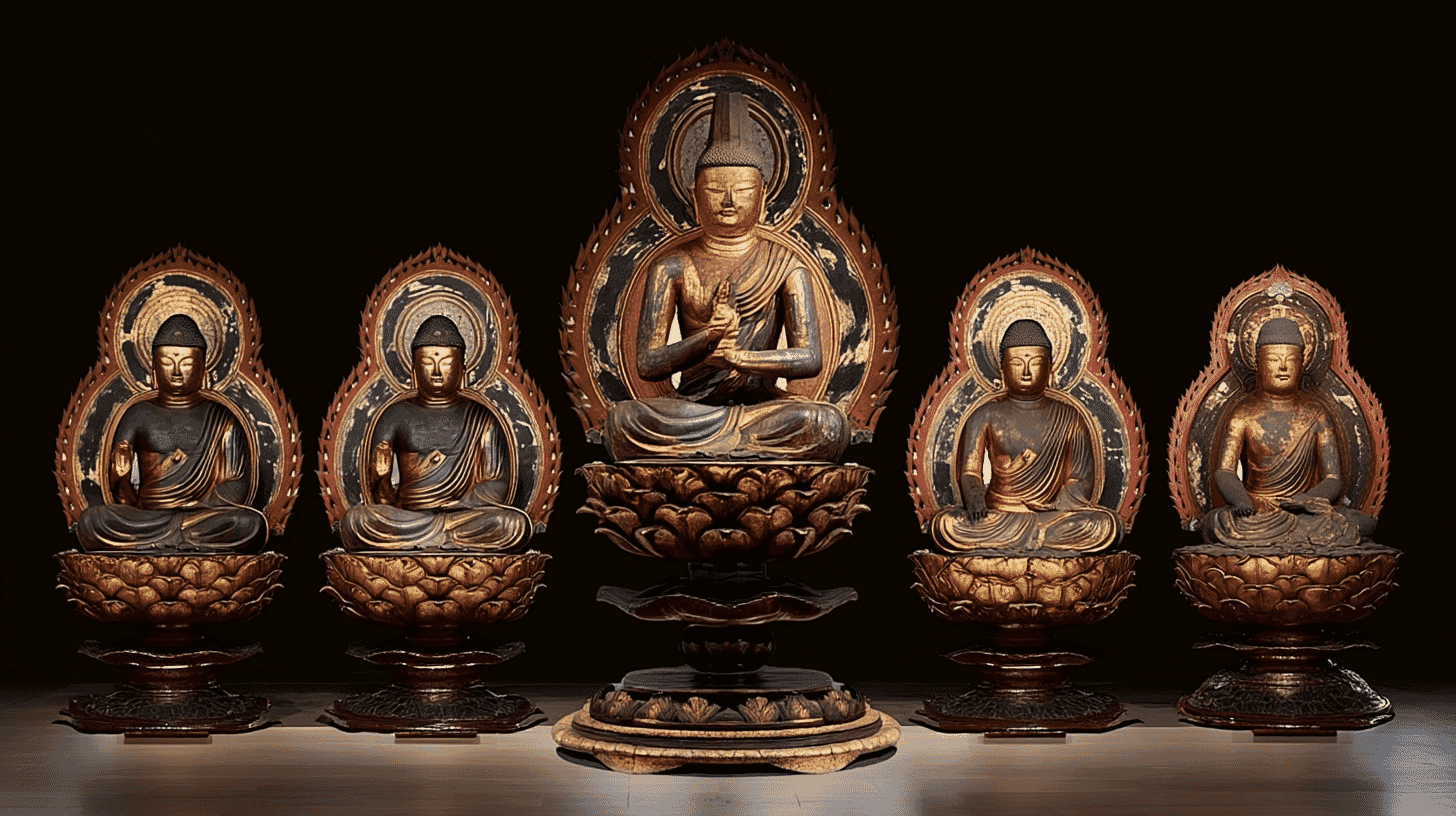
The Five Wisdom Buddhas of Anshoji Temple: A Timeless Encounter with Esoteric Buddhism
Tucked within the serene galleries of the Kyoto National Museum, five golden Buddha statues sit in quiet majesty, just as they have for over 1,100 years. These are the Wooden Seated Statues of the Five Wisdom Buddhas (木造五智如来坐像, Mokuzō Gochi Nyorai Zazō), owned by Anshoji Temple in Kyoto's Yamashina district and designated a National Treasure of Japan in 2019. They are the oldest complete surviving set of Five Wisdom Buddha sculptures in the country—a breathtaking testament to the power and artistry of early Japanese Esoteric Buddhism.
For international visitors drawn to Japan's spiritual heritage, these sculptures offer a rare and deeply moving window into the sacred world of Shingon Buddhism as it was practiced over a millennium ago, during an era when monks traveled to Tang Dynasty China and returned to Japan carrying the esoteric teachings that would reshape the nation's religious landscape.
What Are the Five Wisdom Buddhas?
The Five Wisdom Buddhas (五智如来, Gochi Nyorai), also known internationally as the Five Dhyani Buddhas or Five Tathagatas, are central figures in Vajrayana (Esoteric) Buddhism. They represent the five aspects of supreme wisdom emanating from Dainichi Nyorai (Mahavairocana), the Cosmic Buddha who sits at the heart of the Diamond Realm Mandala (Vajradhatu Mandala).
The five Buddhas in this set are:
- Dainichi Nyorai (大日如来 / Mahavairocana) — the central, supreme Buddha representing all-encompassing wisdom
- Ashuku Nyorai (阿閦如来 / Akshobhya) — the Immovable Buddha of the East, embodying mirror-like wisdom
- Hosho Nyorai (宝生如来 / Ratnasambhava) — the Jewel-Born Buddha of the South, symbolizing the wisdom of equality
- Amida Nyorai (阿弥陀如来 / Amitabha) — the Buddha of Infinite Light of the West, representing discerning wisdom
- Fuku Joju Nyorai (不空成就如来 / Amoghasiddhi) — the Buddha of Infallible Achievement of the North, embodying all-accomplishing wisdom
Together, these five Buddhas form a three-dimensional expression of the Diamond Realm Mandala—a cosmic map of enlightenment central to Shingon Buddhist practice. While painted mandalas are common, sculptural sets like this one are exceptionally rare, making the Anshoji group an irreplaceable treasure of Buddhist art.
The History of Anshoji Temple
Anshoji Temple (安祥寺) was founded in 848 CE (Kasho 1) in the Yamashina district of Kyoto. Its establishment was driven by the devout wish of Fujiwara no Junshi (藤原順子, 809–871), consort of Emperor Nimmyo and mother of Emperor Montoku. The temple was entrusted to the monk Eun (恵運, 798–869), one of the celebrated Eight Monks Who Traveled to Tang China (入唐八家), who had studied esoteric Buddhist teachings at the great temples of Chang'an.
In its heyday, Anshoji was a grand Shingon institution comparable in scale to Daigoji Temple. Like Daigoji, it had both an Upper Temple (上寺, Kamidera) perched on the mountainside and a Lower Temple (下寺, Shimodera) at its base. According to the temple's detailed inventory record (安祥寺伽藍縁起資財帳), compiled by Eun in 867, the complex housed over thirty Buddhist statues, numerous paintings, ritual implements, sutras, and extensive landholdings across multiple provinces.
However, after the death of Fujiwara no Junshi in 871, the temple lost its primary patron and gradually declined. The Upper Temple fell into ruin by the late Heian period, and the entire complex was effectively destroyed during the Onin War (1467–1477). The temple was revived in the Edo period through the patronage of Tokugawa Ieyasu, though it never regained its former grandeur. Today, Anshoji is a small but dignified temple that has recently begun opening its doors for special seasonal viewings.
Why Were They Designated a National Treasure?
The Five Wisdom Buddha statues of Anshoji were first registered as Important Cultural Properties in 1910. Over a century later, in July 2019, they received the nation's highest cultural designation as a National Treasure. Several factors contributed to this elevated recognition:
First and foremost, these sculptures constitute the oldest complete set of Five Wisdom Buddhas in Japan. While the Lecture Hall at Toji Temple (To-ji, 東寺) in Kyoto houses a famous three-dimensional mandala with the same five central Buddhas, the Toji statues were replacements created after the originals were lost to fire. The Anshoji statues, dating to approximately 851–854 CE, are therefore the earliest surviving sculptural representation of this fundamental esoteric iconography.
Second, the statues are outstanding examples of early Heian-period sculptural technique. Carved from wood and overlaid with dry lacquer (乾漆, kanshitsu), they display robust yet graceful forms with a naturalistic sense of physical presence. The central Dainichi Nyorai stands at an impressive 158.6 centimeters in height, while the four surrounding Buddhas measure between 106 and 109 centimeters, creating a dignified hierarchical composition.
Third, the complete set of five has survived together for over 1,100 years—a remarkable feat of preservation considering the numerous wars, fires, and natural disasters that have destroyed countless Japanese cultural properties over the centuries. The statues narrowly escaped destruction when the Tahoto pagoda at Anshoji, where they had been housed since the Edo period, burned down in 1906. Fortunately, they had already been entrusted to the Kyoto National Museum for safekeeping, a decision that proved to be providential.
Finally, the statues underwent expert conservation between 2013 and 2015, addressing issues such as flaking gold leaf and paint. The restoration work revealed further details about their construction and confirmed their exceptional historical and artistic value, paving the way for the National Treasure designation.
Highlights and What to Look For
When you stand before these statues in the gallery of the Kyoto National Museum, several details reward close attention.
The central Dainichi Nyorai commands the composition with his larger scale and distinctive hand gesture (mudra). He forms the chi-ken-in (智拳印), the "wisdom fist" mudra unique to the Diamond Realm Dainichi, in which the left index finger is enclosed by the right hand—a gesture symbolizing the unity of the spiritual and material worlds.
Each of the four surrounding Buddhas bears a different mudra corresponding to their identity and direction in the mandala. These subtle variations in hand position are one of the principal ways that Buddhist sculptors distinguished each figure, and observing them closely can deepen your appreciation of esoteric Buddhist symbolism.
Look for the traces of original gold leaf and polychrome decoration that still adorn the surfaces. When first created, these statues would have gleamed with gold and vivid color in the candlelit interior of the temple's worship hall, evoking the splendor of the Buddha's Pure Land.
The robust, well-proportioned bodies and serene facial expressions are characteristic of early Heian sculpture, reflecting the influence of late Nara-period aesthetics while embodying the spiritual intensity of the new esoteric doctrines imported from Tang China. There is a remarkable sense of physical solidity and calm authority in these figures that distinguishes them from the more slender, ethereal Buddhist sculptures of later periods.
At the 2024 special exhibition "Kukai" at Nara National Museum, the five statues were displayed in their original spatial arrangement for the first time in centuries—an extraordinary opportunity to experience them as a functioning mandala, just as worshippers would have encountered them over a thousand years ago.
Where to See the Five Wisdom Buddhas
The Five Wisdom Buddhas are currently deposited at the Kyoto National Museum (京都国立博物館) in the Higashiyama district of Kyoto. Since the National Treasure designation in 2019, they have frequently been displayed on the first floor of the Heisei Chishinkan building, the museum's main exhibition wing designed by architect Taniguchi Yoshio.
Please note that as deposited works, their display schedule can vary. The statues are typically shown during the museum's regular Collection Gallery (名品ギャラリー) exhibitions, but they may not always be on view during special exhibitions or maintenance periods. It is recommended to check the museum's official website before your visit to confirm the current exhibition schedule.
The Kyoto National Museum is itself a magnificent cultural destination. Founded in 1897, it houses a vast collection of art and artifacts spanning Japanese history, with particular strengths in Buddhist sculpture, painting, calligraphy, and decorative arts. The museum building sits across the street from the celebrated Sanjusangendo Temple, making it easy to combine both visits in a single trip.
Nearby Attractions
The area surrounding the Kyoto National Museum is one of Kyoto's richest cultural zones. Here are some highlights within easy walking distance:
- Sanjusangendo Temple (三十三間堂) — directly across the street, home to 1,001 statues of Kannon, several of which are also National Treasures
- Chishakuin Temple (智積院) — a Shingon Buddhist temple with magnificent painted sliding doors by Hasegawa Tohaku and his school
- Toyokuni Shrine (豊国神社) — dedicated to the great unifier Toyotomi Hideyoshi, with a stunning National Treasure karamon gate
- Kiyomizu-dera Temple — one of Kyoto's most iconic temples, a short bus ride to the northeast
- Fushimi Inari Taisha — the famous shrine with thousands of vermillion torii gates, accessible by train from nearby stations
For those interested in deepening their connection to the Five Wisdom Buddhas, a visit to Anshoji Temple itself in the Yamashina district is also worthwhile. While the temple is not ordinarily open to the public, it has begun offering special seasonal openings in recent years, including spring and autumn viewing periods. The temple grounds feature a newly created garden called Gochi Henmyo-tei (五智遍明庭), inspired by the Five Wisdom Buddhas, as well as a charming temple cafe called Terakabo Semui.
Toji Temple (東寺), about fifteen minutes by bus from Kyoto Station, houses the famous three-dimensional mandala in its Lecture Hall (講堂), featuring a later set of Five Wisdom Buddhas along with bodhisattvas and Wisdom Kings. Comparing the Anshoji originals at the museum with the Toji arrangement offers a fascinating study in the evolution of Japanese esoteric Buddhist sculpture.
- 📍 Plan Your Visit to Kyoto
- Find tours, activities & transport passes near Wooden Seated Statues of the Five Wisdom Buddhas
- [ Kinkakuji Fushimi Inari & Kimono Rental ]
Q&A
- Are the Five Wisdom Buddhas always on display at the Kyoto National Museum?
- Not always. While they have been frequently exhibited since their 2019 National Treasure designation, display schedules can change depending on special exhibitions and gallery rotations. Please check the Kyoto National Museum's official website (https://www.kyohaku.go.jp/) before your visit to confirm the current exhibition lineup.
- Can I visit Anshoji Temple to see the original home of the statues?
- Anshoji Temple is not ordinarily open to the public, but it has begun holding special viewings in spring and autumn in recent years. Check the temple's official website (https://anshouji.or.jp/) for the latest schedule. Note that the Five Wisdom Buddhas themselves are housed at the Kyoto National Museum and are not at the temple.
- Is photography allowed in the gallery where the statues are displayed?
- Photography policies at the Kyoto National Museum vary by exhibition. For the regular Collection Gallery, photography without flash is generally permitted for many items, but restrictions may apply to specific works. Always check the signage in the gallery and follow museum staff instructions.
- What is the difference between the Five Wisdom Buddhas at Anshoji and those at Toji Temple?
- Both sets represent the five central Buddhas of the Diamond Realm Mandala. However, the Toji Temple statues are replacements created after the originals were destroyed by fire, while the Anshoji set dates to approximately 851–854 CE, making them the oldest surviving complete group of Five Wisdom Buddhas in Japan. The Anshoji statues follow the traditional iconography of the Diamond Realm mandala faithfully, with each Buddha displaying the specific mudra (hand gesture) prescribed by esoteric Buddhist texts.
- Is there English signage or audio guide available at the Kyoto National Museum?
- Yes, the Kyoto National Museum provides multilingual support including English signage for major exhibits. Audio guides are available for rent during collection gallery exhibitions. The museum's website also offers English-language information about current exhibitions and visitor services.
Basic Information
| Official Name | Wooden Seated Statues of the Five Wisdom Buddhas (木造五智如来坐像) |
|---|---|
| Designation | National Treasure (Sculpture) |
| Number of Statues | 5 |
| Period | Heian period (ca. 851–854 CE) |
| Material | Wood with dry lacquer overlay |
| Dimensions | Dainichi Nyorai: H 158.6 cm; other four Buddhas: H 106–109 cm |
| Owner | Anshoji Temple (安祥寺), Yamashina-ku, Kyoto |
| Current Location | Kyoto National Museum, 527 Chayacho, Higashiyama-ku, Kyoto 605-0931 |
| Important Cultural Property Designation | August 29, 1910 |
| National Treasure Designation | July 23, 2019 |
| Museum Hours | 9:30–17:00 (last entry 16:30); Fridays until 20:00 (last entry 19:30) |
| Museum Closed | Mondays (or following Tuesday if Monday is a national holiday) |
| Admission (Collection Gallery) | Adults: 700 yen / University students: 350 yen / Under 18 and over 70: Free |
| Access | 7-minute walk east from Keihan Shichijo Station; or city bus #100, #206, or #208 from JR Kyoto Station to "Hakubutsukan Sanjusangendo-mae" stop |
| Museum Website | https://www.kyohaku.go.jp/ |
| Anshoji Temple Website | https://anshouji.or.jp/ |
References
- WANDER 国宝 — 国宝-彫刻|五智如来坐像[安祥寺/京都]
- https://wanderkokuho.com/201-03507/
- 文化遺産データベース — 木造五智如来坐像
- https://bunka.nii.ac.jp/db/heritages/detail/162415
- Kyoto National Museum — Japanese Sculpture Gallery
- https://www.kyohaku.go.jp/old/eng/theme/floor1_2/past/scu_20180102.html
- Kyoto National Museum — Buddhist and Shinto Images of Kyoto
- https://www.kyohaku.go.jp/old/eng/theme/floor1_2/past/1F-1_20190702.html
- Nara National Museum — KŪKAI Special Exhibition
- https://www.narahaku.go.jp/english/exhibition/special/202404_kukai/
- 吉祥山宝塔院 安祥寺 — 御本尊
- https://anshouji.or.jp/about/detail/
- 安祥寺 (京都市) — Wikipedia
- https://ja.wikipedia.org/wiki/安祥寺_(京都市)
- 京都大学 — 安祥寺の概要
- https://www.bun.kyoto-u.ac.jp/archive/jp/projects/projects_completed/hmn/ouken/anshoji/overview.html
- Five Tathāgatas — Wikipedia
- https://en.wikipedia.org/wiki/Five_Tathāgatas
- 京都国立博物館 — 休館日・開館時間・観覧料
- https://www.kyohaku.go.jp/jp/visit/info/
Last verified: 2026.02.17
Nearby heritages
- Artifacts Excavated from Ozuka Tomb, Kaho County, Chikuzen
- Kyoto National Museum, 527 Chayamachi, Higashiyama-ku, Kyoto City, Kyoto Prefecture
- Bronze Statue of Nyoirin Kannon (half Seated) (said to Be
- Kyoto National Museum, 527 Chayamachi, Higashiyama-ku, Kyoto City, Kyoto Prefecture
- Wooden Standing Statue of Jizo Bodhisattva
- Kyoto National Museum, 527 Chayamachi, Higashiyama-ku, Kyoto City, Kyoto Prefecture
- Colored Statue of Ichikawabeian on Silk (written by Watanabe
- Kyoto National Museum, 527 Chayamachi, Higashiyama-ku, Kyoto City, Kyoto Prefecture
- Avatamsaka Sutra (Volume 40)
- Kyoto National Museum, 527 Chayamachi, Higashiyama-ku, Kyoto City, Kyoto Prefecture
- Avatamsaka Sutra, Volume 8
- Kyoto National Museum, 527 Chayamachi, Higashiyama-ku, Kyoto City, Kyoto Prefecture
- The Huayan Kongmu Zhang Fatsouki (Record of Enlightenment)
- Kyoto National Museum, 527 Chayamachi, Higashiyama-ku, Kyoto City, Kyoto Prefecture
- The Seven Chapters of the Avatamsaka Sutra, Volume 3,
- Kyoto National Museum, 527 Chayamachi, Higashiyama-ku, Kyoto City, Kyoto Prefecture
- Kegon Mongi-Ki (Volume 6, Remaining)
- Kyoto National Museum, 527 Chayamachi, Higashiyama-ku, Kyoto City, Kyoto Prefecture
- Silk Light Color Painting of Willow Herons and Flocks of
- Kyoto National Museum, 527 Chayamachi, Higashiyama-ku, Kyoto City, Kyoto Prefecture