
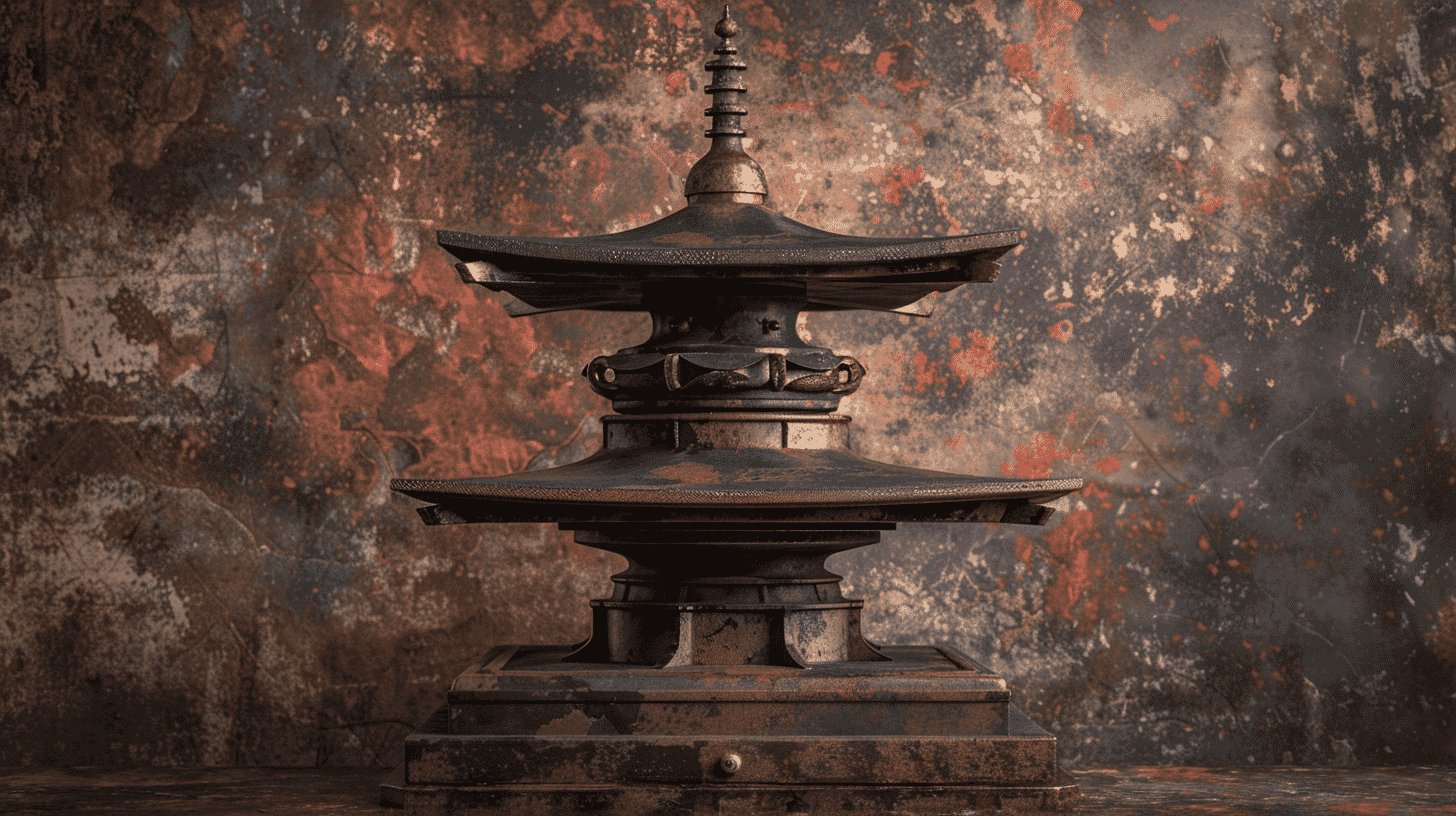
One Pagoda, National Treasure since 1953
Iron Pagoda (鉄宝塔, Tetsu Hoto) is a Kamakura-period craft object owned by Saidaiji in Nara Prefecture, made an Important Cultural Property on 14 November 1953 and designated a National Treasure on that same day of 1953. The quantity is one pagoda.
Both steps fall on one date, the fourth such case here after the Tenjukoku embroidery and the two swords at Kasuga Taisha.
It stands 163.6 centimetres high overall, with a base 65.1 centimetres square, a body 43.3 centimetres across at the foot and eaves 67.6 centimetres wide. The date field gives 1284.
Where It Is and Who Owns It Are Recorded Apart
The place that holds it and the party that owns it are not the same.
The Agency's record gives the holding institution as the Nara National Museum, at 50 Noborioji-cho, Nara City, and the owner as Saidaiji.
A temple owns it and a museum keeps it.
Fourteen properties covered here have had a blank address field, among them the Hosoge sutra box, the red-laced armour and the gilded bronze staff head.
In those, the location was simply not written. Here the reverse: the location is named as a museum, and the split from the owner is plain to see.
Because a museum holds it, any chance to see it follows the museum's own schedule.
Two Dates Drawn from a Separate Text
The evidence for the date lies outside the object.
The Agency cites a record of the priest Eison's life: under the seventh day of the eighth month of 1284 it notes the completion of the iron pagoda, and under the second day of the ninth month its consecration.
The work was finished on one day and consecrated on another, twenty-six days apart.
At the Myooin pagoda, an inscription on the finial gave the day the rings were raised. At the Daizenji main hall, a pillar inscription confirmed the date. At the Shofukuji Jizo hall, an inscription on a bracket did the same.
All of those are characters on the object itself. Here the dates come from a passage in another book.
The object does carry an inscription: characters are incised on the central post. What is offered as evidence for the date, however, is the text.
What Is Absent Is Written Down Twice
The account of the form names parts the pagoda does not have.
Of the lower storey: it opens on four sides, but has no eaves of the kind seen on a built pagoda of this type.
Of the upper storey: it has no doors.
The absence of eaves and the absence of doors are each set down.
At the Kongobuji Fudo hall, a veranda without a railing entered the structural description. On the white-laced armour, the record noted that there are no forehead ornaments before turning to another feature.
Here absence is recorded in two places, and one of them by comparison with a building. A craft object is described by reference to architecture.
Seeing It
Saidaiji owns the pagoda and the Nara National Museum holds it.
Both the man who commissioned it and the man who made it are recorded: Eison, who revived Saidaiji, had the reliquary pagoda made by the master craftsman Fujiwara no Muneyasu and others in the Koan era.
One ordered it and the others made it. With the Mikazuki Munechika and the Nagamitsu naginata, signatures gave the maker. Here two men stand together in a sentence.
The assessment calls it the most complete surviving example of a Kamakura reliquary arrangement. The most complete, in those words.
It adds that the form is beautiful and the work shows fine skill in both cast bronze and forged iron: two techniques named together. Exhibition plans can change, so check the museum's information before travelling.
Q&A
- When was the pagoda designated?
- It became an Important Cultural Property on 14 November 1953 and a National Treasure on the same day, the fourth such case met here.
- Where is it kept?
- At the Nara National Museum, 50 Noborioji-cho, Nara City. The owner is Saidaiji, so a temple owns it and a museum keeps it.
- When was it made?
- In 1284. The Agency cites a record of the priest Eison's life giving the completion of the pagoda on one day and its consecration twenty-six days later.
- Who made it?
- The Agency records that Eison, who revived Saidaiji, had it made by the master craftsman Fujiwara no Muneyasu and others. Both the man who commissioned it and the makers are named.
- What form does it take?
- A two-storeyed pagoda on a square base. The lower storey has no eaves of the kind seen on a built pagoda, and the upper storey has no doors: absence is written down twice.
Basic Information
| Name | Iron Pagoda (鉄宝塔, Tetsu Hoto) |
|---|---|
| Location | Nara National Museum, 50 Noborioji-cho, Nara City, Nara Prefecture; the owner is Saidaiji |
| Designation | National Treasure (craft); the earlier listing and the designation fall on one date |
| Year Designated | 1953 (14 November), Important Cultural Property and National Treasure |
| Quantity | 1 pagoda |
| Dimensions | 163.6 centimetres high overall, the base 65.1 centimetres square, the body 43.3 centimetres across at the foot and the eaves 67.6 centimetres wide. A two-storeyed pagoda on a square base, the lower storey opening on four sides, the upper cylindrical with a railed gallery. It has no eaves and no doors. Characters are incised on the central post. The date is 1284 and the period Kamakura |
| Owner | Saidaiji |
| Public Access | Held by the Nara National Museum; any chance to see it follows the museum's schedule |
References
- Cultural Heritage Online: the iron pagoda
- https://bunka.nii.ac.jp/db/heritages/detail/159355
- Nara National Museum official site
- https://www.narahaku.go.jp/
- Saidaiji official site
- https://saidaiji.or.jp/
- Agency for Cultural Affairs, National Cultural Properties Database
- https://kunishitei.bunka.go.jp/
Last verified: 2026.09.06