
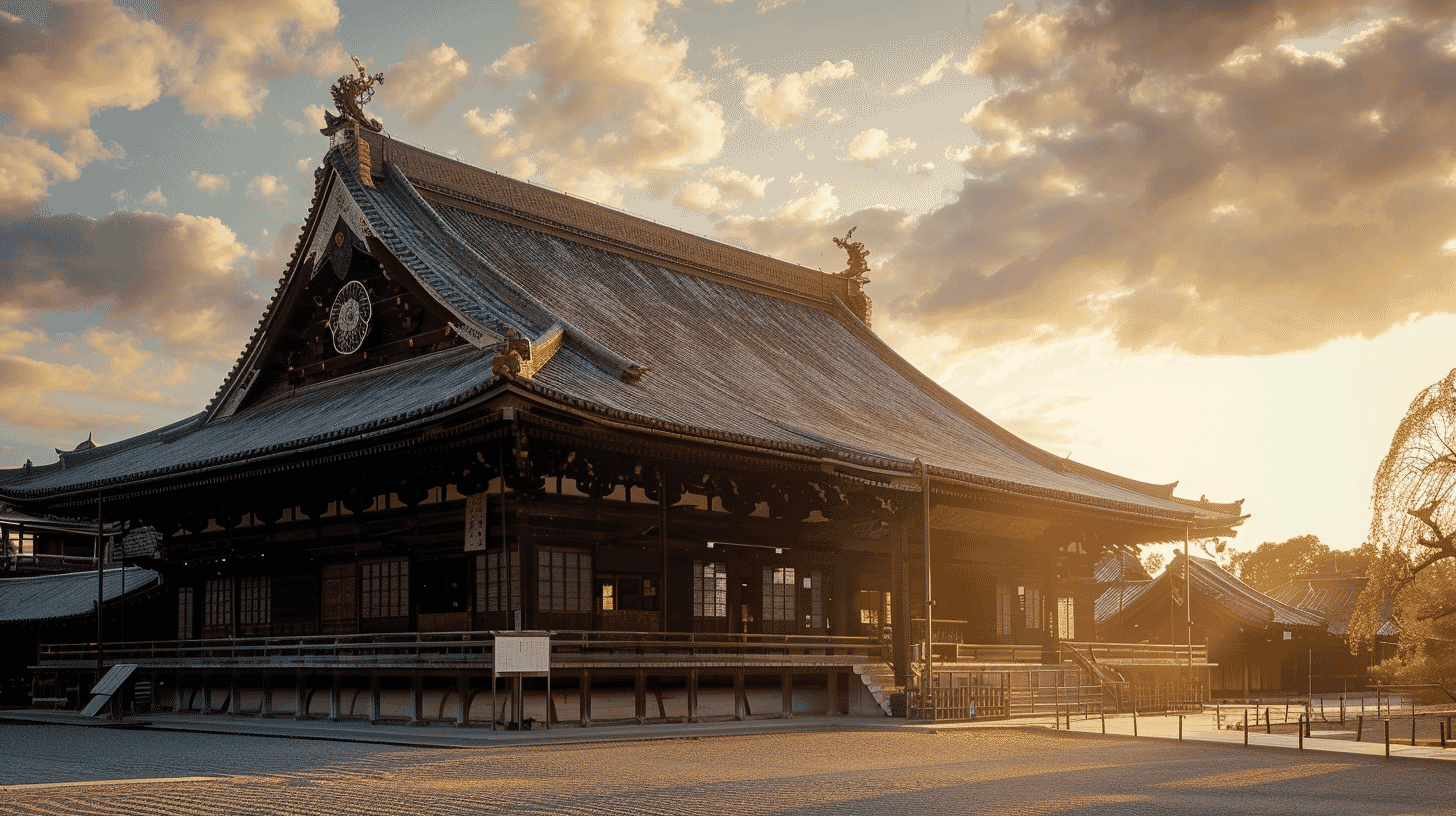
One Hall, National Treasure since 2017
Senshu-Ji Temple Goei-Do Hall (専修寺御影堂, Senjuji Mieido) is a middle Edo structure at Isshinden-cho, Tsu City, Mie Prefecture, made an Important Cultural Property on 7 June 1961 and designated a National Treasure on 28 November 2017. The quantity is one building and the owner the temple as a religious corporation.
Both dates are exactly those of the temple's Nyorai hall. Two buildings took both steps on the same days.
The date field gives 1666. The Agency records that it was built in that year under the patronage of the Todo house, lords of the Tsu domain, and that it ranks among the largest halls surviving from the early modern period.
Nine Bays Each Way, a Square Plan
The figures agree in both directions.
Nine bays by nine bays, single-storeyed, hip-and-gable.
The Onjoji golden hall is seven by seven, the Shinra Zenshindo three by three, and Osasahara Shrine Main Hall three by three: all square in plan.
Nine by nine is the largest square met here.
The temple's own Nyorai hall is five bays by four, and does not agree. The Kongobuji Fudo hall had side bays of differing size on its two flanks.
Within one temple, a square hall and an unequal one stand side by side.
Called an Index for Others
The assessment casts the building as a measure of something else.
It is of deep significance in cultural history, the record says, as a large-scale building that serves as an index for the growth in size and variety of early modern Buddhist halls.
An index: a scale against which other things are placed.
The Myooin main hall was called a work that serves as a standard for dating the period when manners were combined. That word was standard.
Osasahara Shrine Main Hall was called the finest one among medieval shrine buildings: a superlative with a limit inside it.
Here the word is index. A third way of casting a building as a measure.
The Complex Was Assembled over a Long Span
The order in which the temple's buildings went up is recorded.
The present complex was put in order step by step after the temple grounds were enlarged in 1658.
The founder's hall was built in 1666, eight years after that enlargement.
The date field for the Nyorai hall gives 1748: ninety years after the enlargement and eighty-two after this hall.
The two buildings that form the heart of one complex went up more than eighty years apart.
At Jodoji, after the fire of 1325 the pagoda was rebuilt in 1329 and the main hall in 1345, sixteen years apart. This span is far longer.
Visiting
The hall stands at Isshinden-cho, Tsu City, Mie Prefecture, owned by the temple. It stands in the precinct and its exterior can be seen on a visit.
The interior is recorded: within the vast hall, full-height pillars and bracket sets are placed efficiently and to good effect, with regard to both structure and design, achieving a fine open space.
Full-height pillars run from floor to roof in one piece, a means of carrying a wide span.
Of ornament: a richly decorated inner sanctuary and other parts create spaces of solemn devotion throughout.
The assessment continues that the hall clearly shows the character of the Takada school's halls, developed in its own way as devotion to Amida spread. Access to the interior follows the temple's own arrangements. Check before travelling.
Q&A
- When was the hall designated?
- It became an Important Cultural Property on 7 June 1961 and a National Treasure on 28 November 2017. The temple's Nyorai hall shares both of those dates.
- What is the plan like?
- Nine bays by nine bays, a square, the largest square plan met here. The temple's Nyorai hall is five bays by four and does not agree in both directions.
- When was it built?
- The Agency records that it was built in 1666 under the patronage of the Todo house, lords of the Tsu domain, eight years after the temple grounds were enlarged in 1658.
- How far apart are the two halls in date?
- The Nyorai hall's date field gives 1748, eighty-two years after this hall of 1666. The two buildings at the heart of one complex went up more than eighty years apart.
- What is valued in it?
- The Agency calls it a large-scale building that serves as an index for the growth in size and variety of early modern Buddhist halls, of deep significance in cultural history.
Basic Information
| Name | Senshu-Ji Temple Goei-Do Hall (専修寺御影堂, Senjuji Mieido); the temple's Nyorai hall is also a National Treasure |
|---|---|
| Location | Isshinden-cho, Tsu City, Mie Prefecture |
| Designation | National Treasure (structure, religious architecture) |
| Year Designated | 1961 (7 June), Important Cultural Property; 2017 (28 November), National Treasure |
| Quantity | 1 building |
| Dimensions | 9 bays by 9 bays, single-storeyed, hip-and-gable, with an eaves projection at the rear, a 3-bay porch and a projection on the east side of 1 bay by 1, hip-and-gable and gable-fronted, roofed in plain tile. The date field gives 1666, 8 years after the enlargement of the grounds. The period is the middle Edo |
| Owner | Senjuji, as a religious corporation |
| Public Access | Standing in the precinct; the exterior can be seen on a visit, while the interior follows the temple's own arrangements |
References
- Cultural Heritage Online: the Senjuji founder's hall
- https://bunka.nii.ac.jp/heritages/detail/146491
- Cultural Heritage Online: the Senjuji Nyorai hall
- https://bunka.nii.ac.jp/heritages/detail/174532
- Tsu City: Takada Honzan Senjuji
- https://www.info.city.tsu.mie.jp/www/senjuji/
- Agency for Cultural Affairs, National Cultural Properties Database
- https://kunishitei.bunka.go.jp/
Last verified: 2026.09.06