
Kilns That Tiled the First Taga Castle, Designated in 1976
Daikichiyama Tile Kiln Site (大吉山瓦窯跡, Daikichiyama Kawaragama Ato) lies at Uragoshi, Kobayashi, Furukawa, Osaki City, Miyagi Prefecture, designated a national Historic Site on 31 March 1976, with Osaki City as managing body.
Osaki City records that the site came to light in 1972, during work on a farm road that accompanied the opening of new paddy fields. Among the tiles recovered then was one with a double-petalled lotus design, matching a type found at Taga Castle from its earliest phase.
That identified the site as one of the kilns producing the tiles laid on Taga Castle when it was first built. Miyagi Prefecture records that its output went to the first Taga Castle and the temple beside it, and that it appears to have been set up as an official kiln of the ancient province of Mutsu.
First Excavated Forty-Five Years After Designation
The record of this site reads very differently at two points in time.
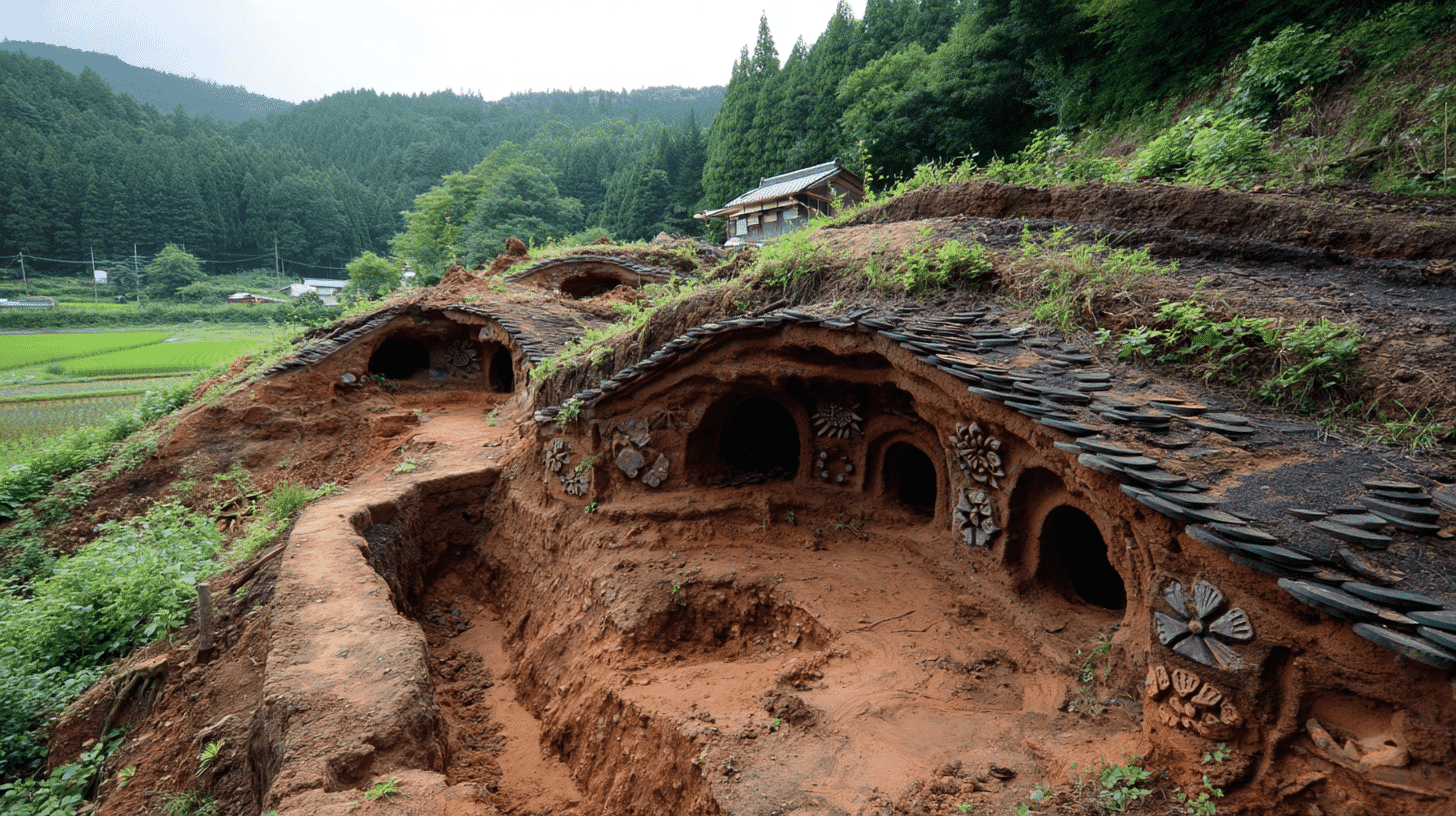
Miyagi Prefecture writes: about five kilns are thought to stand in a row. The site is unexcavated and the details unknown, but observation of a cut face suggests a tunnel kiln dug into the ground.
The site was designated and then left undug for a long time. Even the number of kilns carried a hedge, about five, and the structure rested on what a cut face showed.
Osaki City records that from the 2021 to the 2023 financial year the site was excavated for the first time. Forty-five years had passed since the designation of 1976.
The excavation found six kilns for tiles and one for charcoal. Around them lay ash deposits holding ash raked from the kilns and tiles that had failed in firing.
About five was the estimate; six tile kilns and a charcoal kiln were what stood there. More than expected, and not all of them for tiles.
A Tile Not Found at Taga Castle
Osaki City names one tile as the chief result of the excavation.
A flat tile came up with a lotus flower moulded in relief on its convex face, the side that lies underneath when the tile is laid. The lotus pattern covers the whole surface in a regular repeat.
The city writes that no tile with such a pattern has been found at Taga Castle: this is a new type.
A kiln that supplied Taga Castle produced a tile Taga Castle does not have. Its output was not directed to that one site alone.
Osaki City adds that further work at Taga Castle or at sites near this one may yet show where the tile was carried and used. For now, its destination is unknown.
Writing on the Tiles Collected
Miyagi Prefecture lists the finds gathered from the surface: a round eaves tile with a double-petalled lotus design, an arched ridge-end plate with a lotus design, flat tiles and round tiles.
On the left foot of the ridge-end plate a personal name stands in relief. A name is set into the tile itself.
The round tiles carry two characters incised with a spatula before firing.
Relief and incision differ in both moment and method. Relief is cut into the mould and comes out in the firing; incision is written into the clay after shaping. The prefecture does not say what either signifies.
As for position, the site lies on the eastern slope of a ridge about 50 metres high running southeast along the Aiai River. Kilns dug into that slope are what the record infers.
Visiting
Miyagi Prefecture records access as free. This is an open-air site with no restriction on entry.
The excavation ended in the 2023 financial year, however, and how the ground has been laid out since may change. Check Osaki City's information for current conditions before travelling.
The tiles recovered may be kept and shown at the Tohoku History Museum or elsewhere rather than on site. Seeing the lotus-moulded flat tile means looking to the institution holding it.
From the Furukawa interchange on the Tohoku Expressway it is ten minutes by car, or fifteen minutes from Furukawa Station on the Tohoku Shinkansen.
Q&A
- When was the site designated?
- On 31 March 1976, as a national Historic Site, with Osaki City as managing body. It lies at Uragoshi, Kobayashi, Furukawa, Osaki City, Miyagi Prefecture, and came to light in 1972 during work on a farm road.
- What was fired here?
- Miyagi Prefecture records that the output went to the first Taga Castle and the temple beside it, and that the kilns appear to have been set up as an official kiln of the ancient province of Mutsu. A tile found in 1972 matched a type from Taga Castle's earliest phase.
- How many kilns are there?
- Miyagi Prefecture writes that about five are thought to stand in a row and that the site is unexcavated, but Osaki City records that excavation from 2021 to 2023 found six kilns for tiles and one for charcoal. More than the estimate, and not all of them for tiles.
- What did the excavation show?
- Osaki City names as its chief result a flat tile with a lotus flower moulded in relief across its convex face, a pattern found on no tile at Taga Castle and therefore a new type. Where it was carried and used is not yet known.
- Can the site be visited?
- Miyagi Prefecture records access as free. It is an open-air site, but how the ground has been laid out since the excavation may change, so check Osaki City's information before travelling. The tiles may be held at the Tohoku History Museum or elsewhere.
Basic Information
| Name | Daikichiyama Tile Kiln Site (大吉山瓦窯跡, Daikichiyama Kawaragama Ato) |
|---|---|
| Location | Uragoshi, Kobayashi, Furukawa, Osaki City, Miyagi Prefecture |
| Designation | Historic Site (monuments) |
| Year Designated | 1976 (31 March), Historic Site |
| Quantity | The Agency's quantity field is blank |
| Dimensions | The site lies on the eastern slope of a ridge about 50 metres high running southeast along the Aiai River. Miyagi Prefecture estimates about 5 kilns dug into the slope, while Osaki City reports that excavation confirmed 6 tile kilns and 1 charcoal kiln. Nara period |
| Owner | Managing body: Osaki City |
| Public Access | Miyagi Prefecture records access as free. An open-air site |
References
- Cultural Heritage Online: Daikichiyama Tile Kiln Site
- https://bunka.nii.ac.jp/heritages/detail/137684
- Miyagi Prefecture: designated cultural property, Historic Site, Daikichiyama Tile Kiln Site
- https://www.pref.miyagi.jp/soshiki/bunkazai/kuni-siseki17.html
- Osaki City: Daikichiyama Tile Kiln Site, a newly found tile
- https://www.city.osaki.miyagi.jp/shisei/soshikikarasagasu/kyoikuiinkaijimukyoku/bunkazaika/oosakinotakara/19440.html
- Tohoku History Museum: commentary on the Taga Castle site
- https://www.thm.pref.miyagi.jp/kenkyusyo/explanation_tagajoato.html
Last verified: 2026.09.28