
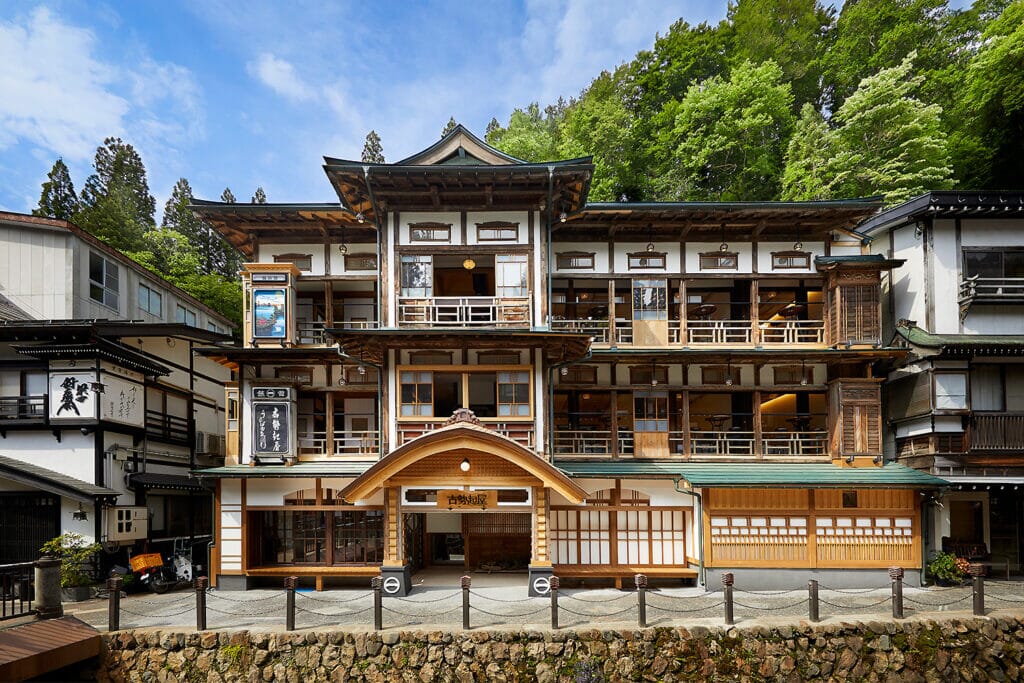
One Three-Storeyed Timber Building, a Registered Tangible Cultural Property since 2023
Kosekiya Main Building (古勢起屋本館, Kosekiya Honkan) stands at 412 Kita, Ginzan-shinhata, Obanazawa City, Yamagata Prefecture, a Taisho-period three-storeyed timber building entered on the register of tangible cultural properties on 7 August 2023. It is a registered property rather than a designated one.
The quantity is one building. The owner is the company Ginzanso.
The structure is timber, three-storeyed, roofed in sheet iron, with a floor area of 218 square metres. The date field reads Taisho and the year field 1914.
A Bathroom on the Street Side of the Ground Floor
The room for bathing is set on the side facing the street.
The Agency records a three-storeyed timber hot-spring building on the north bank of the river through the Ginzan hot-spring town, typical of the district in placing its bathroom on the street side of the ground floor.
In this town, then, the ground-floor bathroom facing the street was the usual arrangement.
The Gengabashi baths are a public bathhouse divided into men's and women's sides at the attendant's seat: there the whole building is the bath.
Here the bathroom occupies the ground floor of a three-storeyed building, with rooms stacked above.
The assessment turns not on rarity but on fitting the type of its place, as with the former Kadowaki main house, said to bear the character of its district's mountain farmhouses.
Verandas Toward the River and a Tower-Like Entrance
On its front and its river side, the building carries features that make the character of the town.
The Agency records a hip-and-gable roof sheeted in copper, with small eaves running round every floor. Such eaves project over windows and verandas.
It closes that the entrance with its tower-like form, and the verandas of the second and third floors looking over the river, make up the character of a historic hot-spring town. A tower here is a part rising a stage above the roof.
The Ota power station throws out an octagonal tower at its southern corner: of stone, the tower itself a landmark.
This one is of timber, and its tower-like entrance and river verandas are said to shape the character of the street.
The assessment speaks not of one building's quality alone but of what it gives to the prospect of the town.
Sheet Iron in the Structure Field, Copper in the Commentary
The roofing is written two ways in the record.
The structure field reads timber, three-storeyed, roofed in sheet iron. The commentary, by contrast, gives a hip-and-gable roof sheeted in copper.
Sheet iron and copper are both metal sheets for roofing, but they are different materials. The record alone cannot say which is right.
At Obaraya Harada Shoten, the new reception room is two-storeyed in the structure field and single-storeyed in the commentary; at the Kikkawa storehouse, the structure field says timber and the commentary an earthen store.
Here too the structure field and the commentary disagree, on the roofing material.
Of the rooms, the record says that originally formal rooms with alcoves were set in a row. The word originally suggests that the plan is not the same today.
Visiting
The building stands at 412 Kita, Ginzan-shinhata, Obanazawa City, Yamagata Prefecture, on the north bank of the river. It is owned by the company Ginzanso.
It is a three-storeyed timber building covering 218 square metres, dated 1914.
It is owned and in use by a company, so whether and how it may be visited follows the owner's arrangements. Check before travelling.
The year 1914 is the third year of the Taisho era.
It was registered in 2023, 109 years after it was built.
Q&A
- When was the building registered?
- On 7 August 2023, as a registered tangible cultural property. It is registered rather than designated, and the quantity is one building.
- Where is it?
- On the north bank of the river through the Ginzan hot-spring town, at 412 Kita, Ginzan-shinhata, Obanazawa.
- What is typical of the district?
- Placing the bathroom on the street side of the ground floor.
- What is valued in it?
- That its tower-like entrance and its river verandas on the second and third floors make up the character of a historic hot-spring town.
- What is the roof covered with?
- The structure field says sheet iron and the commentary copper; the record does not agree with itself.
Basic Information
| Name | Kosekiya Main Building (古勢起屋本館, Kosekiya Honkan) |
|---|---|
| Location | 412 Kita, Ginzan-shinhata, Obanazawa City, Yamagata Prefecture |
| Designation | Registered tangible cultural property (structure); registered rather than designated |
| Year Designated | 2023 (7 August), registered |
| Quantity | 1 building |
| Dimensions | Timber, 3-storeyed, roofed in sheet iron, with a floor area of 218 square metres (the commentary gives a hip-and-gable roof in copper). Eaves round every floor, a bathroom on the street side of the ground floor, a tower-like entrance, and verandas on the 2nd and 3rd floors looking over the river. The date field reads Taisho and the year field 1914 |
| Owner | The company Ginzanso |
| Public Access | Visiting follows the owner's arrangements |
References
- Cultural Heritage Online: the building
- https://bunka.nii.ac.jp/heritages/detail/605109
- Agency for Cultural Affairs, National Cultural Properties Database
- https://kunishitei.bunka.go.jp/
- Obanazawa City
- https://www.city.obanazawa.yamagata.jp/
- Yamagata Prefecture: cultural properties
- https://www.pref.yamagata.jp/
Last verified: 2026.09.24