
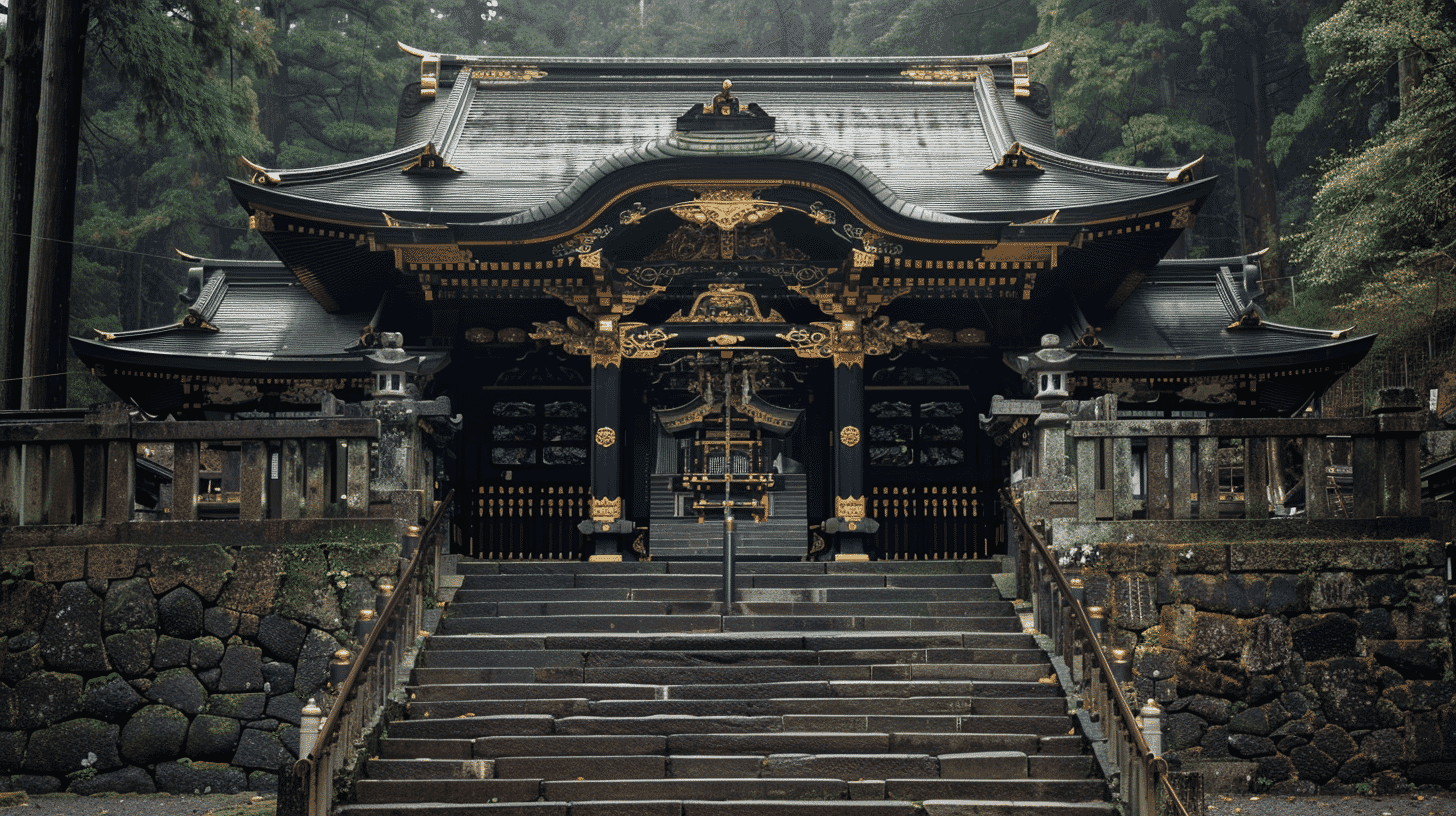
Built in 1607 in the Gongen Style, National Treasure since 1952
Osaki Hachiman Shrine (大崎八幡宮, Osaki Hachimangu) stands at Hachiman, Aoba Ward, Sendai City, Miyagi Prefecture, and its main sanctuary, stone room and worship hall were designated a National Treasure in 1952, on 22 November. In 1903, on 15 April, they had been listed as a specially protected structure under the old preservation law. The quantity is one building, with one ridge tablet as attached property.
Miyagi Prefecture records that the shrine was founded in 1607 by Date Masamune. The ridge tablet listed as attached property is inscribed with a date corresponding to the twelfth day of the eighth month of 1607, fixing the year of construction.
Sendai City notes that the same tablet names those who built it: the carpenter Josshu Hyuga-no-kami Ietsugu, the master builder Umemura Sanjuro Yoritsugu and Gyobu Zaemon Kunitsugu, leading craftsmen of their day brought in for the work. A single tablet carries both the year and the makers.
The Stone Room: A Lower Floor Joining Two Buildings
Joining a main sanctuary and a worship hall by a stone room gives the form called ishinoma-zukuri, or gongen-zukuri. Sendai City explains its origin: the stone room has a floor lower than those of the sanctuary and the hall, and the form arose from joining two originally separate buildings by an earth-floored space.
The floor sits low because the space began as bare earth. Sendai City calls Osaki Hachimangu the oldest surviving example of the type, and the Agency for Cultural Affairs' Japan Heritage portal likewise describes it as the oldest gongen-style building to survive.
One feature preserves the original character of the form: the eaves at the front of the main sanctuary are left visible inside the stone room. What was once the outside of the sanctuary is enclosed within the joining space. The way two buildings were brought together survives in the shape itself.
Records differ on the bay count of the stone room. The Agency's database gives one bay by one; another Cultural Heritage Online record gives five bays east to west and two north to south; Sendai City gives five bays by one. This article does not choose between them and notes only that the accounts differ.
Dimensions and Roofs
The main sanctuary is five bays by three, single storey, hip-and-gable roof, shingled. The worship hall is seven bays across the front and five across the back, three bays deep, single storey, hip-and-gable, with a dormer gable at the front and a five-bay porch carrying a cusped gable. The stone room is single storey with a double lean-to roof, shingled.
A bay here is not a unit of length but a count of intervals between columns. The worship hall differs front and back, seven against five, because more intervals fall on the front.
Shingle roofing lays thin wooden boards in overlapping courses, a material distinct from tile or cypress bark. All the roofs are shingled alike.
Decoration: Black Lacquer Below, Color Above
Miyagi Prefecture describes it thus: lacquered inside and out, colored over a chalk ground, ornamented with carving and metal fittings, and in the harmony of the whole producing a splendid effect, a masterpiece of Momoyama architecture.
The shrine's own record adds that above the lintel line the bracket sets and carvings are brightly colored over chalk, while below the surfaces are lacquered black throughout. The division of the surface, dark below and colored above, governs how the building reads.
The carving takes many subjects. Sendai City lists celestial figures, tigers, cats, peonies, butterflies, elephants, tortoiseshell patterns and plants; Miyagi Prefecture names Buddhist subjects such as heavenly beings and Makara, and Chinese-style combinations of cat, butterfly and peony. All are colored freely over a chalk ground.
The coffered ceiling of the stone room carries plants. Miyagi Prefecture writes of many flowers and medicinal herbs; the shrine gives the number as fifty-three species. Inside the worship hall are painted lions by the Kano school painter Sakuma Sakyo, and a dragon on the great beam.
To correct settlement and leaning of the columns and damage to the bracket sets carrying the eaves, the buildings were dismantled and repaired over five years from 2000, the work completed in autumn 2004.
Visiting
The precinct is open and the exterior of the buildings can be seen. The interiors are not normally open.
The precinct also holds the Nagatoko, an Important Cultural Property, and a stone torii designated by Miyagi Prefecture. The Nagatoko is a worship hall of the divided type and carries its own designation, separate from the National Treasure buildings.
The Matsutaki festival on 14 January, a Sendai City intangible folk cultural property, burns pine decorations and old talismans; the naked pilgrimage held then is widely known. At the September festival, sacred kagura designated by Miyagi Prefecture is performed, with a portable shrine procession and horseback archery the following day.
From JR Sendai Station the bus takes about 20 minutes to the Osaki Hachimangu-mae stop, or it is about 15 minutes on foot from Tohoku Fukushi Daimae Station on the JR Senzan Line.
Q&A
- When were the buildings of Osaki Hachiman Shrine built and designated?
- They were founded in 1607 by Date Masamune. They were listed as a specially protected structure on 15 April 1903 and designated a National Treasure in 1952, on 22 November. The main sanctuary, stone room and worship hall count as one building, with one ridge tablet as attached property.
- What is the ishinoma or gongen style?
- A main sanctuary and a worship hall joined by a stone room. The stone room's floor is lower than the others because the form arose from joining two originally separate buildings by an earth-floored space. The eaves at the front of the sanctuary remain visible inside the stone room, preserving the character of that joining.
- What are the dimensions of the buildings?
- The main sanctuary is five bays by three, hip-and-gable, shingled. The worship hall is seven bays across the front and five across the back, three deep, with a dormer gable at the front and a five-bay porch with a cusped gable. Accounts of the stone room's bay count differ, and this article does not choose between them.
- What marks the decoration?
- Above the lintel line the bracket sets and carvings are brightly colored over chalk; below, the surfaces are lacquered black throughout. Carving subjects include celestial figures, tigers, cats, peonies, butterflies and elephants. The stone room ceiling carries plants, and painted lions by Sakuma Sakyo hang inside the worship hall.
- Can the shrine be visited?
- The precinct is open and the exteriors can be seen, though the interiors are not normally open. The precinct holds the Nagatoko, an Important Cultural Property, and a stone torii. The Matsutaki festival on 14 January and its naked pilgrimage are widely known. It is about 20 minutes by bus from JR Sendai Station.
Basic Information
| Name | Osaki Hachiman Shrine (大崎八幡宮, Osaki Hachimangu); designated as the main sanctuary, stone room and worship hall |
|---|---|
| Location | 4-6-1 Hachiman, Aoba Ward, Sendai City, Miyagi Prefecture |
| Designation | National Treasure (structure); the Nagatoko in the precinct is an Important Cultural Property and the stone torii a Miyagi Prefecture cultural property |
| Year Designated | 1903 (15 April), specially protected structure; 1952 (22 November), National Treasure |
| Quantity | 1 building; 1 ridge tablet as attached property |
| Dimensions | Main sanctuary: 5 bays by 3, single storey, hip-and-gable, shingled. Worship hall: 7 bays front and 5 back, 3 deep, single storey, hip-and-gable, dormer gable at the front, 5-bay porch with cusped gable, shingled. Stone room: single storey, double lean-to roof, shingled. Built 1607 |
| Owner | Osaki Hachimangu |
| Public Access | Precinct open; exteriors visible. Interiors not normally open |
References
- Miyagi Prefecture: designated cultural properties, Osaki Hachimangu
- https://www.pref.miyagi.jp/soshiki/bunkazai/01oosaki1.html
- Sendai City: designated and registered cultural properties, Osaki Hachimangu
- https://www.sendai-c.ed.jp/~bunkazai/shiteidb/c00001.html
- Cultural Heritage Online: Osaki Hachimangu
- https://online.bunka.go.jp/heritages/detail/184266
- Osaki Hachimangu: origins
- https://www.oosaki-hachiman.or.jp/origin/
Last verified: 2026.09.28