
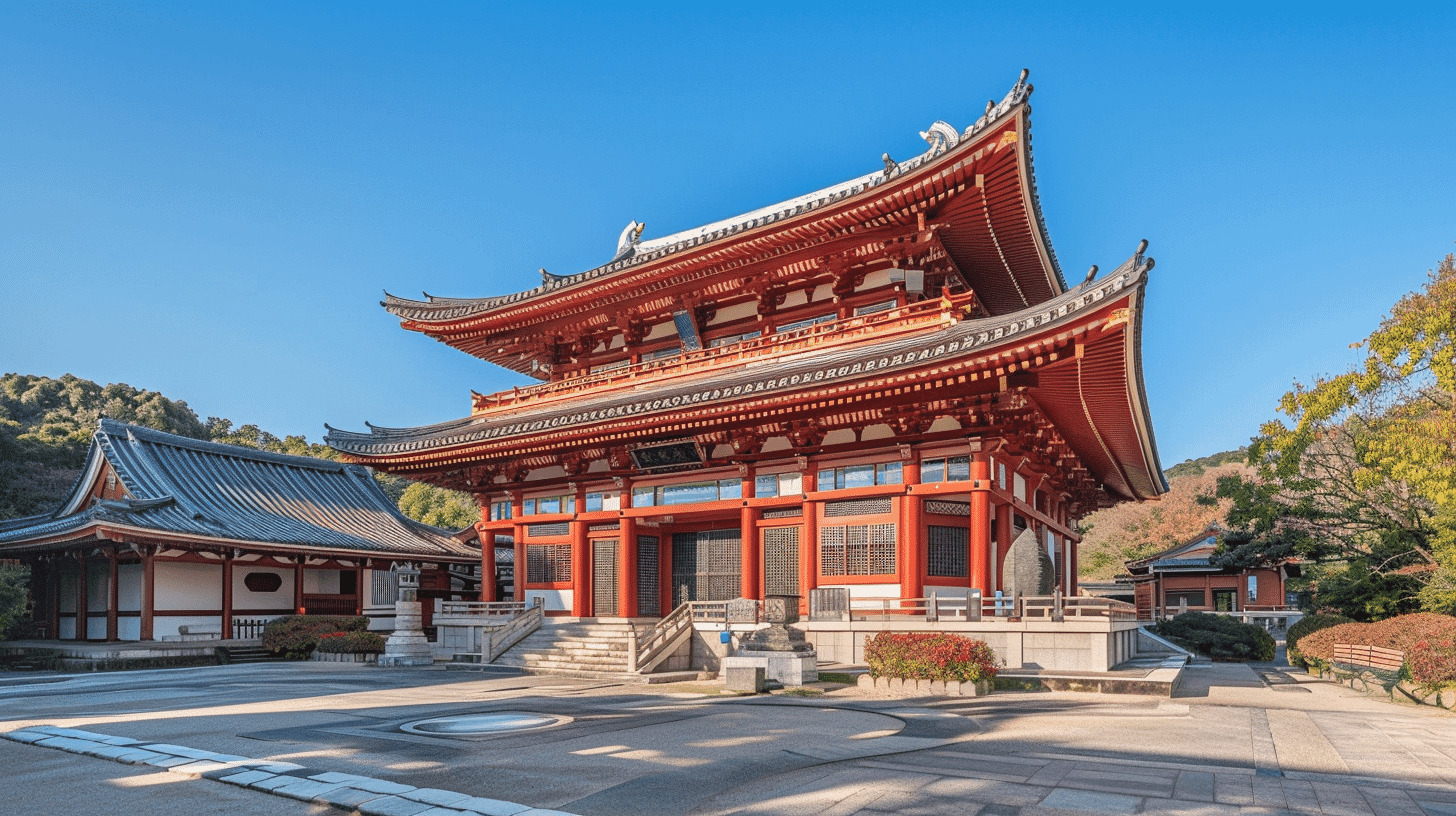
One Hall, National Treasure since 1953
Sofukuji Daiyuhoden (崇福寺大雄宝殿, Sofukuji Daiyuhoden) is an early Edo structure at Kajiya-machi, Nagasaki City, Nagasaki Prefecture, made an Important Cultural Property on 14 April 1906 and designated a National Treasure on 31 March 1953. The quantity is one building and the owner the temple.
14 April 1906 is the day the Onjoji golden hall was also listed; 31 March 1953 the day it, the Shinra Zenshindo and the Jodoji pagoda were designated.
Sofukuji Daiyuhoden is five bays by four bays, of two storeys, with a hip-and-gable roof of plain tile. The date field gives 1646, and the era name in the commentary agrees.
Only the Upper Storey Was Added Later
Sofukuji Daiyuhoden stands in two storeys, and the two came about differently.
The commentary records that the upper storey was added in the Genroku era and is strongly in the native manner.
Genroku runs from 1688 to 1704. Against a date field of 1646, the upper storey came forty to sixty years afterwards.
The manner differs too. The upper storey is called strongly native, while of the lower the commentary says the influence of late Ming and early Qing building, imported at the beginning of the Edo period, is marked.
Chinese below, Japanese above. Within one building the tradition changes from storey to storey.
At the Jodoji pagoda a railing was first set up in 1732; on the chrysanthemum waist sword only one hilt ornament was replaced. Those were additions of parts. Here the upper half of a building sits on the lower.
Two National Treasures Sharing One Commentary
Another building of the same temple carries the same commentary.
The text for the temple's first gate is word for word that of Sofukuji Daiyuhoden. Both records set out the temple's founding, the building of the hall, the addition of the upper storey and the assessment of the gate.
At Aoi Aso Shrine, all five National Treasure buildings carried one commentary, which described a single group of shrine buildings together.
Here two independent National Treasures share one text. The gate too was designated on 31 March 1953.
Their dates differ. The gate is dated 1644 and Sofukuji Daiyuhoden 1646, two years apart. The commentary nonetheless says the gate was built at about the same time.
Two years are treated as about the same time.
An Outdated Term Left in the Commentary
The account of the founding uses old language.
It records that the temple was founded in 1629 by Choran, a monk who had come from China. The record, however, refers to him with a term for Chinese that is no longer used.
This article does not repeat that term and writes simply that he came from China, noting only that the record words it otherwise.
An older variant form also appears in the era name. With the ceremonial sword on pear-skin ground, the title itself used older variant characters.
When the commentary was written is not recorded. Its vocabulary shows the age of the writing.
At the Ataka and Kurohashi shell mounds, literary and colloquial styles marked a difference in when records were made. Here it is vocabulary that shows it.
Visiting
The hall stands at Kajiya-machi, Nagasaki City, Nagasaki Prefecture, owned by the temple. It stands in the precinct and its exterior can be seen on a visit.
The assessment is made in terms of cultural history: as a building strongly showing the influence of late Ming and early Qing architecture, imported at the beginning of the Edo period, it is important in cultural history.
Not architectural history but cultural history is invoked. That a style carried across the sea survives as a building is what is valued.
Other buildings of the same precinct are recorded: the triple gate, the gate to the sea goddess, the guardian hall and the bell and drum tower. Related entries include main halls of the same type at two other Nagasaki temples.
Access to the interior follows the temple's own arrangements. Check before travelling.
Q&A
- When was the hall designated?
- It became an Important Cultural Property on 14 April 1906 and a National Treasure on 31 March 1953. The quantity is one building, at Kajiya-machi, Nagasaki City, owned by the temple.
- Is it as first built?
- No. The Agency records that the upper storey was added in the Genroku era and is strongly in the native manner. Against a date field of 1646, that is forty to sixty years later.
- Do the storeys differ in style?
- Yes. The upper storey is called strongly native, while the lower is said to show marked influence of late Ming and early Qing building. The tradition changes from storey to storey.
- Are there other National Treasures at the temple?
- Yes. The temple's first gate, dated 1644, was designated on the same day. The two commentaries are word for word identical, so two National Treasures share one text.
- What is valued in it?
- The Agency records that as a building strongly showing the influence of late Ming and early Qing architecture, imported at the beginning of the Edo period, it is important in cultural history rather than architectural history.
Basic Information
| Name | Sofukuji Daiyuhoden (崇福寺大雄宝殿, Sofukuji Daiyuhoden); the temple's first gate in the same precinct is also a National Treasure |
|---|---|
| Location | Kajiya-machi, Nagasaki City, Nagasaki Prefecture |
| Designation | National Treasure (structure, religious architecture) |
| Year Designated | 1906 (14 April), Important Cultural Property; 1953 (31 March), National Treasure |
| Quantity | 1 building |
| Dimensions | 5 bays by 4 bays, of two storeys, hip-and-gable roof of plain tile. The date field gives 1646, and the upper storey is recorded as added in the Genroku era. The lower storey shows marked influence of late Ming and early Qing building, the upper is strongly native. The period is the early Edo |
| Owner | Sofukuji |
| Public Access | Standing in the precinct; the exterior can be seen on a visit, while the interior follows the temple's own arrangements |
References
- Cultural Heritage Online: Sofukuji Daiyuhoden
- https://bunka.nii.ac.jp/heritages/detail/191353
- Cultural Heritage Online: the temple's first gate
- https://bunka.nii.ac.jp/heritages/detail/158055
- Nagasaki Prefecture cultural properties database
- https://www.pref.nagasaki.jp/bunkadb/index.php/view/107
- Nagasaki City: Sofukuji
- https://www.city.nagasaki.lg.jp/page/1196.html
Last verified: 2026.09.05