
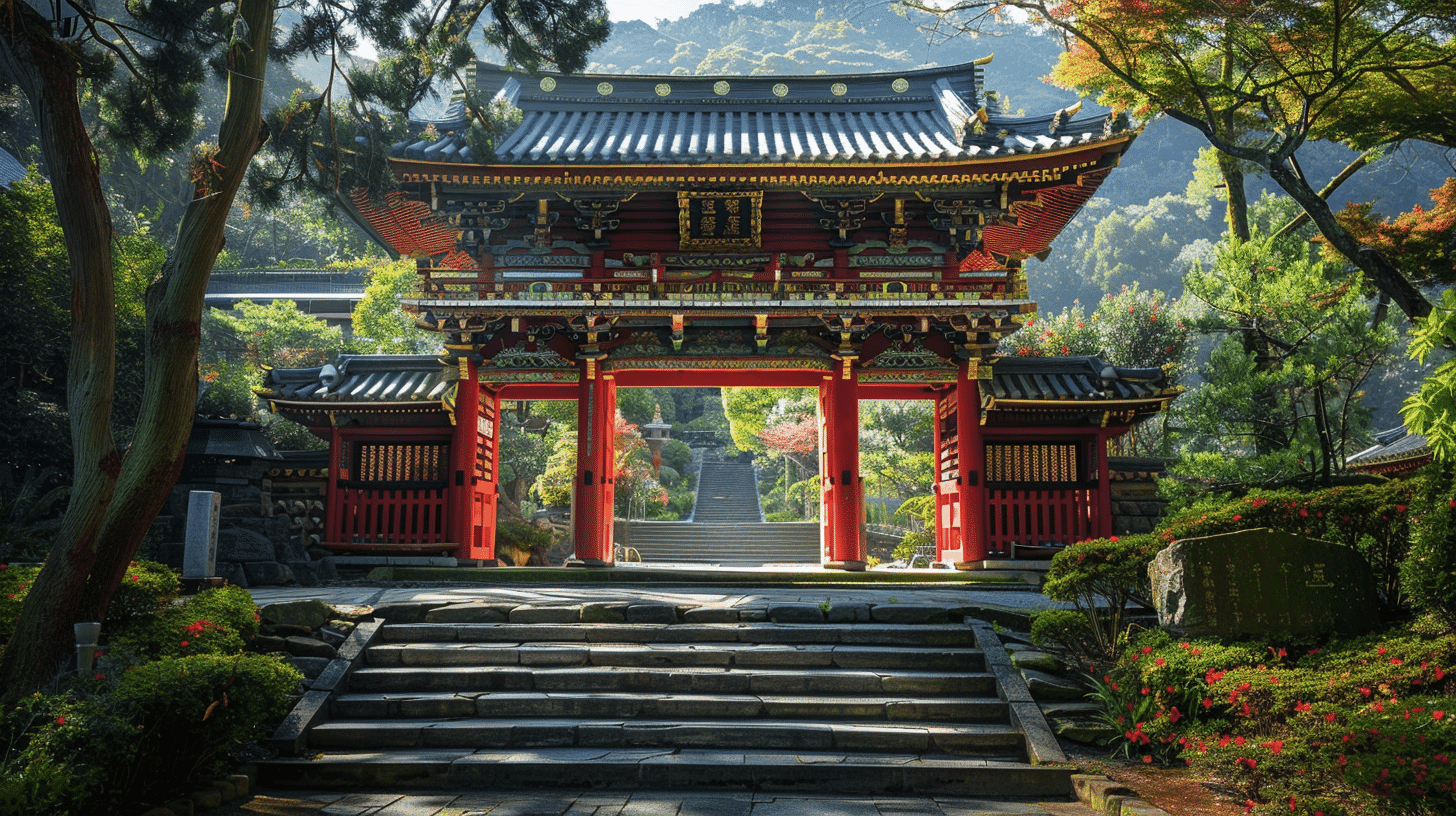
One Gate, National Treasure since 1953
Sofukuji Temple First Gate (崇福寺第一峰門, Sofukuji Daiippomon) is an early Edo structure at Kajiya-machi, Nagasaki City, Nagasaki Prefecture, made an Important Cultural Property on 14 April 1906 and designated a National Treasure on 31 March 1953. The quantity is one building and the owner the temple.
It is a four-legged gate with a hip-and-gable roof of plain tile. The temple's main hall in the same precinct was designated on the same day, and the commentaries for the two are word for word identical.
The commentary for Sofukuji Temple First Gate sets out the temple's founding, the building of the main hall, the addition of its upper storey and the assessment of the gate. Two independent National Treasures share one text.
Two Records Date It Fifty-One Years Apart
When it dates from is entered very differently.
The Agency's date field reads: early Edo, 1644.
Nagasaki City records that the timbers were cut and fitted at Ningbo in China and shipped over in several Chinese vessels, and the gate rebuilt in 1695.
Fifty-one years separate 1644 from 1695. The city gives a year of rebuilding; the Agency gives only a date.
At the Jodoji pagoda, date field and commentary differed by ten years; at the Kanshinji golden hall, two records differed by one. This gap is wider.
This article gives both and does not settle which is right.
Timbers Crossed the Sea, Divided among Several Ships
The city's account describes how it was built.
The timbers were cut and fitted at Ningbo, then loaded in portions aboard several Chinese vessels and carried over.
The wood was worked in China, split among ships, and brought across the sea. Only the assembly took place in Nagasaki.
At the Toshodaiji sutra repository, a storehouse older than the temple was converted. At the Kangakuin guest hall, one room was reproduced in New York.
Those are a building that never moved and a copy. Here the members themselves crossed a border.
The bracketing is called exceptional: a complex packed arrangement of four tiers with triple-leaf blocks, said to have no other example, and rare even in southern China. Rare in Japan, and rare where its timbers were cut.
Demoted in Rank, and Named from a Plaque
The gate's standing changed partway through.
Nagasaki City records that it was originally the temple's main gate, but that in 1673 a new triple gate was built below it facing west, and this became the second gate.
It was once the gate at the front of the temple. A new gate went up below, and it became the second.
Its name calls it the first peak, yet in order it is not the first.
The origin of the name is recorded too: other names for it are the Chinese gate, the sea-and-sky gate and the middle gate, and the names first peak and sea-and-sky come from the characters on its plaques.
Writing hung on the building gives the name. The Mikazuki Munechika took its by-name from a pattern in steel, the chrysanthemum waist sword from carving on a hilt, the Inaba Tenmoku from an owner's family. This one takes it from letters displayed on itself.
Visiting
The gate stands at Kajiya-machi, Nagasaki City, Nagasaki Prefecture, owned by the temple. It stands in the precinct and its exterior can be seen on a visit.
Details are recorded: fan rafters in two tiers laid flat, a board concealing the rafter ends, inserted bracket arms and rattan binding at the tops of the columns are found in other buildings of the temple as well.
These are not peculiar to the gate but shared with the rest of the temple.
Of colour: brilliant auspicious patterns are applied beneath the eaves and on their undersides, while the parts exposed to rain are painted a single vermilion.
The Agency's assessment reads that, as a building strongly showing the influence of late Ming and early Qing architecture imported at the beginning of the Edo period, it is important in cultural history. Access to the interior follows the temple's own arrangements. Check before travelling.
Q&A
- When was the gate designated?
- It became an Important Cultural Property on 14 April 1906 and a National Treasure on 31 March 1953. The quantity is one building, at Kajiya-machi, Nagasaki City, owned by the temple.
- What date is it?
- The records disagree. The Agency's date field gives 1644, while Nagasaki City records a rebuilding in 1695 with timbers shipped from China. Fifty-one years separate the two, and this article gives both.
- How was it built?
- Nagasaki City records that the timbers were cut and fitted at Ningbo and loaded in portions aboard several Chinese vessels, so only the assembly took place in Nagasaki.
- Why is it called the first peak gate?
- Nagasaki City records that the names first peak and sea-and-sky come from the characters on its plaques. Other names for it are the Chinese gate, the sea-and-sky gate and the middle gate.
- Is it the temple's main gate?
- No. Nagasaki City records that it was originally the main gate, but that in 1673 a new triple gate was built below it and this became the second gate. Its name says first, but in order it is not.
Basic Information
| Name | Sofukuji Temple First Gate (崇福寺第一峰門, Sofukuji Daiippomon); also called the Chinese gate, the sea-and-sky gate and the middle gate |
|---|---|
| Location | Kajiya-machi, Nagasaki City, Nagasaki Prefecture |
| Designation | National Treasure (structure, religious architecture); the temple's main hall in the same precinct is also a National Treasure |
| Year Designated | 1906 (14 April), Important Cultural Property; 1953 (31 March), National Treasure |
| Quantity | 1 building |
| Dimensions | A four-legged gate with a hip-and-gable roof of plain tile. The Agency's date field gives 1644, while Nagasaki City gives a rebuilding in 1695. The bracketing is said to have no other example. The period is the early Edo |
| Owner | Sofukuji |
| Public Access | Standing in the precinct; the exterior can be seen on a visit, while the interior follows the temple's own arrangements |
References
- Cultural Heritage Online: the Sofukuji first gate
- https://bunka.nii.ac.jp/heritages/detail/158055
- Nagasaki City: the Sofukuji first gate
- https://www.city.nagasaki.lg.jp/page/1197.html
- Cultural Heritage Online: Sofukuji Daiyuhoden
- https://bunka.nii.ac.jp/heritages/detail/191353
- Nagasaki City: Sofukuji Daiyuhoden
- https://www.city.nagasaki.lg.jp/page/1196.html
Last verified: 2026.09.05