
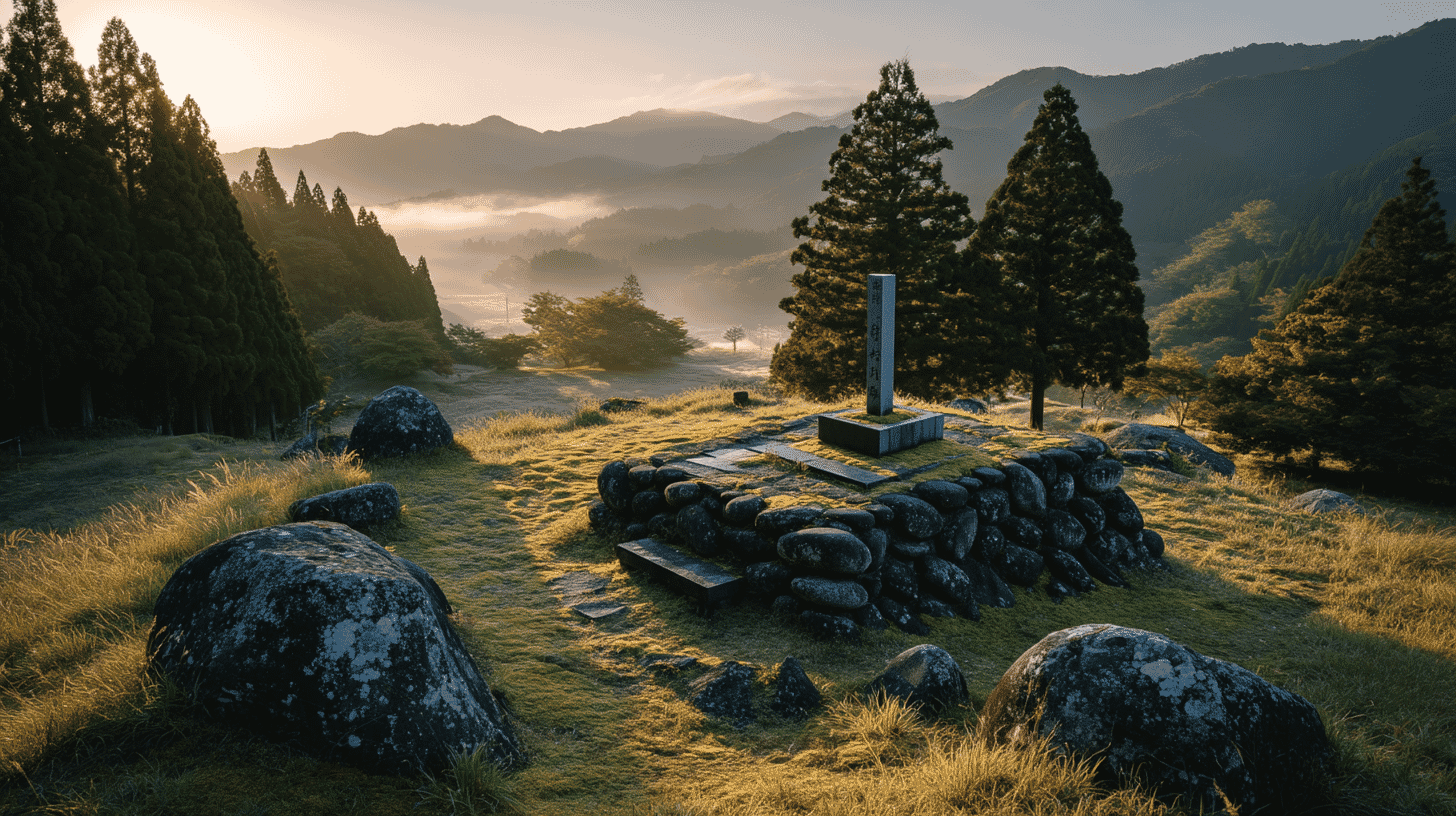
One Grave, Designated by the State in 1984
Bunnemaro Tomb (文祢麻呂墓, the grave of Fumi no Nemaro) lies at Haibara-Hataki, Uda City, Nara Prefecture, a grave of the Asuka to Nara periods, designated by the state on 5 April 1984. Its category is that of historic sites.
The city gives its location as lots 1557-4 and 1558-3, Haibara-Hataki, Uda City.
The city records it as a representative grave of the Asuka and Nara periods, and one of the few important sites to show how high officials of antiquity were buried, designated a national historic site on that account.
The Grave at Uda, Its Contents in Tokyo
The place of burial and what came out of it are now in different places.
What the state designated is the place of the grave, in Uda City.
The epitaph plate, the gilt bronze jar and other finds from the grave are kept at the Tokyo National Museum, as a separate cultural property from this site.
An epitaph plate records the name and career of the dead and is placed in the grave.
At Tomo, the tools of making and the things made were gathered into one property.
Here, the other way about, the place of burial and what was laid in it are separate properties, far apart.
The Name and Date of Death Inscribed on the Plate
Whose grave it is has been confirmed by writing found within it.
The record of the epitaph plate gives its inscription: a general of the year of the Jinshin War, commander of the palace guards of the left, senior fourth rank upper grade, who died on the 21st day of the 9th month of the 4th year of Keiun.
From this inscription the grave is known to be that of Fumi no Nemaro, who died on the 21st day of the 9th month of 707. The general of the Jinshin year refers to his service as a general in the Jinshin War of 672.
The record of the plate notes that in life he rose to the junior fourth rank lower grade, but that the plate gives senior fourth rank upper grade, so a higher rank seems to have been conferred after his death.
At the Yoshida main house, a ridge tablet names a carpenter; at the Kojimaya storehouse, a window grille gives a year.
Here a bronze plate laid in a grave gives the name of the one who lies there, the day of death and the rank.
Found in the Course of Farm Work
The grave was not dug for study but found by chance.
The city records that a bronze box holding the epitaph plate, a gilt bronze jar and other things were found in 1831.
The record of the plate says a farmer found them while working the land. Inside the gilt bronze jar was a glass jar filled with the ashes of cremated bones, and the pit had been laid with charcoal.
From the finding to the state's designation is 153 years.
At the Bingo provincial seat, a written record was borne out by excavation.
Here the owner of the grave is known from the inscription on things turned up in a field. The burial of a high official of antiquity, as the city puts it, is shown as cremated bones laid in a glass jar within a gilt bronze jar.
Visiting
The site lies at lots 1557-4 and 1558-3, Haibara-Hataki, Uda City, Nara Prefecture.
The national online heritage database has no entry for the site itself, but has entries for the epitaph plate and the finds. This article rests chiefly on the record of the city's cultural properties section, supplemented by the record of the plate.
The reading varies between sources: the plate's entry gives Fumi no Nemaro, the entry for the plate and its box gives Fumi no Yamaro.
The record of the plate notes that only 16 epitaph plates have been found in Japan, and calls this a very valuable early example.
This is an open-air site, so whether and how it may be visited follows the arrangements of the local authority. Check before travelling.
Q&A
- When was the grave designated?
- On 5 April 1984, by the state, as a historic site.
- Whose grave is it?
- The inscription on the epitaph plate shows it to be that of Fumi no Nemaro, who died in the 9th month of 707 and served as a general in the Jinshin War.
- When was it found?
- The city records that it was found in 1831; the record of the plate says a farmer came upon it while working the land.
- Where is the epitaph plate now?
- The plate, the gilt bronze jar and other finds are kept at the Tokyo National Museum, as a separate cultural property.
- What is valued in it?
- The city calls it one of the few important sites to show how high officials of antiquity were buried.
Basic Information
| Name | Bunnemaro Tomb (文祢麻呂墓); the grave of Fumi no Nemaro, read Fumi no Yamaro in one entry |
|---|---|
| Location | Lots 1557-4 and 1558-3, Haibara-Hataki, Uda City, Nara Prefecture |
| Designation | Historic site; designated as an archaeological site rather than as a building or a work of art |
| Year Designated | 1984 (5 April), designated |
| Quantity | 1 grave |
| Dimensions | No measurements of the grave are in the records to hand. In 1831 a bronze box holding the epitaph plate, a gilt bronze jar and other things were found; within the gilt bronze jar was a glass jar of cremated bones, and the pit was laid with charcoal |
| Owner | Not stated in the record; the finds are held by the Tokyo National Museum |
| Public Access | An open-air site; visiting follows the arrangements of the local authority |
References
- Uda City, cultural properties section: the grave
- https://www.city.uda.lg.jp/soshiki/41/1096.html
- Cultural Heritage Online: the epitaph plate
- https://bunka.nii.ac.jp/heritages/detail/540371
- Cultural Heritage Online: finds from the grave
- https://bunka.nii.ac.jp/heritages/detail/204169
- Agency for Cultural Affairs, National Cultural Properties Database
- https://kunishitei.bunka.go.jp/
Last verified: 2026.09.22