Gekimōshō: A Gateway to Medieval Japanese Poetic Mastery
Hidden within the remarkable collection of Tenri Central Library in Nara Prefecture lies one of Japan's most precious literary treasures: the Gekimōshō (撃蒙抄). This 14th-century manuscript represents the oldest surviving copy of an essential treatise on renga—the collaborative linked-verse poetry that captivated Japanese aristocrats and laid the foundation for modern haiku.
For visitors seeking to understand Japan's profound poetic heritage beyond the typical tourist destinations, the Gekimōshō offers a unique window into an era when poetry was the supreme art of the cultured elite. Designated as an Important Cultural Property (Jūyō Bunkazai), this manuscript invites you to explore a literary tradition that continues to influence Japanese aesthetics today.
What is Gekimōshō?
The Gekimōshō, whose title can be interpreted as "Treatise to Enlighten the Ignorant," is a practical guide to composing renga poetry. It was written in July 1358 (Enbun 3) by Nijō Yoshimoto (1320-1388), one of the most influential cultural figures of medieval Japan, at the command of Emperor Go-Kōgon of the Northern Court.
Renga was a collaborative form of poetry where multiple poets would take turns adding verses—alternating between three-line stanzas of 5-7-5 syllables and two-line stanzas of 7-7 syllables. Unlike solitary composition, renga was a social art requiring quick wit, deep literary knowledge, and the ability to create meaningful connections between verses. The Gekimōshō served as an essential textbook for those wishing to master this sophisticated art form.
The Author: Nijō Yoshimoto—Statesman and Poetry Master
Nijō Yoshimoto was no ordinary poet. As a member of one of the five regent families (Gosekke), he served four times as regent or chief advisor to the emperor, reaching the pinnacle of aristocratic power as Grand Minister of State (Daijō-daijin). Yet despite his demanding political career during the turbulent Nanboku-chō period of civil war, Yoshimoto devoted himself passionately to literature.
Working with the master poet Kyūsei (also known as Gusai), Yoshimoto compiled the Tsukubashū in 1356—the first imperially-commissioned anthology of renga, elevating this once-casual pastime to the status of high art. He also established the Ōan Shinshiki (1372), the rules that governed renga composition for generations. The Gekimōshō represents his early effort to systematize renga instruction, making the art accessible to dedicated beginners while maintaining its literary sophistication.
Why Was It Designated an Important Cultural Property?
The manuscript held at Tenri Central Library is extraordinary for several reasons. First, it is the oldest known copy of the Gekimōshō, transcribed in 1366 (Jōji 5)—merely eight years after the work's original composition and during Yoshimoto's own lifetime. This proximity to the source makes it invaluable for understanding the author's true intentions.
Second, this is the only complete and accurate version known to exist. Another manuscript, formerly in the collection of scholar Yamada Takao, contains errors, omissions, and pages bound out of order. The Tenri manuscript thus serves as the definitive text for scholars studying medieval renga theory.
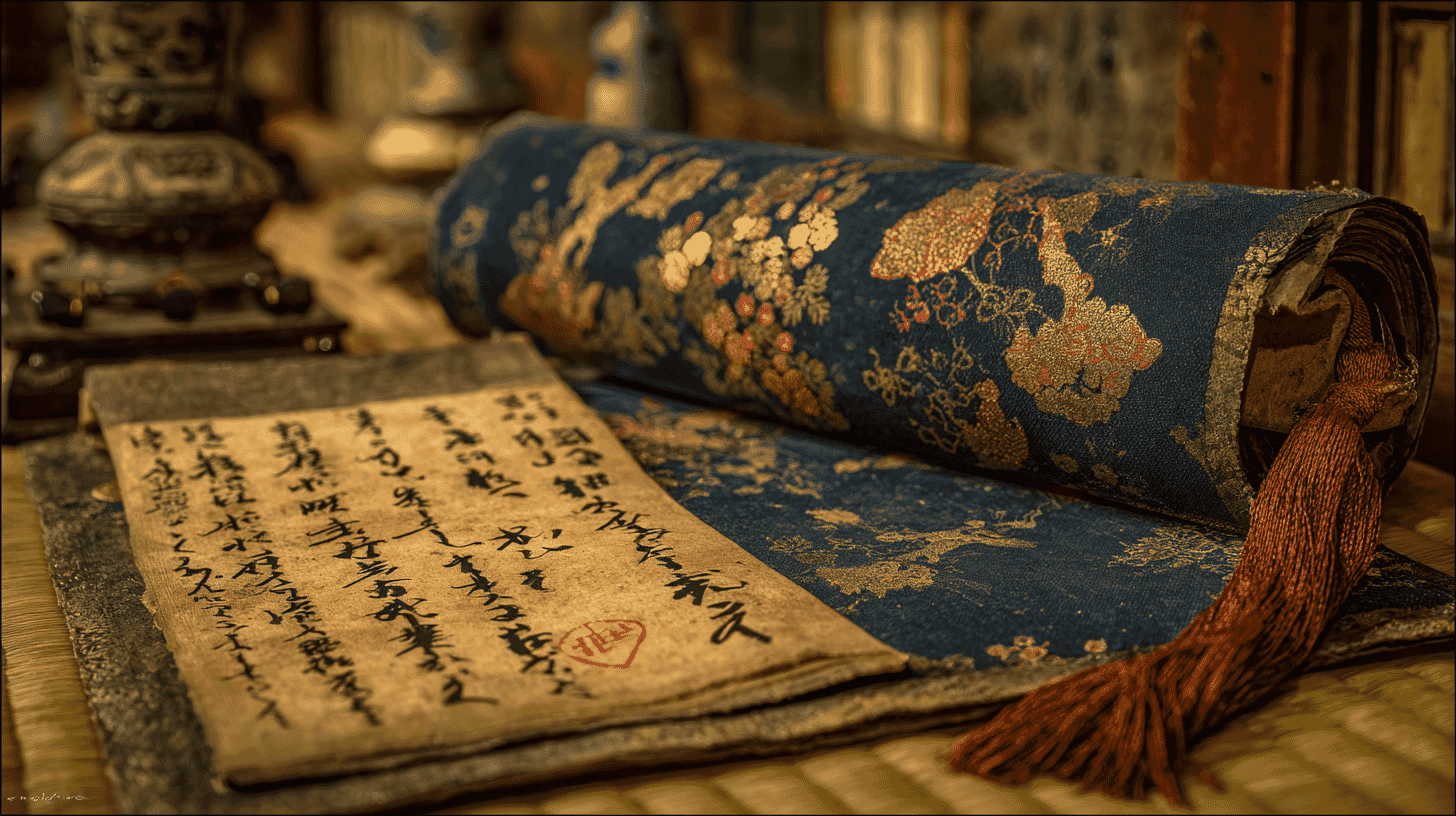
The physical manuscript itself is a work of art. It features a butterfly binding (detchōsō) with an indigo paper cover decorated with gold brocade depicting rabbits and flower-diamond patterns. The inner cover displays delicate silver wave designs with gold autumn leaves, butterflies, and dragonflies. The text is written on fine handmade paper (kōzo) alternating between pale yellow, light brown, and white sheets, with graceful calligraphy averaging seven to eight lines per page.
Contents and Structure of the Gekimōshō
The Gekimōshō is organized as a practical teaching text. It begins with a table of contents listing fourteen major topics under headings from "Initial Learning" to "Linked Verses." The main text then explores eleven different verse-linking techniques (tsukeyō), including methods for connecting verses through contrast, allusion to classical poems, place names, and unusual expressions.
Yoshimoto illustrates his teachings with 170 example verses, demonstrating how theory translates into practice. Notably, six opening verses (hokku) and 41 linking verses appear in the Tsukubashū anthology, showing the close relationship between this instructional work and the masterpieces of the era. Many examples feature verses by Kyūsei, Yoshimoto's teacher and collaborator, revealing their intimate artistic partnership.
Historical Journey of the Manuscript
The Gekimōshō manuscript has traveled through Japanese history before finding its current home. In August 1729 (Kyōhō 4), it was donated to Kaikō Shrine in Sakai, Osaka—a shrine with deep connections to the merchant culture of that prosperous port city. After World War II, the manuscript entered the collection of Tenri University, where it remains carefully preserved as part of one of Japan's finest private library collections.
The manuscript was designated an Important Cultural Property on June 21, 1991, recognizing its exceptional value for Japanese literary and cultural history.
The Legacy of Renga in Japanese Culture
Understanding the Gekimōshō helps visitors appreciate how Japan's beloved haiku emerged from centuries of collaborative poetry. The opening verse of a renga (hokku) eventually became independent as haiku, with masters like Matsuo Bashō transforming what was once merely the starting point of longer sequences into a complete art form.
The collaborative spirit of renga also influenced Japanese aesthetics more broadly—the emphasis on suggestion over statement, the seasonal awareness (kigo), and the art of meaningful connection between disparate elements all continue to shape Japanese literature, art, and even contemporary design.
Visiting Tenri Central Library
Tenri Central Library (Tenri Toshokan) houses approximately 1.5 million volumes, including six National Treasures and 87 Important Cultural Properties. Established in 1930, the library building itself—with its distinctive Romanesque-influenced architecture—was designated a Registered Tangible Cultural Property in 2023.
While the Gekimōshō is part of the library's special collection and may not be on permanent display, the library occasionally features its treasures in exhibitions. Visitors interested in viewing specific items should contact the library in advance to inquire about availability and access procedures for special materials.
General collections are open to the public for those 15 years and older. The library's reading rooms, surrounded by magnificent ginkgo trees, offer a contemplative atmosphere perfect for appreciating Japan's literary heritage.
Nearby Attractions
A visit to Tenri offers much more than library treasures. The city lies along the ancient Yamanobe-no-Michi (山の辺の道), considered Japan's oldest road, which connects numerous historical sites through scenic mountain scenery.
Isonokami Shrine (Isonokami Jingū), one of Japan's oldest Shinto shrines, is just a 15-minute walk away. The shrine possesses the legendary Seven-Branched Sword (Shichishitō), a National Treasure from ancient Korea, and its Nanboku-chō period worship hall (haiden) is also designated a National Treasure. Free-roaming sacred chickens add charm to the atmospheric grounds.
The Tenri Sankokan Museum offers excellent displays of ethnological and archaeological materials from around the world, including Byzantine mosaics and artifacts from ancient civilizations. Together with the library, these institutions make Tenri an unexpected destination for those interested in both Japanese and world cultural heritage.
Travel Tips for International Visitors
Tenri is easily accessible from Nara (15 minutes by train) and Osaka (about 50 minutes). The JR Manyo Mahoroba Line and Kintetsu Tenri Line both serve Tenri Station, from which the library is about a 20-minute walk through the pleasant city center.
Consider combining your Tenri visit with hiking along the Yamanobe-no-Michi for a full day that blends cultural exploration with nature. Spring cherry blossoms and autumn foliage make particularly beautiful seasons for this journey through ancient Yamato Province.
- 📍 Plan Your Visit to Nara
- Find tours, activities & transport passes near Gekimonsho
- [ Todaiji Great Buddha & Nara Park Deer Experience ]
Q&A
- What is renga and why is it significant in Japanese literature?
- Renga is a collaborative form of linked-verse poetry where multiple poets take turns adding verses in alternating patterns of 5-7-5 and 7-7 syllables. It was the dominant poetic art form in medieval Japan and directly gave birth to haiku. The opening verse (hokku) of renga sequences eventually became independent as the haiku we know today, thanks to masters like Matsuo Bashō.
- Can visitors see the Gekimōshō manuscript at Tenri Library?
- The Gekimōshō is part of the library's special collection, so it may not always be on public display. Tenri Central Library occasionally features items from its collection in special exhibitions. For those with research purposes, the library has procedures for requesting access to special materials. It is recommended to contact the library in advance to inquire about viewing possibilities.
- What makes the Tenri manuscript of Gekimōshō unique?
- The Tenri manuscript is the oldest surviving copy of the Gekimōshō, transcribed just eight years after the original was written and during the author Nijō Yoshimoto's lifetime. It is also the only complete and accurate version—other known manuscripts contain errors and missing sections. Its exceptional physical condition and artistic binding also contribute to its importance.
- Is Tenri Library open to foreign visitors?
- Yes, Tenri Central Library is open to the general public for those aged 15 and above. While most collections and signage are in Japanese, the library welcomes international visitors. The historic library building itself, with its distinctive early 20th-century Romanesque architecture, is worth visiting for its atmosphere alone.
- What other attractions can be combined with a visit to see the Gekimōshō?
- Tenri offers several excellent cultural attractions. Isonokami Shrine, one of Japan's oldest shrines with National Treasure structures, is nearby. The Tenri Sankokan Museum features world-class ethnological collections. The ancient Yamanobe-no-Michi pilgrimage road passes through the area, connecting numerous historical sites amid beautiful natural scenery.
Basic Information
| Name | Gekimōshō (撃蒙抄) |
|---|---|
| Author | Nijō Yoshimoto (二条良基, 1320-1388) |
| Date of Original Composition | July 1358 (Enbun 3) |
| Date of This Manuscript | November 20, 1366 (Jōji 5) |
| Cultural Property Designation | Important Cultural Property (designated June 21, 1991) |
| Category | Historical Material / Books and Documents |
| Era | Nanboku-chō Period (Northern and Southern Courts Period) |
| Format | 1 volume (jō), butterfly binding |
| Owner | Tenri University (School Corporation) |
| Location | Tenri Central Library, 1050 Somanouchichō, Tenri City, Nara Prefecture 632-8577 |
| Library Hours | 9:00-17:30 (varies by season, closed certain days) |
| Access | Approximately 20 minutes on foot from JR/Kintetsu Tenri Station; 5 minutes from Tenri East IC on Meihan National Route |
| Contact | Tel: 0743-63-9200 |
References
- Cultural Heritage Database - Gekimōshō
- https://bunka.nii.ac.jp/db/heritages/detail/201113
- Tenri Central Library - Masterpiece Introduction: Gekimōshō
- https://www.tcl.gr.jp/col/col-3477/
- Tenri Central Library Official Website
- https://www.tcl.gr.jp/
- Wikipedia - Nijō Yoshimoto
- https://ja.wikipedia.org/wiki/二条良基
- Kotobank - Nijō Yoshimoto
- https://kotobank.jp/word/二条良基-109654
- Tenri Tourism Guide - Tenri Central Library
- https://kanko-tenri.jp/tourist-spots/center/tenritoshokan/
- Tenri Tourism Guide - Isonokami Shrine
- https://kanko-tenri.jp/tourist-spots/center/isonokamijingu/
- Wikipedia - Renga
- https://en.wikipedia.org/wiki/Renga
Last verified: 2026.01.29
Nearby heritages
- Records of the Experiences of the Diamond Sutra (remaining
- Tenri University Library, 1050 Somanouchicho, Tenri City, Nara Prefecture
- Sanbo Ruijishu Volume 1 (Kozanji Version)
- Tenri University Library, 1050 Somanouchicho, Tenri City, Nara Prefecture
- 360th Song Group
- Tenri University Library, 1050 Somanouchicho, Tenri City, Nara Prefecture
- Essay Outline
- Tenri University Library, 1050 Somanouchicho, Tenri City, Nara Prefecture
- Song Edition of Soshinpiran (Volumes 1, 2, and 3)
- Tenri University Library, 1050 Somanouchicho, Tenri City, Nara Prefecture
- Kontemutsumunji (Kyoto Edition of the Christian Edition,
- Tenri University Library, 1050 Somanouchicho, Tenri City, Nara Prefecture
- Ancient Text: the Book of Filial Piety
- Tenri University Library, 1050 Somanouchicho, Tenri City, Nara Prefecture
- The Remaining 20th Volume of the Goshin Order Selection
- Tenri University Library, 1050 Somanouchicho, Tenri City, Nara Prefecture
- Guzhengfu
- Tenri University Library, 1050 Somanouchicho, Tenri City, Nara Prefecture
- Shika Wakashu
- Tenri University Library, 1050 Somanouchicho, Tenri City, Nara Prefecture