
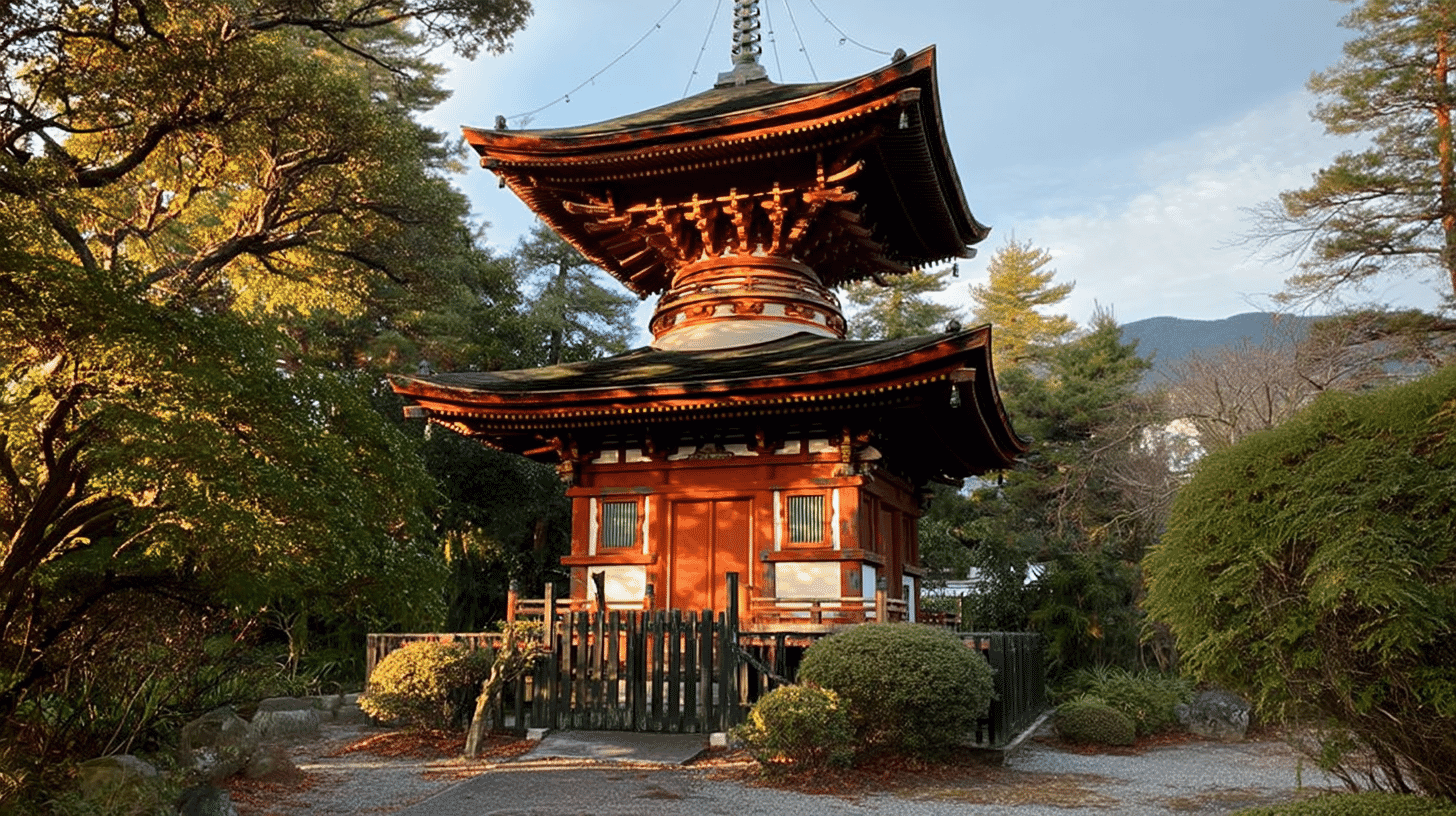
One Pagoda, an Important Cultural Property since 1976
Kumedera Temple Pagoda (久米寺多宝塔, Kumedera Tahoto) stands at Kume-cho, Kashihara City, Nara Prefecture, an early Edo building listed as an Important Cultural Property on 20 May 1976. The listing is as an Important Cultural Property, not a National Treasure, and the owner is the temple.
The quantity is one pagoda. The structure is a two-storeyed pagoda of three bays, roofed in thick split shingles. The date field reads early Edo, 1615 to 1660: a span of forty-five years.
This roofing lays thickly split boards in overlapping layers. Cypress bark, formal tile, pantile, thatch and thin shingle have appeared here; this is the first of its kind.
An Edo Pagoda Standing on a Nara-Period Base
The date of the building and the date of its site lie far apart.
The Agency records that the pagoda stands on the great foundations of a Nara-period pagoda, and is said to have been moved here from Ninnaji in Kyoto during the Edo period.
The site is where a pagoda of the Nara period once stood. On it now stands one of the Edo period.
Roughly 1000 years separate the two.
At the former Shuseikan machinery factory, one piece of ground carried two listings, as a structure and as a historic site. Those concern industrial works of the same era.
Here the age of the ground and the age of what stands on it are different things, and the building itself came from elsewhere.
Called Conventional, and Valued All the Same
Being an ordinary form is not treated here as a fault.
The Agency writes that it is a conventional two-storeyed pagoda of three bays, but that the whole is well proportioned and the materials and workmanship alike are excellent, a building of the orthodox tradition.
Conventional is said outright, and then three grounds are given: proportion, materials and workmanship.
The main hall at Ozasahara Shrine was called one of the finest of its kind; the founder's hall at Senjuji a benchmark. At Kitaguchi Hongu Fuji Sengen Shrine, regional character was named. Each of those turns on being unlike others.
With the lacquered dais, fitness for its purpose was the reason; with the Wakato Bridge, cooperation among engineers of differing specialisms.
Here the reason is how well a standard form has been executed. As a way of stating value this is the seventh met. The record adds that the members are well preserved.
The Two Records Date the Move Differently
When the pagoda was moved is put two ways.
The Agency says it is said to have been moved from Ninnaji during the Edo period. No year is given, and the account is offered as tradition.
The pilgrimage association for this circuit records instead that the pagoda was moved from Ninnaji in Kyoto in 1659. A single year.
That year falls near the end of the range of 1615 to 1660 given in the date field.
At the Haba residence, the Agency gave a span of ninety years and the city twelve: a difference in how closely the date was fixed.
Here one record gives a range and a tradition, the other a fixed year. The same association records the main hall as rebuilt in 1663, four years after the pagoda was moved.
Visiting
The pagoda stands at Kume-cho, Kashihara City, Nara Prefecture, owned by the temple.
The interior is recorded too. The Agency notes that the doors on all four sides of the lower storey carry paintings of guardian deities, and that an image of the cosmic Buddha of the Womb Realm is enshrined within.
The lower storey is the ground level of the pagoda. Paintings on its four doors, and an image inside.
With the nine-storied pagoda, the structural field noted a missing finial and said nothing of any interior. At the Jinkakuji main hall, the commentary field was empty.
Here the record covers not only the outward form but the paintings on the doors and the figure enshrined. It is a temple building, and access follows the temple's own arrangements. Check before travelling.
Q&A
- When was the pagoda listed?
- On 20 May 1976, as an Important Cultural Property rather than a National Treasure. The quantity is one pagoda and the owner the temple.
- When was it moved here?
- The records differ. The Agency says only that it is said to have been moved during the Edo period; the pilgrimage association gives 1659.
- What does it stand on?
- The Agency records that it stands on the great foundations of a Nara-period pagoda, roughly 1000 years older than the building itself.
- What is valued in it?
- The Agency calls it a conventional pagoda of its type, but well proportioned, excellent in materials and workmanship, and well preserved in its members.
- What is the roof made of?
- Thickly split boards laid in overlapping layers, heavier than the thin shingles used elsewhere.
Basic Information
| Name | Kumedera Temple Pagoda (久米寺多宝塔, Kumedera Tahoto) |
|---|---|
| Location | Kume-cho, Kashihara City, Nara Prefecture |
| Designation | Important Cultural Property (structure, religious architecture); not a National Treasure |
| Year Designated | 1976 (20 May), Important Cultural Property |
| Quantity | 1 pagoda |
| Dimensions | A two-storeyed pagoda of 3 bays, roofed in thick split shingles, standing on the foundations of a Nara-period pagoda. The doors on all 4 sides of the lower storey carry paintings of guardian deities, with an image of the cosmic Buddha of the Womb Realm enshrined within. The date field reads early Edo, 1615 to 1660, a span of 45 years |
| Owner | Kumedera |
| Public Access | A temple building; access follows the temple's own arrangements |
References
- Cultural Heritage Online: the Kumedera pagoda
- https://bunka.nii.ac.jp/db/heritages/detail/123424
- The Yakushi pilgrimage association: Kumedera, no. 7
- https://yakushi49.jp/07kumedera/
- Kashihara City: cultural properties
- https://www.city.kashihara.nara.jp/
- Agency for Cultural Affairs, National Cultural Properties Database
- https://kunishitei.bunka.go.jp/
Last verified: 2026.09.10